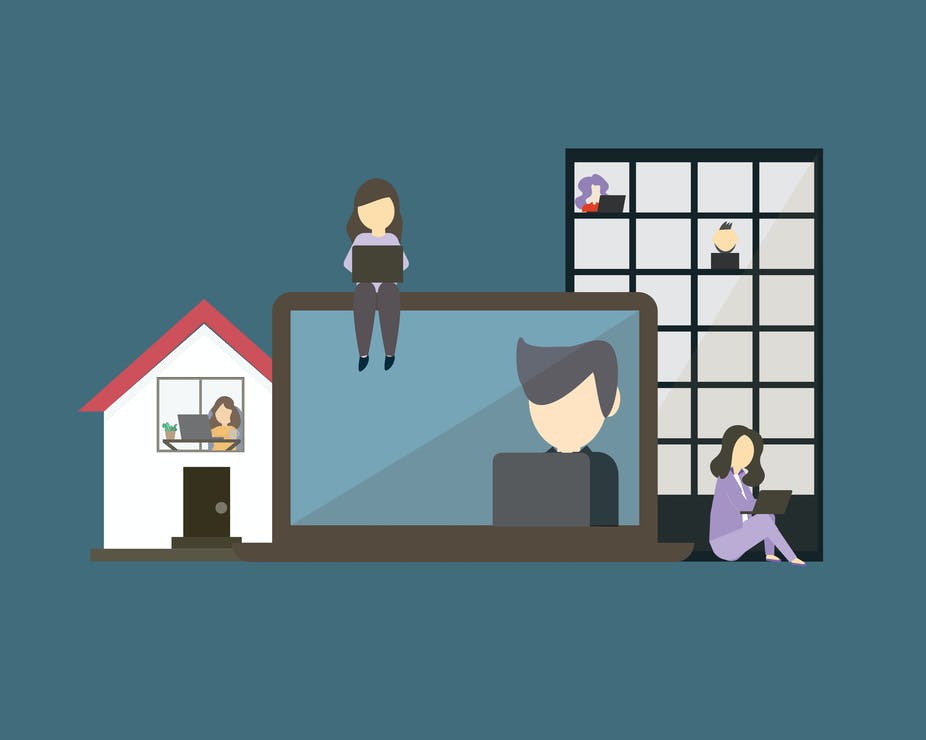
Just 5% of employed people in the UK worked from home in 2019. The onset of the pandemic and the overnight shuttering of offices during the first lockdown meant 47% of employees were doing the same in April 2020.
Although returning to work in offices full time is now possible, the latest figures from May show 26% are still working from home while a further 11% are hybrid working: splitting their work time between the office and home.
With fewer people commuting and less food wasted as previously catered work events were held online instead, many hoped that a shift to remote working would benefit workers and the environment.
But that may not be the case. Not everyone can afford a home office, nor the additional heating or internet bills. And the loss of scale involved in heating and cooling individual homes during the day compared to offices may mean remote working is less energy efficient.
Our research into the adaptations office workers made to work from home during 2020’s first lockdown revealed two troubling trends: the duplication of office equipment and demand for more space and larger homes.
The duplication of stuff
Interviews with 17 UK households, selected for their diverse professional backgrounds, ages and sizes, uncovered how and why some people went from working at kitchen tables and on sofas, expecting lockdown to last a few weeks, to creating more permanent and higher quality set-ups.
To accommodate this and recreate offices at home, workers bought tech and furnishings which were often transported across the globe. Worldwide sales of laptops and desktops increased by 11.2% between April and June 2020, with 72.3 million units shipping. Monitor sales also spiked and webcams were temporarily sold out across the UK. Online searches for office desks and chairs increased by 438% and 300% respectively on the previous year.
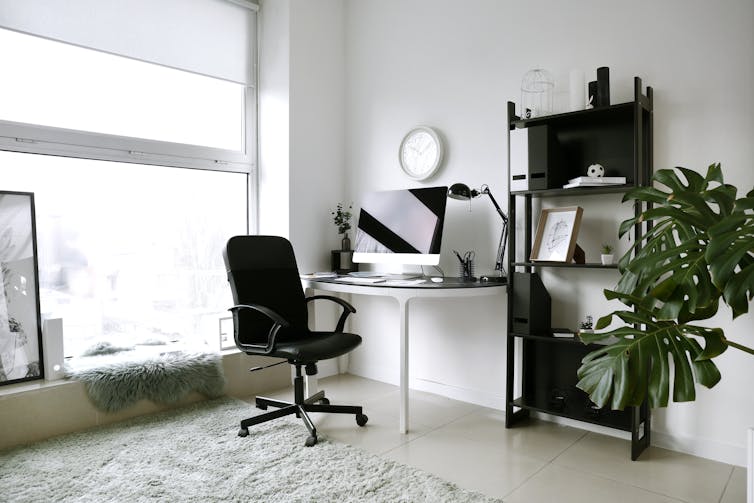
A good home office isn’t cheap. Shadow Inspiration/Shutterstock
Office equipment and furniture purchases peaked during the first lockdown, but demand is likely to remain high. Five times more people now want to work from home compared to 2019.
And making offices at home with new chairs, computers, monitors, desks and stands has also driven desire for bigger houses.
The demand for bigger homes
Our research revealed how working from home meant more people wanting homes with bigger kitchens, spare rooms, offices, garages and gardens. Whether it was the embarrassment of your partner’s colleagues spotting you in your yoga shorts or the horror of dashing offscreen to chase after your naked son, lockdown led to a collective reassessment of what one needs from a home. A sense of quiet and privacy tends to be lost when multiple people share a room. And although many offices are in essence co-working spaces, it has proved difficult to work in the same room as another doing different work – especially when making audio or video calls.
Since the first lockdown house sales have shot up, with June seeing the most sales since records began.
Much of these sales have involved people moving out of cities and into suburbs and the countryside, where homes tend to offer more space. This, sadly, is bad news for sustainability. More domestic space per person can increase energy consumption and suburban households typically have higher carbon footprints. Even people who might have moved to the countryside to work from home more often may ultimately emit more carbon per commute due to less frequent, but longer distance travel.

Suburban homes tend to use more energy and are more likely to have more than one car. 1000 Words/Shutterstock
Possible responses
The duplication of equipment and the simultaneous need for heating and lighting in offices and homes that arises from workers splitting time across both is a particularly unsustainable arrangement.
While some workplaces allowed employees to take their office set-ups home during the first lockdown, the difficulty in acquiring a webcam and long wait times for office equipment showed how most failed to adequately redistribute resources or support workers. Businesses that are currently downsizing their offices could offer discounts on spare items like Hootsuite did. Or, they could reject the hybrid model and encourage home or office working only.
The movement out of cities and smaller accommodation was arguably bolstered by the UK government’s stamp duty holiday, too. The decision to temporarily raise the threshold at which this property tax kicked in is credited with sparking a frenzy of buying. Housing policies are also climate policies, and the UK government, as a self-proclaimed climate leader and host of the 2021 UN climate talks, should be more sensitive to the implications of all policies for climate change.
The hybrid model of working is still emerging, and so it can be made more sustainable. That means appropriate policies to support people moving out of cities and navigating flexible working arrangements.