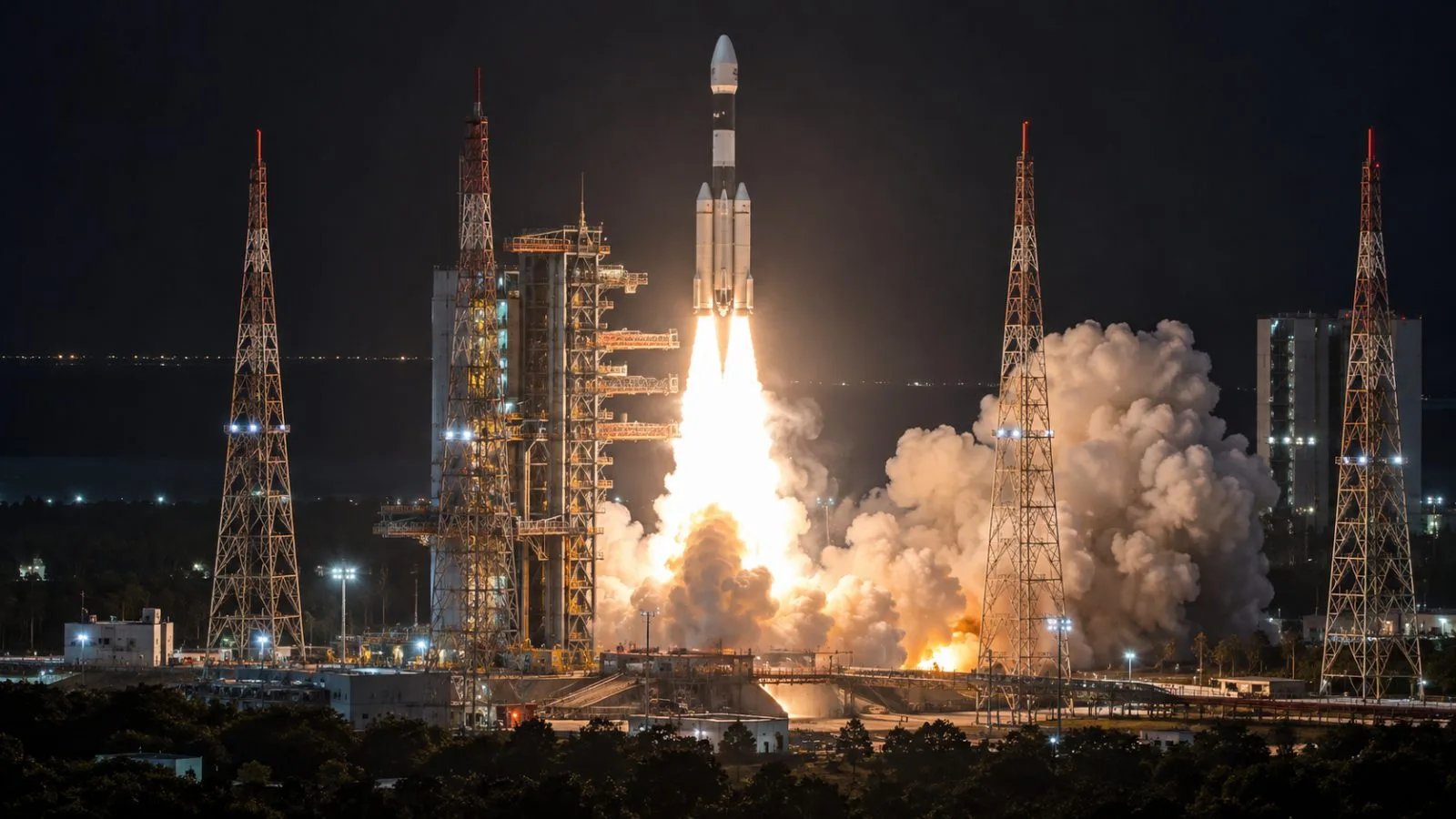
India’s NavIC program advanced its five-satellite effort Friday as NVS-03 reached transfer orbit with an added signal to support regional navigation services across the area.
The GSLV-F18 rocket lifted off from Satish Dhawan Space Centre in Sriharikota at 2:21 p.m. EDT (18:21 UTC) Oct. 30. The Indian Space Research Organisation (ISRO) confirmed that the satellite reached geosynchronous transfer orbit.
ISRO says NVS-03 broadens NavIC’s signal offering by carrying L1 in addition to L5 and S. Its timing system pairs an atomic clock developed in India with procured atomic clocks.
NavIC, or Navigation with Indian Constellation, supplies location, movement and timing data across India and a surrounding area extending about 1,500 kilometers beyond the country’s boundary, according to ISRO. Civilians are the intended users of the Standard Positioning Service. The Restricted Service is encrypted and serves authorized users.
ISRO’s second-generation program calls for five satellites to reinforce NavIC’s constellation and maintain service availability. The agency has not announced when NVS-03 will begin operational service, as noted in EconoTimes’ earlier report on the satellite’s transfer-orbit placement.