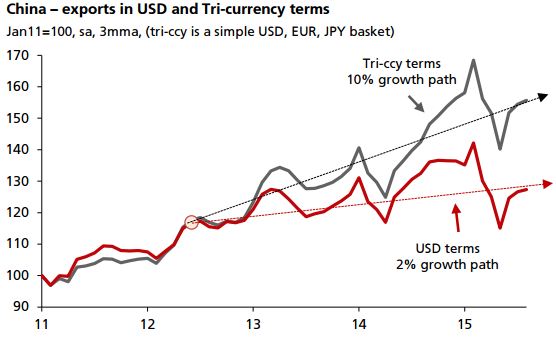
If you measure things like exports and currencies in dollar terms, the sky seem to be falling. Not so much, according to DBS Bank research, if you measure them the way they should be: against a basket of dollars, euros and yen.
Singapore's known this for eons; it's monetary policy is based entirely on the currency and the currency policy is based entirely on a basket. Why a basket? Because if you track the dollar alone and the dollar is soaring like it is today, it would be export suicide. If you track the yen alone, and it's plunges 57% like it has since mid-2012, it would be inflation suicide. Walk the middle road and you won't distort the economy unnecessarily. It works: Singapore has Asia's highest per-capital income (some US$62k per person in 2014) and it's had Asia's lowest inflation since, well, forever.
Measuring exports in dollars alone is just as misleading as basing policy on dollars alone is dangerous. Asia's exports have fallen hard over the past year but that's mainly a re-valuation effect. When the dollar goes to the moon, the dollar value of exports goes the other way, whether they have in real terms or not. The only way to tell is to measure them in baskets of dollars, euros and yen. When you do this, you discover that Asia's exports continue to grind ahead at the same 7% growth they have since early-2012.
China is a particularly important case in point. Yesterday, August trade figures were released and the headlines across the world were "More bad news". Exports fell by 5% on-year, almost as much as the 8% on-year drop in July. But were they really bad? Not at all. First of all, they rose by 1% month-on-month, which is almost a 12% annualized rate - not bad. Then, seasonally adjust them, like every advanced country does. The monthly rise was 1.1% - even better.
But now do the most important thing of all: express them in tri-currency basket terms. And what you will see is that China's exports in August continued to grow exactly at the 10% trend pace they have since early-2012. Asia has its troubles. And China has its troubles. But export growth really isn't one of them. The way we measure things in dollar terms alone, is.