
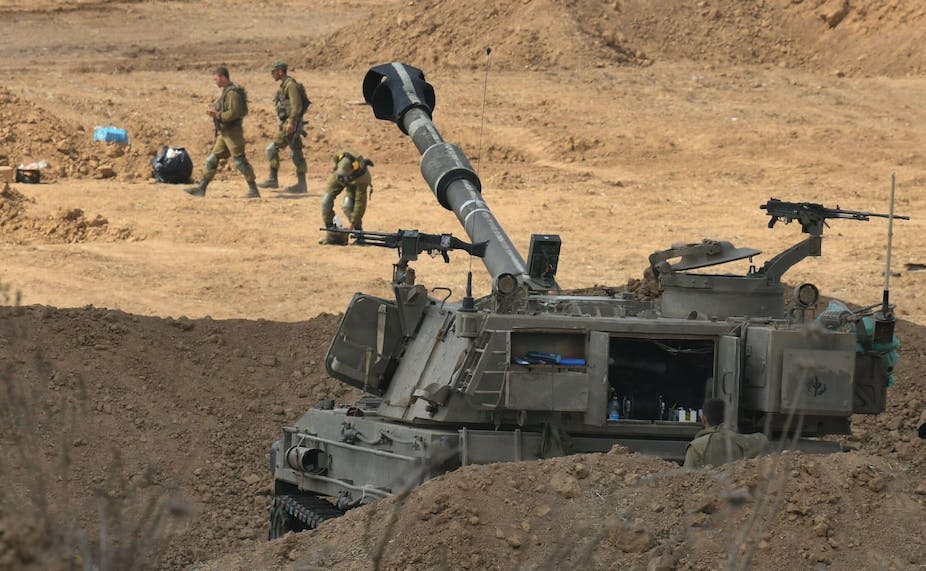
As news of Palestinian militant group Hamas launching a deadly attack on Israel and Israel’s threat of retaliation began to filter across news networks and social media platforms, a wave of misinformation and fake videos rose alongside.
In a “tech-first” society, it is increasingly difficult to differentiate between authentic information and false claims or deliberately misleading video content. It is clear that numerous videos, social media posts and images purportedly about the Israel–Hamas conflict are deliberately misleading.
This problem highlights why the verification efforts of journalists reporting on conflicts are vital. And understanding how they work is important for ensuring the public can have confidence in what they read and see from media publishers.
The Digital News Report 2023 from the University of Oxford’s Reuters Institute, of which I am acting director, surveyed people from 46 countries about their news consumption habits. It found 56% said they were worried about identifying the difference between what is real and fake on the internet when it comes to news – up from 54% in 2022.
There is heightened concern among audiences in areas close to violent conflict. As our survey found, in Slovakia, one of the countries bordering Ukraine, almost half the sample said they had seen misinformation about the Ukraine conflict in the previous week. That’s double the proportion that said this in the UK, United States or Japan.
Several media reports have pointed to a surge of fake posts around the Israel-Hamas conflict on Twitter/X (formerly known as Twitter), which has recently made significant changes in how it operates. The Guardian pointed to data from Israeli monitoring firm Cyabra, which covers US election disinformation and tracks bot accounts on X, to demonstrate the levels of fake posts.
Cyabra claimed that many were coming from fake accounts – using automated bots – which were very active on X, TikTok and other platforms. Cyabra scanned over two million pictures, posts and videos. Out of 162,000 profiles, 25% were fake, it claimed.
How verification can work
In the last few years, many traditional media outlets had robust factchecking arms that were flagging fake news and videos quickly. An example of that is BBC Verify. Started in 2023, BBC Verify aims to build audience trust by showing how its journalists know what they are reporting is accurate. The team of journalists use advanced editorial tools and techniques to investigate, source and verify information, video and images.
BBC Verify has been flagging videos and social media posts about Israel and Gaza that they have found to be either untrue or misleading. In the case of the attack by Hamas on the Supernova festival in a remote area of southern Israel, factchecking arms including BBC Verify pieced events together to check accuracy of claims using video and social media posts, dash cam footage from parked cars and facial recognition technology such as Amazon Rekognition software.
I would stress that, although there are many useful tools that can help with this work, it’s important for humans to ultimately review automated factchecking apps and tools.
AP Fact Check and Reuters have also been addressing misinformation online. A recent example is how Reuters factchecked a clip being circulated online with the false claim that the video showed how Israel or Palestine was attempting to create fake footage of deaths. The news agency had previously highlighted the origins of this film clip when it was previously shared in 2022.
In its analysis , Reuters said: “Claims that the clip shows Israelis or Palestinians faking death footage are false, however. Reuters previously addressed the clip when it was shared in 2022 with claims it showed Palestinians staging a fake killing and reported that it shows behind the scenes footage of a Palestinian production.” It added that what the clip actually shows is the filming of Empty Place, a short movie released in 2022 on YouTube.
Long-standing challenges around social media platforms, and people’s reliance on them as news sources, does seem to have an impact on how confident people feel about the information they come across. So more than ever before, there is a need for verifiable, clear and fact-based news gathering. Violent conflict needs responsible, sensitive and timely attention and communication from journalists across the world.
In the words of the pioneering American broadcast journalist Edward Murrow: “The speed of communications is wondrous to behold. It is also true that speed can multiply the distribution of information that we know to be untrue.”


