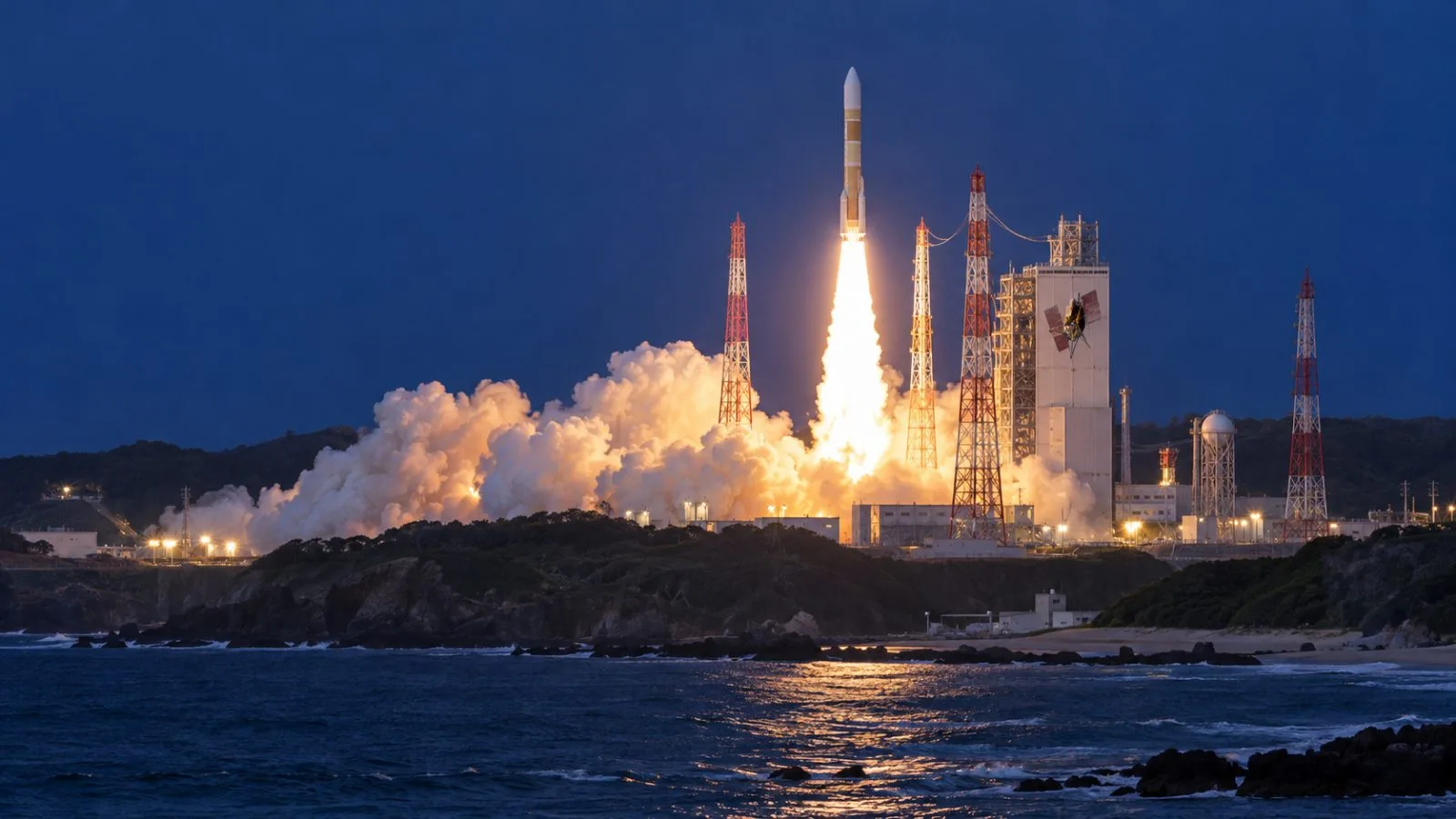
Japan launched a spacecraft to collect material from Phobos, a moon of Mars, on Oct. 19, beginning a mission whose samples could help explain how the Martian moons formed.
The Japan Aerospace Exploration Agency (JAXA) said an H3 rocket carrying the Martian Moons eXploration (MMX) spacecraft lifted off from Tanegashima Space Center at 3:41 p.m. EDT (19:41 UTC) on Oct. 19, or 4:41 a.m. Japan Standard Time on Oct. 20. The spacecraft separated from the rocket and entered its planned orbit about 71 minutes later, JAXA said.
MMX aims to collect at least 10 grams of material from two sites on Phobos and return it to Earth in 2031. The landings, collection and return remain planned steps.
JAXA says the samples could help scientists test two explanations for the origins of Mars’ moons: that they formed from debris after a collision with the planet, or that Mars captured asteroids with its gravity. MMX also plans to observe Deimos, Mars’ other moon. JAXA cites Phobos’ low gravity as one reason to attempt sample return there and points to its Hayabusa missions as a technical precedent.
Ahead of the spacecraft’s planned landings, the Idefix® rover is expected to explore Phobos. It was built by the German Aerospace Center (DLR) and Centre national d’études spatiales (CNES). NASA provided a science instrument and sampling technology; it expects to receive and curate about 15% of the material if samples return.
NASA expects MMX to reach Mars in August 2027. The European Space Agency’s timeline places MMX’s entry into orbit around Phobos in September 2027, while NASA says sampling is planned no earlier than December 2028.