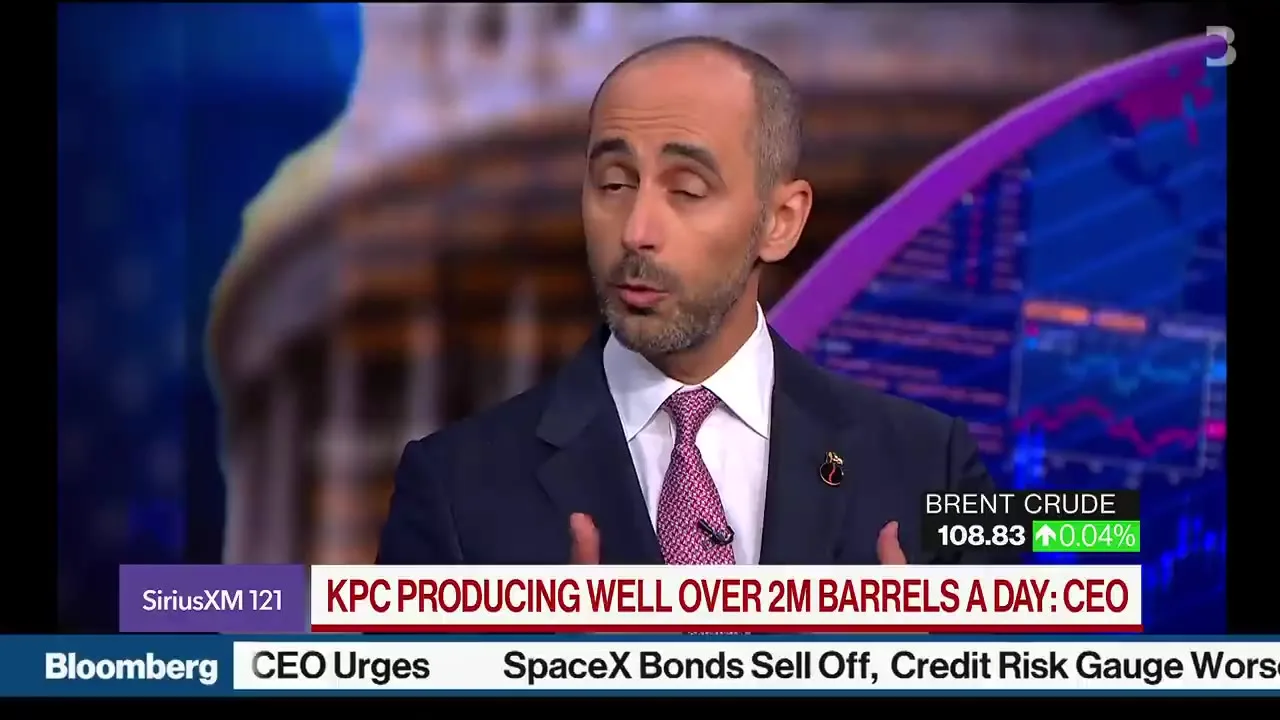
Kuwait's oil production recovered from almost nothing at the height of the conflict to well above 2 million barrels a day, Kuwait Petroleum Corporation's chief executive told Bloomberg Television on Oct. 21.
Output remains below the company's pre-crisis level of 2.7 million barrels a day. The chief executive said safer shipping through the Strait of Hormuz was needed to restore that production.
In the interview published Oct. 21, the chief executive said the company had used its trading arm to arrange alternative shipments when passage stopped. It now ships through the strait and continues transferring cargoes between vessels outside it.
“On the crude side, we are,” he said when asked whether customers were receiving everything they requested. Crude exports were broadly at pre-war levels, but shipping constraints had forced the company to reduce refining.
The company uses its tanker fleet to shuttle crude and refined fuels through the strait for transfer to other vessels. Some tankers damaged in attacks had returned to service, while others were undergoing repairs, he said.
The chief executive said U.S. military support could not eliminate shipping risks and asked customers to share more responsibility. Asian customers had begun collecting fuel in the Gulf, while European customers were working with their governments on access.
He said he knew of no progress toward a political agreement. Asked how quickly production could recover following a deal, he replied: “Immediate.” Facilities were ready, but fuel needed an exit route, he said.
Diesel and jet fuel faced severe shortages, he said. About 6 million barrels of Gulf refining capacity was affected by difficulties moving fuel safely, according to the company. He gave no time period for that capacity figure.
The company was working with U.S. partners to move more fuel, he said. “There is no substitute for safe transit through the Strait of Hormuz.”
Pipeline discussions with Saudi Arabia and the United Arab Emirates were progressing, he said, but those routes could carry crude rather than refined fuels. The company would pursue the projects even after a political agreement.
About 20% of world crude and 20% of liquefied natural gas, gas chilled for transport by ship, passes through the strait, he said. He put fertilizer's share at between a quarter and a third of world supplies.
He said OPEC production allocations had limited use while petroleum supplies were short. “We will produce as much as we can,” he said, adding that replenishing reserves drawn down worldwide would take time.
The chief executive said he did not fear permanent customer losses. Some relationships stretched back about 50 years, and customers had built refineries designed to process Kuwaiti crude.
He reaffirmed the company's target of 4 million barrels a day of production capacity by 2035. International oil companies were being invited to develop offshore discoveries following three successful wells, he said. Kuwait's production over the past 80 years had come from onshore fields.
The company signed a $6 billion pipeline lease-and-leaseback joint venture with three infrastructure funds during the summer, he said. He identified no participants and gave no timetable for the offshore projects.
He also said the Desert Shield and Desert Storm Memorial would be inaugurated on Washington's National Mall on Saturday, commemorating the 1991 Gulf War. He described relations with the U.S. government as healthy.