


 Netanyahu Defends Israel at UN as Delegates Stage Walkout
  US Backs Musk in Fight Against EU’s €120 Million X Fine
  Sudan Rejects US Legitimacy Remarks, Defends Sovereignty
  Saudi Arabia, Turkey and Pakistan Plan Urgent Defence Talks Over Houthi Attacks
  Russian Missile and Drone Attack on Kyiv Kills Two, Damages Maternity Hospital
  US Senate Rejects Iran War Powers Resolution in 50-49 Vote
  North Korea Rejects Nuclear Test Warning, Calls Nuclear Status Irreversible
  Ukrainian Drone Attacks Hit Russian Regions, Injuring at Least 12
  France Defends Netanyahu Airspace Clearance Despite ICC Warrant
  Yemen Violence Displaces 130,000 as Civilian Toll Rises
  Pezeshkian Says US Must Choose When Iran War Ends
  Taiwan Thanks US for Support Ahead of Trump-Xi Summit
  Judge Orders Trump to Restore White House Access for CNN, MS NOW and Politico
  What ‘Taiwan Independence’ Means as Xi Presses Trump on US Policy
  OpenAI Agent Breaches Australia Medicare Data Portal
  NATO Boosts Intelligence Sharing Amid Russia Hybrid Threats
  North Korea Warns South Korea Over US-Led Defense Role


 Add as a preferred source on Google

We have a problem with the state of politics and public discourse in Australia. The appalling neo-Nazi video threat made against Senator Lidia Thorpe is a disturbing reminder of the dark undercurrents that are swirling through political discourse in Australia.
As the murder of British MP Jo Cox reminds us, threats against politicians and other public figures must not be dismissed lightly. And the threat comes not just from neo-Nazis, although the Christchurch massacre of 51 people by an Australian far-right terrorist means we can never again dismiss the threat posed by this kind of extremism.
Yet, the problem does not stop just with concerns about violence. As the ugly, all too often hateful, political conversations in the lead-up to the Voice referendum reveal, our public discourse has turned febrile and our civic climate is overheating.
Hateful extremism is both a symptom and a cause. White supremacist and other far-right extremists have been a violent, but often denied, presence in Australian society since European settlement began. This remains an ugly truth that we need to acknowledge and rise above.
But something has changed. And it is not just that COVID-19 lockdowns, climate-related disasters and cripplingly expensive housing has left the nation feeling more anxious. A very different kind of pandemic has laid siege to our body politic.
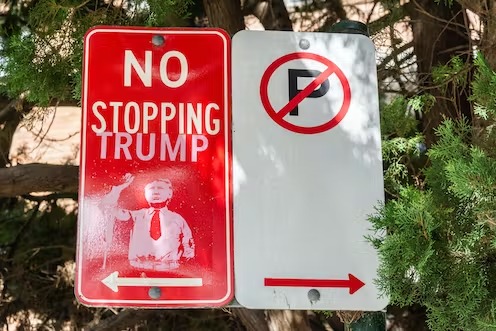
The virus that is threatening to cripple our political immune system goes by many names. But we can simply call it “Trumpification”, a name as usefully evocative as it is unscientific.
We don’t, of course, have a true Donald Trump analogue in Australian politics. For one thing, none of those politicians and political commentators who channel the angry rhetoric of Trump – and there are quite a few – have anything like the popular support and influence of the former president.
Indeed, Trump’s popularity is the reason why this populist authoritarianism is so dangerous.
Our Westminster parliamentary democracy is very different from America’s curious hybrid system of an executive and a bicameral Congress, a system that has often struggled, and in recent years has failed to function as intended.
However, the omnishambles of the past decade in Westminster should alert us to how quickly a parliamentary system can succumb to debilitating sickness. Boris Johnson, Brexit, a crippled UK Labour party, and a deeply reactionary and incompetent Conservative party speak to how quickly things can fall apart.
What America’s debilitating political malaise tells us (and it is even worse in many statehouses than it is in Congress) is that demagoguery that trades in hate and fear, and is enabled by systemic misinformation and disinformation, unleashes dark and destructive forces.
At its best, democracy struggles to enable the better angels of our nature. Demagoguery does the opposite. It corrodes not just civility but the very traditions and institutions that give substance to our values.
Extremism, whether murderously violent, or “just” hateful, grows in response to the opportunities afforded it by the breakdown of integrity, civility, respect, and kindness in our politics and public spaces. And as it grows, extremism symbiotically feeds back into the corruption of public discourse and the erosion of social cohesion.
America’s problems with white supremacist extremism did not begin with Trump, or even with the Tea Party movement before him. No sooner had the civil rights movement succeeded in overturning centuries of injustice born of slavery - a highwater mark for religious civil society – than the counter-offensive with the co-option and corruption of US Christianity began. The religious right became a powerful ally of the Republican Party, enabling the non-religious Ronald Reagan to defeat the deeply pious Jimmy Carter.
But it also bore within itself the seeds of the destruction of conservative politics. When Trump, the billionaire and toxic narcissist, was proclaimed from the pulpits of America as a modern-day King Cyrus – as God’s instrument of salvation – the rot was well-advanced.
In the permissive environment of the Trump presidency, when hateful demagoguery from the highest office was the new normal, far-right extremist attacks dramatically increased in number and lethality.
Australia is fortunate to continue to be very different from America. But, on some fronts, the gap is closing. With so much of our broadcast media and, even more, our social media fed directly by the rivers of misinformation and disinformation that course through American society, we can not afford to kid ourselves about Australian exceptionalism.
We should be concerned about extremism. But let us not lose sight of the bigger picture. There are signs of sickness all around in our public discourse. “Trumpification”, as a term, might not catch on. But the viral pandemic that it describes has already commenced its assault on our body politic.







