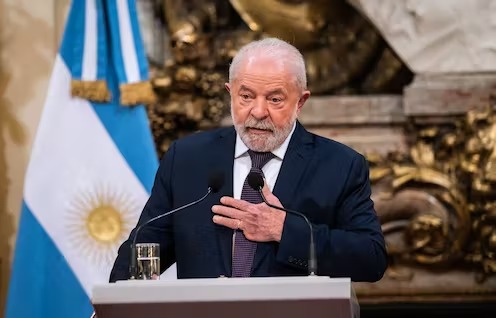
Brazilian President Luiz Inácio Lula da Silva launched his final reelection campaign on Sunday in Sao Bernardo do Campo, returning to the stadium where his rise as a labor leader began nearly five decades ago.
Speaking to about 20,000 supporters at the May 1 stadium, Lula celebrated Brazil’s working class and the labor movement that helped propel him from factory worker to the presidency. But ahead of Brazil’s October election, the Workers Party (PT) faces a new challenge: winning over millions of gig economy and informal workers who have little connection to traditional unions.
Brazil’s labor market has changed significantly. Formal employment accounted for 38.2% of workers in December, down from 46.7% at the end of 2010, despite unemployment reaching a record-low 5.1% in 2025. Lula said his government created 10.1 million formal jobs over the past three and a half years.
Meanwhile, an estimated 2.1 million Brazilians now work through digital platforms, representing 170% growth between 2015 and 2025. Many app-based drivers and delivery workers value flexibility and worry that government regulation could reduce their independence.
The PT has proposed a shorter work week and stronger protections for platform workers, including rules covering pay, social security, working conditions and algorithms. Previous regulatory efforts faced resistance from technology companies and workers, while a new bill remains stalled in Congress.
The political challenge is significant. Brazil’s unionization rate dropped from 15.7% in 2014 to 8.9% in 2024. A 2023 survey found 40% of platform workers identified with the political right, compared with 20% identifying with the left.
Still, informal workers show interest in greater security. A PT-commissioned 2025 survey found 65% aspired to become entrepreneurs, while 56% considered protections such as sick pay, injury benefits and a minimum wage very important.
Lula’s main right-wing rival, Senator Flavio Bolsonaro, is also courting younger workers. Launching his presidential campaign in Rio de Janeiro, Bolsonaro proposed a “My First Company” program and closer university-private sector partnerships aimed at expanding technology, innovation and employment opportunities.