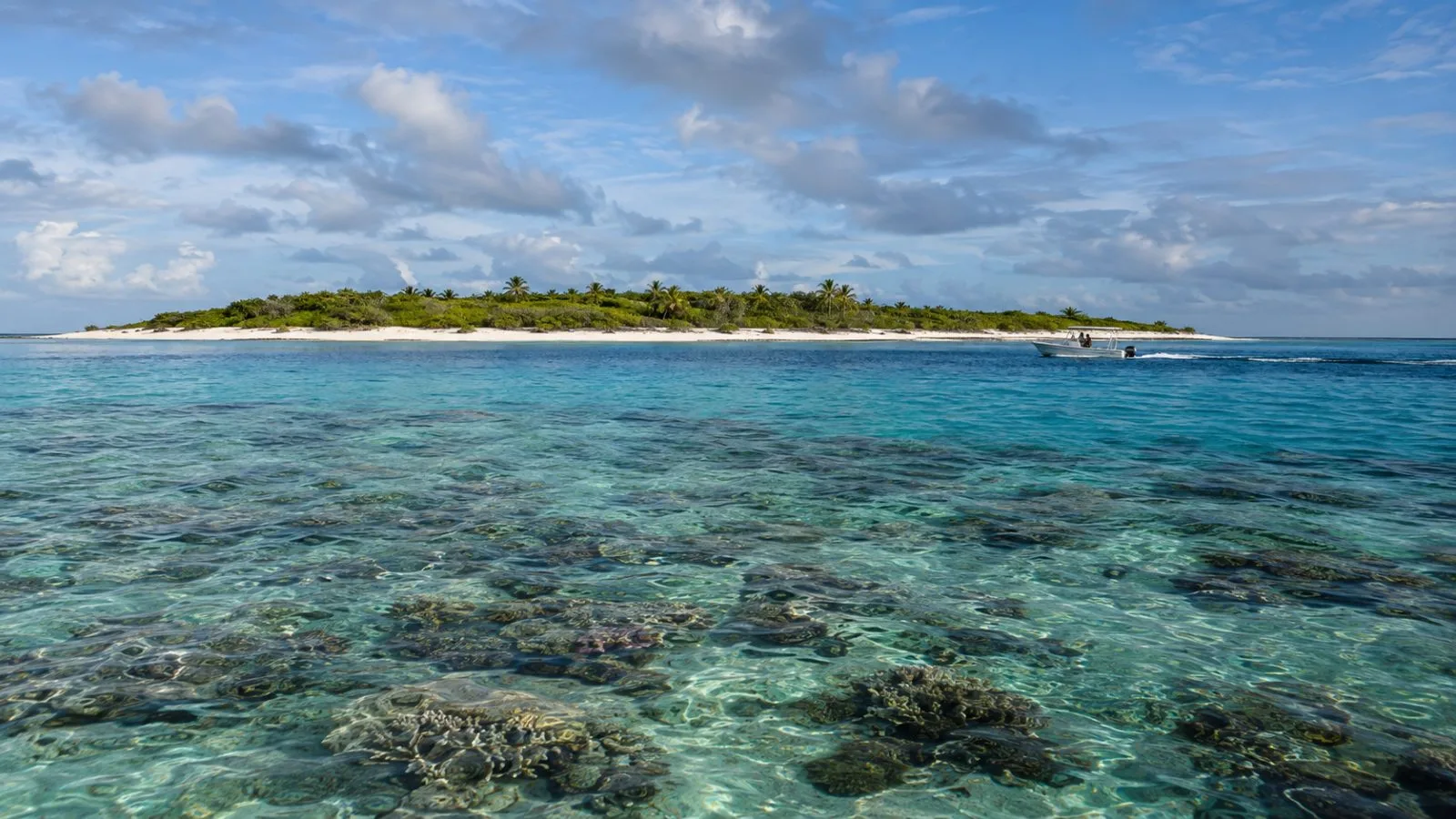
A 2023 survey of Bikar and Bokak adds a broad ecosystem baseline for tracking ecological change across remote land and marine habitats within the Marshall Islands’ first national marine sanctuary.
Published Nov. 11, 2026, in Frontiers in Marine Science, the study builds on baseline assessments conducted in 2019. The researchers surveyed terrestrial habitats, seabirds, turtle nesting areas, reefs, open water and deep-sea environments. Bikar and Bokak are uninhabited and lie about 116 kilometers and 385 kilometers, respectively, from Utrik, the nearest inhabited atoll.
Land surveys recorded 17 seabird species, with 15 confirmed or considered likely to be breeding. Researchers documented 266 reef-fish taxa from 38 families, observed 138 fish taxa during submersible dives and recorded 79 vertebrate taxa with deep-sea cameras. At Bikar, they counted 71 turtle crawls and 132 nest pits, most attributed to Green Sea Turtles.
The atolls had different reef characteristics. At shallow forereef stations, mean fish biomass was 445.0 ± 327.9 grams per square meter at Bokak, compared with 210.0 ± 117.2 grams at Bikar. Bokak’s reefs were more coral-dominated; Bikar had greater macroalgal and crustose coralline algae cover. The researchers did not establish what caused the differences.
The Marshall Islands government announced Jan. 28, 2025, that it had signed the country’s first national marine sanctuary, covering Bikar and Bokak. The government says fishing and activities it considers destructive are prohibited there. It describes the Reimaanlok framework as combining traditional knowledge with modern science, with resource-use decisions made in local communities under the permission and guidance of local governments and traditional leaders. The announcement framed the sanctuary as supporting a sustainable future for residents but did not identify affected fishers or quantify economic costs.
Marine ecologist and study author Alan M. Friedlander said in a Frontiers news release that the atolls are “not just treasures for the Marshall Islands but for the entire planet.” The paper says its findings can support long-term monitoring and assessment of climate impacts. The survey covered one period and did not assess bleaching history, thermal exposure or recovery after disturbances, so it does not establish the atolls’ resilience. The paper gives no schedule for follow-up research.