Fintechs, notably mobile money, have transformed banking and finance in developing and emerging economies in Africa and beyond. Financial technology (better known as fintech) is used to describe new technology that seeks to improve and automate the delivery and use of financial services.
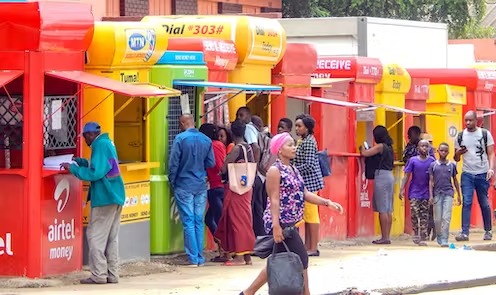
Mobile money in Africa was spearheaded by Kenya’s M-Pesa in 2007. Ghana’s MTN MoMo followed in 2009. Mobile money is a pay-as-you-go digital medium of exchange and store of value using mobile money accounts and a mobile phone.
In Ghana, the volume of mobile money transactions increased from 2.85billion in 2020 to 4.26 billion in 2021, representing a 48.6 per cent growth. Similarly, the total value of transactions increased to GH¢ 978.32 billion ($87 billion) in 2021, from GH¢ 571.80 billion ($50 billion) in 2020 according to the central bank.
Over the last ten years, mobile money has gone beyond sending and receiving money to several other services including accessing microcredit. Mobile money accounts are now seamlessly linked to bank accounts.
The fintech boom has brought obvious benefits to a number of African countries, particularly in promoting financial inclusion. But there hasn’t been a sufficiently critical conversation about who actually benefits from the growth of digital finance.
What exactly is the political economy of fintech-led financial inclusion in Ghana and across Africa? How has it expressed itself in Ghana’s mobile money industry? And to what extent do the outcomes in Ghana reflect wider conversations about global finance capitalism?
I am a Research Associate and PhD candidate at the Africa Multiple Cluster, currently studying the political economy of money and finance in Ghana. In a recently published paper based on my research, I examine whether or not increased access to financial services through the delivery of mobile money services has helped poor people. My findings raise serious concerns about the current state of digital finance in Ghana.
In particular, I found that they have been accompanied by higher customer indebtedness from digital microloans, high and multiple transaction costs, excessive taxation due to a recently introduced tax, and a prevalence of dormant accounts.
My research shows that far from ending poverty, financial inclusion has opened new frontiers of exploitation. This is particularly true for poor and working class Ghanaians. Many of the problems identified in my research have been raised by Ghanaians using mobile money banking services. But their complaints have been ignored. It is time this changed and their concerns were taken seriously.
Findings
My study relied on two sources of data. One was the central bank’s payment systems data (2012-2021). I also conducted 42 interviews made up of 32 mobile money customers and 10 mobile money agents across seven regions of the country.
My research found a number of problems.
Firstly, that digital loans for instance are usually small amounts. They are therefore incapable of supporting social entrepreneurship. Yet they attract significant interest rates (averagely 6.9%) over a 30-day repayment period. The result is that borrowers get into debt juggling, borrowing from one subscriber to repay others and simply buying time. Of course, most borrowers are unable to ‘buy enough time’ before they default and fall into a debt trap that can lead to other problems. As one person put it:
I owe them for so many months. My brother, I am a graduate but as you know there are no opportunities. The only thing is for me to bet, maybe I will win big so I can pay them
Secondly, that transactions are expensive. This is because there are multiple charges for transfers and withdrawals ranging between 1% and 5%.
Thirdly, that a recently introduced tax has further raised costs. The government put in place an electronic transactions levy in 2022.
The way the tax works is that as the transaction amount increases, subscribers can pay up paying up twice or more of the original transaction fee.
Users have been up in arms.
As one put it:
How can you tax the same money several times? I work, and at the end of the month receive salary, which I have already paid tax and when I send part of it to my mother in the village, you will tax it again. Imagine she wants to send part of it to another relative, and you tax it again.
Broader problems
The problems identified by users of mobile money services aren’t the only challenges facing the sector.
Key ones include:
-
Regulation: there isn’t enough regulation of the pricing of digital financial services. Existing legal requirements in Ghana don’t impose limits on digital transaction charges. These regulations have to be expanded to limit how much fintechs can charge for money transfers and withdrawals as well as interests on microloans.
-
Customers’ complaints about multiple transaction fees are being ignored by government.
-
About 50% of registered mobile money accounts lie dormant as subscribers resort to alternative modes of money transfer in their attempt to avoid transaction costs and debt. This has raised the cost burden for both corporations and government who struggle to retrieve taxes and loans owed by these accounts.
Lastly, I conclude in my paper that although fintech has improved the ease and speed of financial transactions it nevertheless has heralded in a set of new problems. In particular it has exposed subscribers to debt as well as exorbitant transaction costs. These outcomes are not accidental. I argue that the rollout of mobile money in Ghana should be viewed as part of global processes opening new frontiers for global digital financial capitalism.