
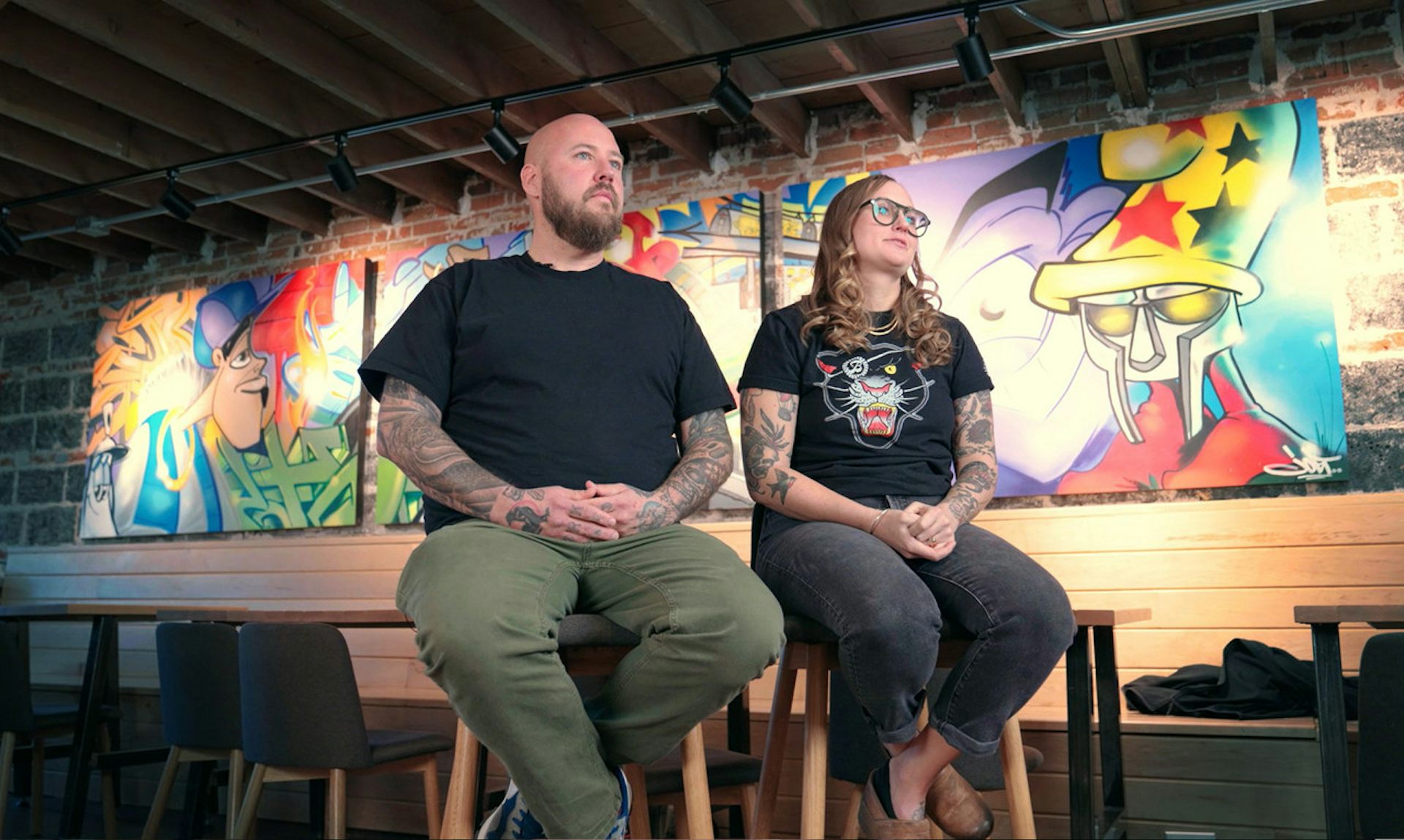
At Odie B’s, a sandwich shop in Denver, recovery from drug and alcohol use is part of daily operations.
“Seventy percent of our staff is active in recovery,” Cliff Blauvelt, co-owner of Odie B’s, said in a video testimonial. “We try to provide a safe space where people can feel comfortable.”
Blauvelt has struggled with alcohol use for more than 20 years. He co-owns Odie B’s with his wife, Cara Blauvelt.
One employee, Molly, said working at Odie B’s helped her focus on sobriety and reconnect with her sense of purpose.
“I was burned out, I was working a lot of hours. … I started dry January, and after a few months I realized I needed to quit drinking,” she said in the same video testimonial. “Cara definitely helped with my sobriety journey, just reminding me one day at a time, and now, I have been sober for going on two years.”
Staffers at Odie B’s, a sandwich shop in Denver, participated in Colorado’s Recovery Friendly Workplace Initiative and were interviewed about the experience.
Colorado is one of more than 30 states that have launched recovery-friendly workplace programs in recent years. They’re part of a growing effort to reframe how employers address addiction, mental health and recovery for the well-being of their employees and businesses.
Our team from the Centers for Health, Work & Environment at the Colorado School of Public Health works with employers to develop training guidelines and policies to help make their workplaces supportive of recovery.
Over the past three years, we’ve worked to understand the tools employers need to better support employees with substance use disorders.
Many are deeply motivated but lack formal policies or training. That gap is what the Colorado Recovery Friendly Workplace Initiative is designed to fill.
Since 2021, our team has developed and delivered recovery and mental health training to more than 8,000 Colorado employees. They represent more than 100 businesses in industries ranging from local government to construction companies and health care providers. Our training sessions focus on equipping individuals with an understanding of mental health and substance use disorders, explaining how to combat stigma, and outlining how to navigate accommodations in the workplace.
The toll of addiction
Substance use is not just a personal issue; it’s a public health and workforce challenge.
In 2023, 1,865 Coloradans died from a drug overdose, according to data from the Colorado Department of Public Health and Environment. That’s up about 65 deaths from the previous year. Nationally, overdose deaths have more than doubled since 2015.
In high-risk industries, such as construction and mining, where physically demanding work, long hours and job insecurity are common, workers have some of the highest rates of nonmedical opioid use. These workers are thus at a high risk of developing substance use disorders.
They also face other mental health challenges. These same sectors face the highest suicide rates across all occupations and nearly double that of the general public.
Recovery, as defined by the Substance Abuse and Mental Health Services Administration, a federal agency, includes “a process of change through which people improve their health and wellness, live self-directed lives, and strive to reach their full potential.” In Colorado, an estimated 400,000 people identify as being in recovery. Many of them are working, raising families and rebuilding their lives.
The economic impact of substance use is significant. Colorado has lost more than 360 million work hours to opioid use over the past decade, according to the American Action Forum, a nonprofit that conducts economic analyses. That’s the equivalent of 173,000 full-time jobs for one year.
In 2017 alone, the cost of lost productivity due to opioid use disorder and fatal opioid overdose in Colorado was estimated to be US$834 million.
Employers save an average of $8,500 per year for each employee in recovery, according to the National Safety Council. These savings come from lower health care costs, reduced absenteeism and decreased turnover. In other words, when employers retain and support workers through recovery rather than lose them to untreated substance use, they see measurable benefits.
A shifting policy landscape
In 2024, Colorado lawmakers passed a bill for supporting recovery and addressing the opioid epidemic. The legislation provided funding to establish the Recovery Friendly Workplaces Initiative and the voluntary employer participation and certification program.
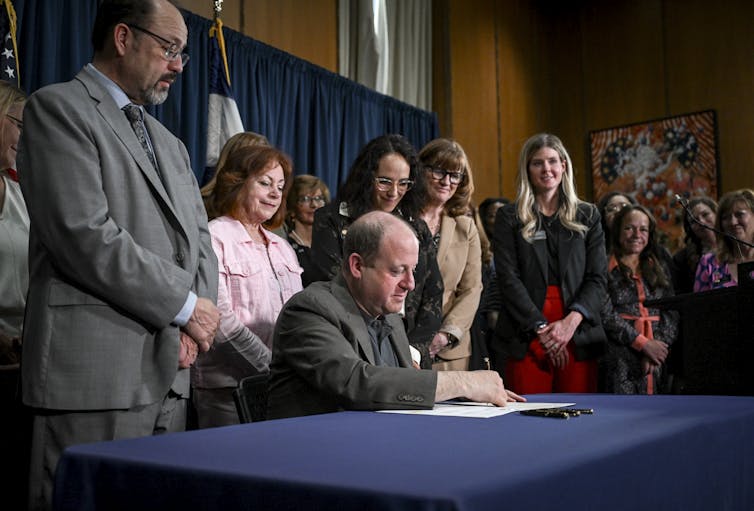
Colorado Gov. Jared Polis signs legislation into law. The Recovery Friendly Workplace Initiative received state funding as part of a 2024 bill aimed at addressing the state’s opioid epidemic. Aaron Ontiveroz/Getty Images
In early 2025, funding for the initiative was removed from the state budget due to a broader fiscal shortfall. The funding cut disrupted many of our planned activities, and we are currently relying on interim support from counties and state offices.
Looking ahead
Small businesses remain a priority for our team, despite recent funding cuts. Many lack human resources departments or formal wellness programs but are nonetheless deeply committed to helping their employees succeed.
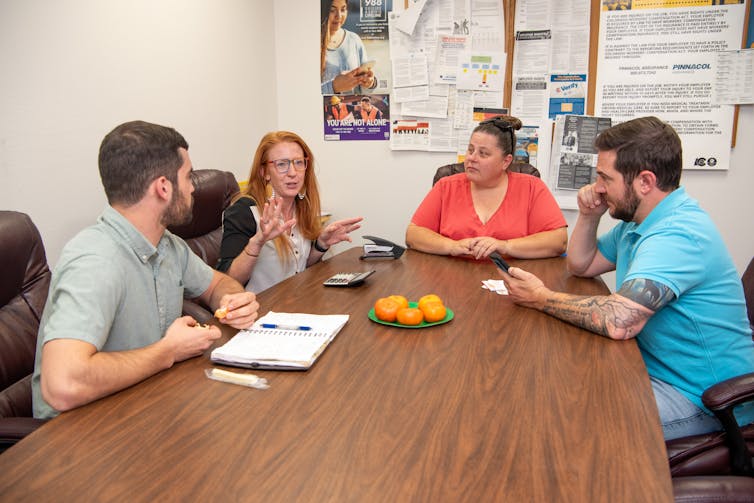
Sarah Deering, vice president of Absolute Caulking & Waterproofing of Colorado, joined the Recovery Friendly Workplace Initiative. Courtesy of the Center for Health, Work and Environment
A Colorado Recovery Friendly Workplace Initative participant, Absolute Caulking & Waterproofing of Colorado, employs 39 people. Absolute has championed recovery-friendly policies as something the business values.
“This partnership saves us time and resources, which is invaluable for our small, family-owned business,” said Sarah Deering, vice president of the company.
The road ahead presents challenges, including limited funding, the societal stigma around recovery and all of the complexities of recovery itself. But we continue to follow the scientific evidence. Our research team is evaluating the outcomes of our programs to better understand their impact and hopefully inform future policy recommendations. We are committed to the belief that work can and should be a place of healing.


