
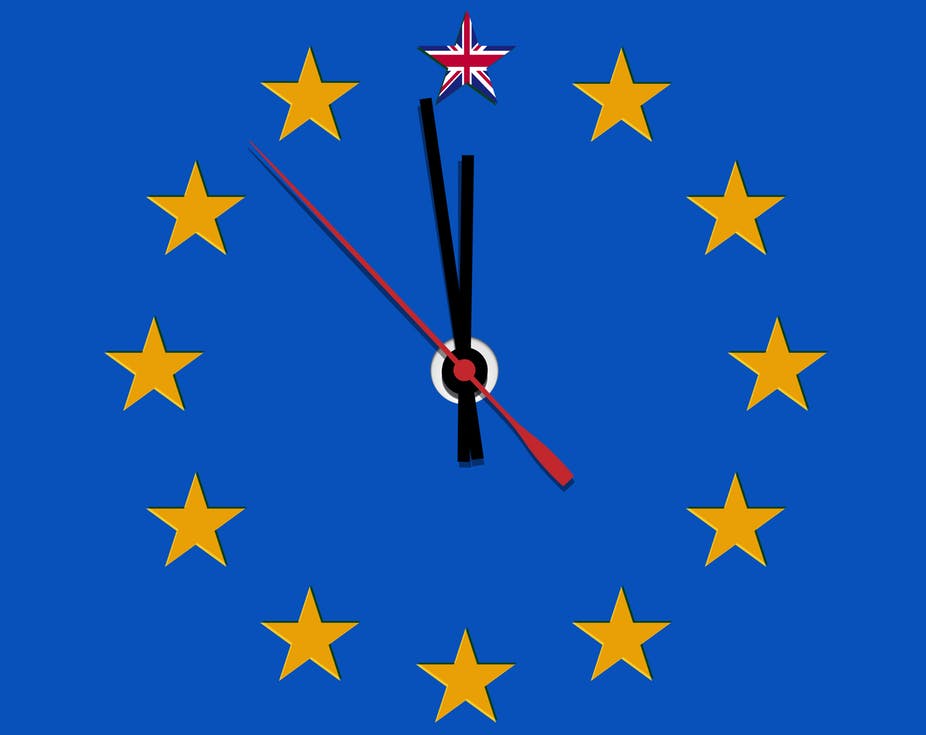
When it comes to how Brexit will affect business, much of the debate in the UK has focused on large firms, particularly international ones such as Honda and Nissan. The CBI, which mainly represents big business, has been tirelessly warning of the economic dangers of a no deal in the coming weeks.
The likely impact on small and medium-sized enterprises (SMEs) has received much less attention by comparison. We have published a new study in the journal Regional Studies that looks at this in detail. We found that well over one million UK SMEs, around a quarter of the total, were concerned about how Brexit would affect the success of their business. We also examined how Brexit uncertainty varies according to the size and location of companies and their business orientation.

The life of pie. phushutter
SMEs represent a core part of the UK economy, accounting for 99% of all UK firms and 60% of total private sector employment. They are crucial for innovation and productivity growth and have disproportionately driven job creation since 2010. They are also particularly affected by institutional and political uncertainty and less resilient when it comes to unforeseen events such as Brexit.
To find out what they thought about Brexit, we investigated a large survey of 15,867 SMEs that had been compiled by the UK Department for Business, Energy and Industrial Strategy in 2016 and 2017. The 25% who viewed Brexit as a major obstacle to their success – some 1.25m businesses – was a significant increase on the 16% who were of this view immediately after the referendum in 2016.
These fears will almost certainly have escalated as the UK moves ever closer to eventual exit from the EU: a recent survey of SMEs by the Cooperative Bank, for instance, found that Brexit’s effect on the economy was their top concern for 2019, with 30% drawing attention to it. Meanwhile, a new survey has found that 57% of Scottish SMEs believe Brexit will be negative for their business, compared to only 41% of the managers of bigger companies.
Worriers in chief
Our study found that larger SMEs that were internationally oriented and/or innovators, such as tech firms, were particularly concerned about Brexit – as were those located in major cities. Worryingly, the firms most concerned by Brexit – these innovators and exporters – are the same SMEs deemed most important for generating productivity growth.
We found that the single largest factor concerning SMEs was uncertainty regarding future regulatory change, with 74% citing it. Smaller businesses were particularly worried, as were exporters. Other major concerns included increased import costs (52%) and uncertainty regarding future access to EU markets (59%).
Around two-thirds of SMEs had scaled back plans for future capital investment to 2020, while as many as 77% were less focused on increasing export sales over the same period. The study also found that SMEs’ concerns about Brexit were considerably higher in devolved areas like Scotland and Northern Ireland. This is despite the fact that these jurisdictions are best equipped to deal with any negative ramifications through the likes of their enterprise and export agencies and, at least in the case of Scotland, devolved government.
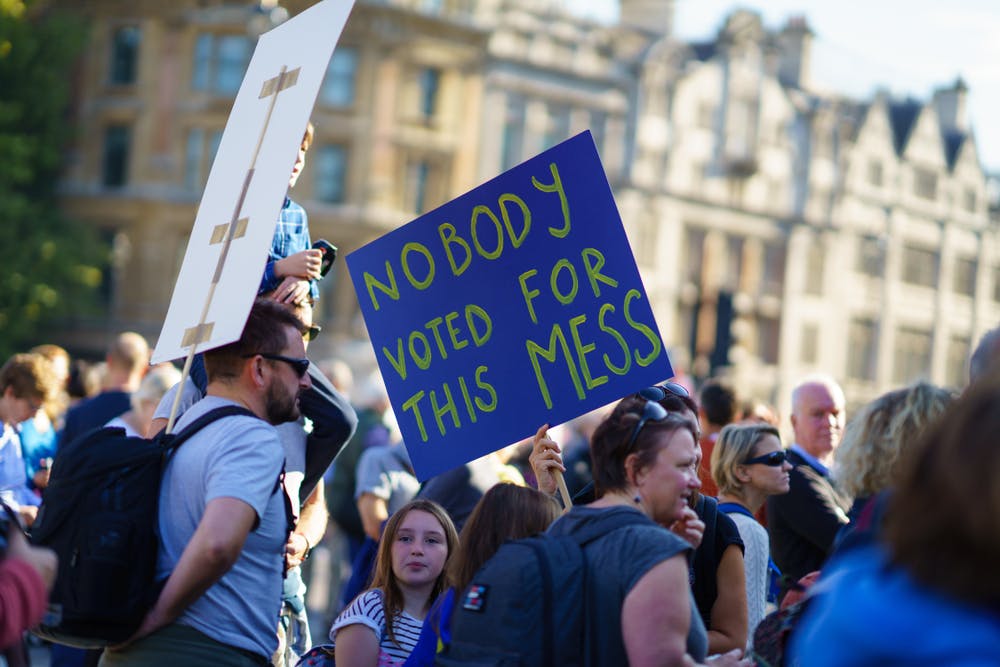
With the uncertainty around Brexit now arguably greater than at any time since the 2016 referendum, the findings in our study suggest that SMEs will potentially be the firms hardest hit by Brexit.
Nope. nrqemi
The UK government has done little or nothing to ease these uncertainties. There are several lessons here that it could learn from Scotland. The Scottish government is offering grants of £4,000 to helps SMEs to export, for instance. It has also set up a national helpline.
In the absence of better support, we are seeing the private sector taking steps to support SMEs: Barclays Bank, for instance, has just announced a new £14 billion lending fund for SMEs to help cope with the uncertainty, and has been holding Brexit clinics around the country.
Constitutional paralysis or not, the UK government needs to recognise that SMEs are the backbone of the economy and crucial for future productivty growth. It must act now to alleviate the anxieties of these businesses so that whatever form of Brexit comes to pass, they are as well placed as possible to navigate the choppy waters ahead.


