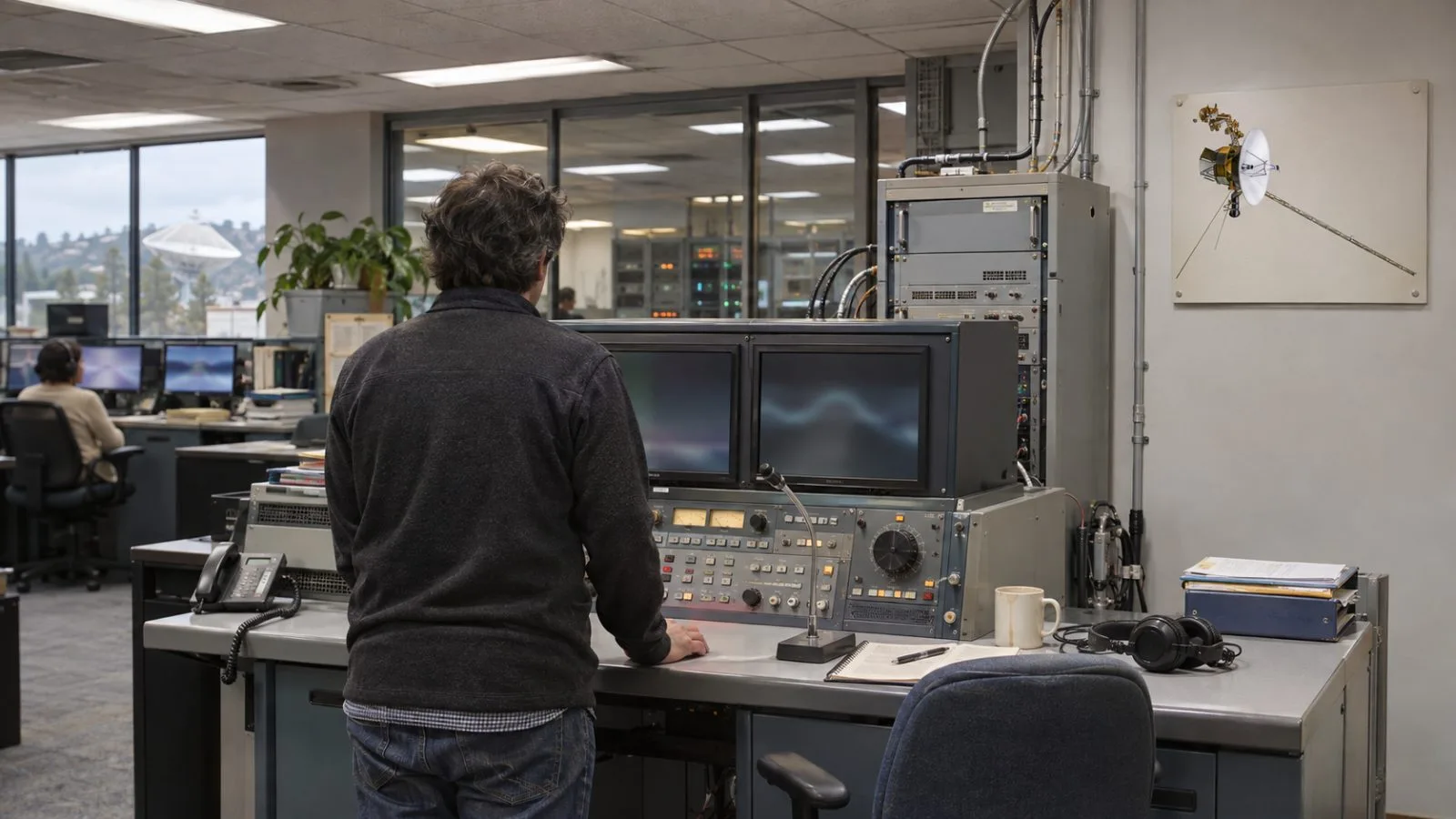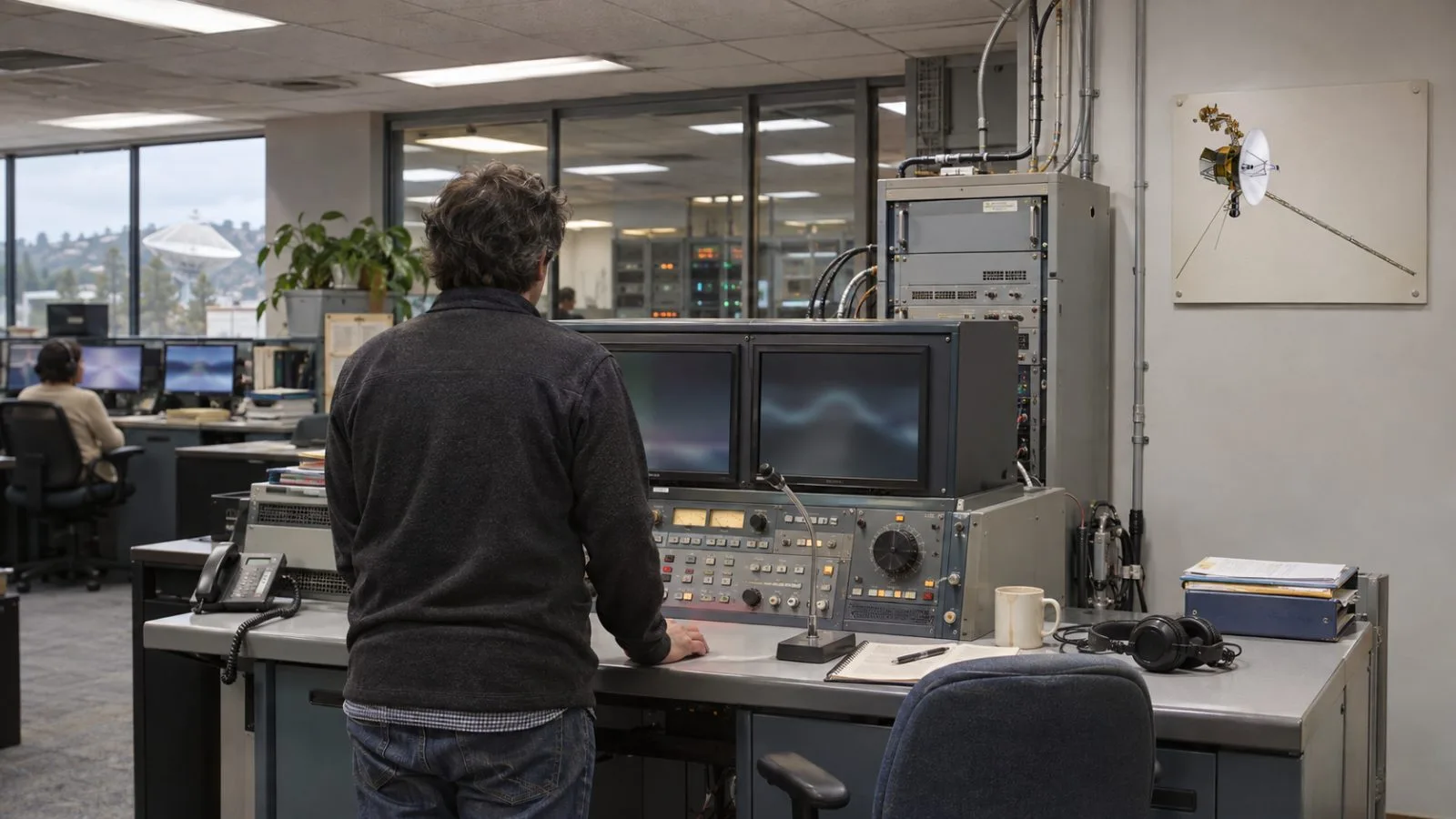
NASA calculates Voyager 1 has passed a distance milestone that leaves Earth controllers waiting roughly two days for a complete radio exchange with the spacecraft, a first for a human-made object.
NASA lists the crossing at 5:16:07 a.m. ET (10:16:07 UTC) on Nov. 18, with Voyager 1 about 16.1 billion miles (25.9 billion kilometers) from Earth. A light-day is a measure of distance: it is how far light travels in 24 hours.
The agency was still waiting for a signal from Voyager 1 to verify the position estimate. At that separation, the outgoing message and the spacecraft’s response each spend about a day in transit, stretching an exchange across roughly 48 hours.
The threshold marks distance rather than a change to the spacecraft. NASA says crossing it does not alter Voyager 1 or its surroundings, while the long communications delay adds a practical constraint for controllers managing the mission.
The date matched NASA’s earlier estimate, covered in EconoTimes’ preview of the crossing. Voyager 1 launched on Sept. 5, 1977, and entered interstellar space in 2012. Voyager 2 followed into interstellar space in 2018. NASA says both continue collecting scientific observations beyond the heliosphere, the protective bubble created by the Sun.
The probes’ power supply is also declining. NASA’s Jet Propulsion Laboratory says Voyager 1 and Voyager 2 each lose about four watts per year as their plutonium supply depletes. Engineers have shut down nonessential systems to conserve power. Suzanne Dodd, Voyager project manager at the laboratory, said anyone sending a message has to “wait two days before you finally get a response.”
NASA plans a Voyager documentary for 2027, the mission’s 50th anniversary year. Its next scheduled event is a public discussion of both spacecraft’s status and science at noon ET Thursday, Nov. 19.