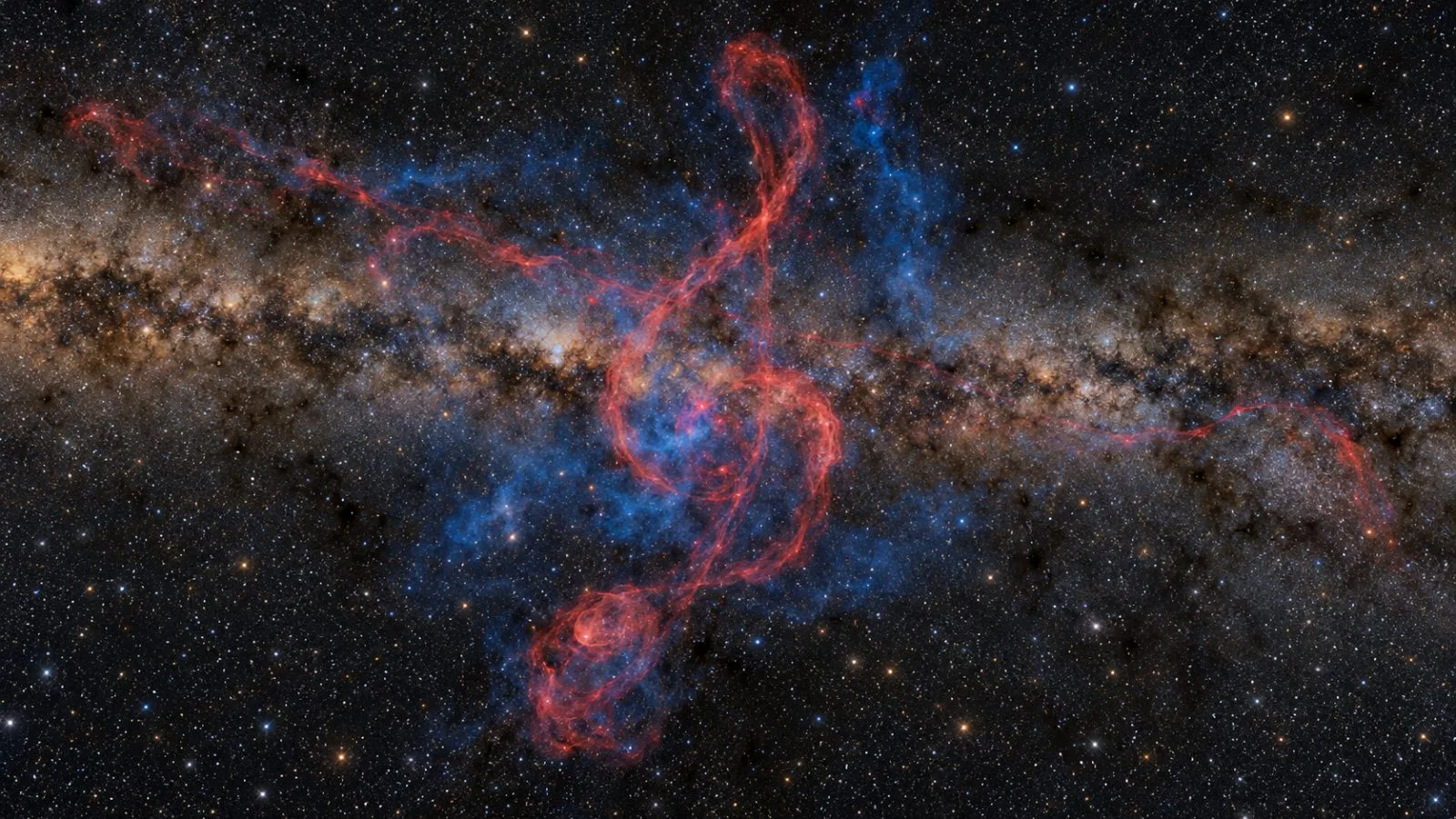
NASA’s Astronomy Picture of the Day for Oct. 19 features a radio structure spanning more than 2 million light-years, while X-ray data place it in a disturbed galaxy cluster.
Catalogued as VLSS J0318.9+5755, the object is nicknamed the “Treble Clef” because its outline resembles musical notation. NASA’s composite displays radio emission in red and X-rays in blue, combining LOFAR radio observations, X-ray data from Chandra and eROSITA, and infrared imaging from the United Kingdom Infrared Telescope. The source lies behind the Milky Way’s plane, where foreground stars, gas and dust make observations more difficult. The paper measures its radio emission across about six arcminutes along its major axis. It reports a spectral index above 4 at the northern and southern tips between 400 and 650 MHz, describing an exceptionally steep spectrum.
Chandra and eROSITA detected extended hot gas around the radio emission. The research team interprets the cluster’s disturbed structure as consistent with a merger. It estimates the cluster’s redshift at 0.117 ± 0.008 and its mass at about 5.4 × 10^14 solar masses using an X-ray luminosity relation, or 6.0 × 10^14 solar masses using a temperature relation.
A team led by Andrea Botteon of Italy’s National Institute for Astrophysics (INAF) classifies the source as a “radio phoenix,” a label for aged radio-emitting plasma that appears to have been revived in a cluster. The paper proposes that an earlier supermassive black-hole outburst left the plasma, which was later revived during the merger. The authors present their explanation for the filaments’ shape as speculative. “We speculate that its complex morphology is shaped by gas motions generated in the intracluster medium during the ongoing merger,” Botteon and co-authors wrote. They also suggest shocks may generate turbulence in the cluster gas.
The image follows earlier EconoTimes coverage of the study’s X-ray evidence and cluster interpretation. The researchers say numerical simulations are needed to test their proposed account and identify sharper LOFAR2.0 imaging at lower radio frequencies as a future research target; they give no observation date.