X-ray and radio observations have linked a sprawling source once considered a possible pulsar to a merging galaxy cluster behind the Milky Way, offering a tentative account of its origin.
The study, published Wednesday in Astronomy & Astrophysics, identifies VLSS J0318.9+5755 as part of the cluster and measures the source at about 760 kiloparsecs across in projection. Researchers nicknamed it the “Treble Clef” because its shape resembles the musical symbol.
The cluster is at redshift 0.117 ± 0.008. The study reports X-ray luminosity of about 2.2 × 10⁴⁴ erg per second in the 0.5–2.0 keV band. At the source’s northern and southern tips, its radio spectral index exceeds 4 between 400 and 650 MHz, indicating a particularly steep spectrum.
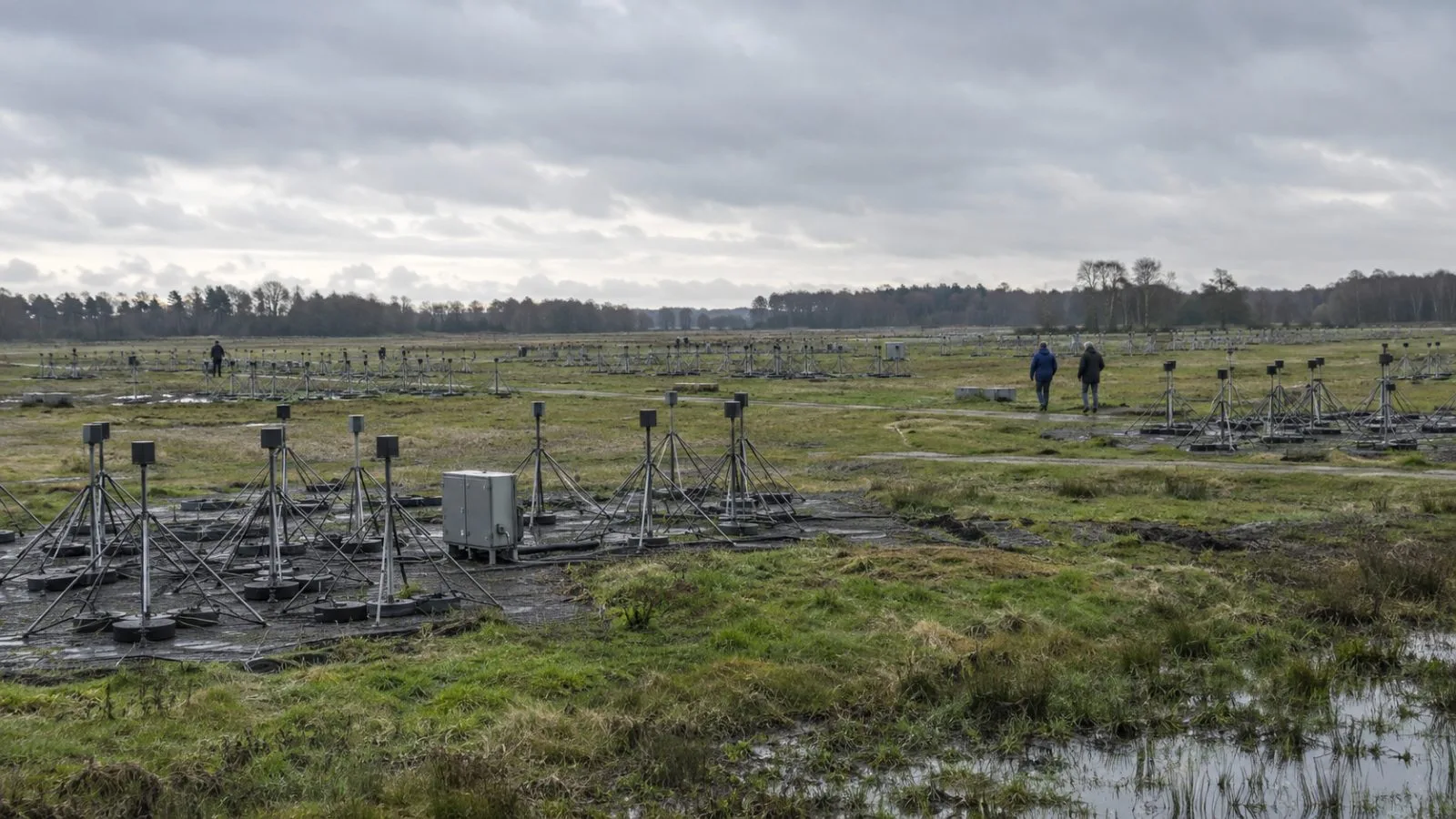
NASA’s Chandra X-ray Observatory and eROSITA detected diffuse hot gas around the radio structure. LOFAR images revealed its filaments, while uGMRT observations added follow-up radio data. The system sits behind the Milky Way’s plane, where foreground stars, gas and dust obstruct observations. The study says the source had once been considered a pulsar; a 2004 paper suggested it was associated with a cluster in the same region.
The researchers classify the structure as a radio phoenix: old radio-emitting plasma that may have become visible again after activity in the cluster. In their proposed model, an earlier episode from a supermassive black hole left plasma behind. Its radio glow weakened over time, and the later cluster merger may have compressed or energized the remnant.
The authors favor mixing in moving cluster gas as the main influence on the filaments, with shocks possibly adding turbulence. They describe the formation model as tentative and say numerical simulations are needed to test whether it explains the observed shape. For comparison, the study points to the radio phoenix in galaxy cluster Abell 85 as an archetypal example.
The study estimates the cluster’s mass at 5.4 × 10¹⁴ solar masses using an X-ray luminosity relation and 6.0 × 10¹⁴ solar masses using a temperature relation. NASA’s Chandra team dates the collision to hundreds of millions of years ago and says the clusters are now traveling away from each other.
The authors identify the source as a target for sharper LOFAR2.0 imaging at lower radio frequencies; the study gives no schedule for those observations.