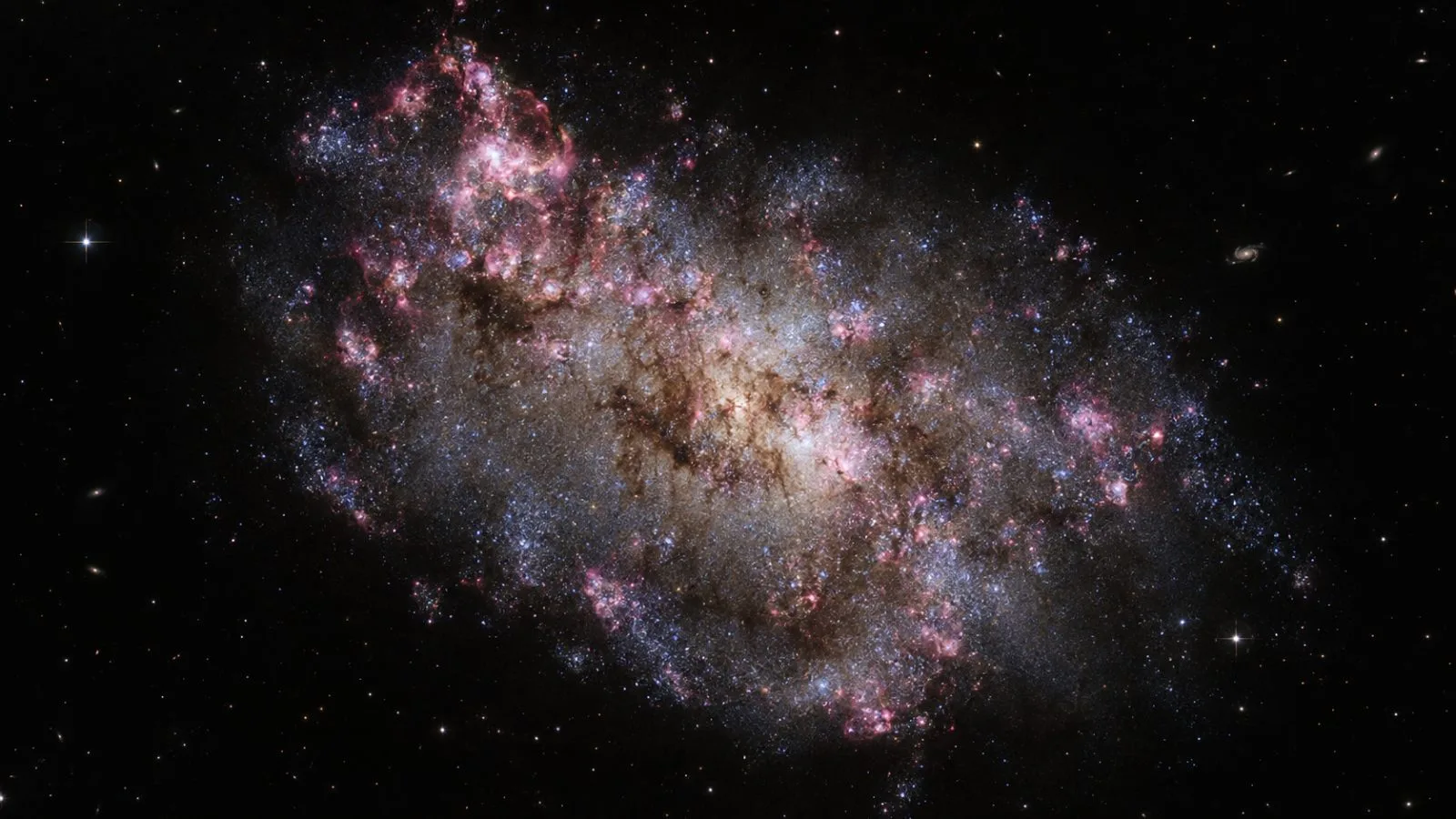
NASA’s Nov. 4 feature on NGC 4449 highlights one of 37 nearby dwarf galaxies in a study that found the systems retained just 4% to 25% of their stars’ oxygen.
The Hubble image was released Nov. 2, according to NASA. The research, published that day in The Astrophysical Journal, found a mean retention rate of 10.7%. The sample comprised gas-rich, low-metallicity systems at distances below 6 megaparsecs; their stellar masses ranged from 10^6.5 to 10^9.5 solar masses.
Gas held almost all the oxygen researchers accounted for; stars, stellar remnants and dust contained smaller amounts. The team reconstructed the galaxies’ star-formation histories from archived Hubble observations that resolve individual stars, then combined those results with data from NASA’s retired Spitzer Space Telescope, the Very Large Array and the Australia Telescope Compact Array. NASA said oxygen was chosen because it is comparatively easy to measure and its production by stars is well understood.
Winds from massive stars and supernovae may have carried oxygen out of the galaxies. Grace Telford, a study co-investigator and assistant professor in the University of Utah’s Department of Physics and Astronomy, said, “The oxygen must have been ejected.” The study does not establish whether most of it remains in gas around the galaxies or traveled farther away.
The paper’s background describes lower-mass galaxies as having shallower gravitational potential, which may make them more prone to losing metals in outflows. Earlier work on Milky Way-like galaxies found some oxygen missing from their disks in surrounding gas halos, and this study extends the question to smaller systems. Across the simulation sets examined, modeled galaxies kept more of their stellar oxygen output than the observed sample did, though the difference varied.
GLOW principal investigator Kristen Wingfield McQuinn hopes to use NASA’s Nancy Grace Roman Space Telescope to find lower-mass galaxies for later study with Hubble and the James Webb Space Telescope. Telford plans more detailed Hubble observations of massive stars in some of the sample galaxies; the sources give no schedule for that work.