Astronomers are using Hubble’s detailed gravitational-lens images to build a model that can help interpret dark matter clues in the wider surveys planned for NASA’s Nancy Grace Roman Space Telescope.
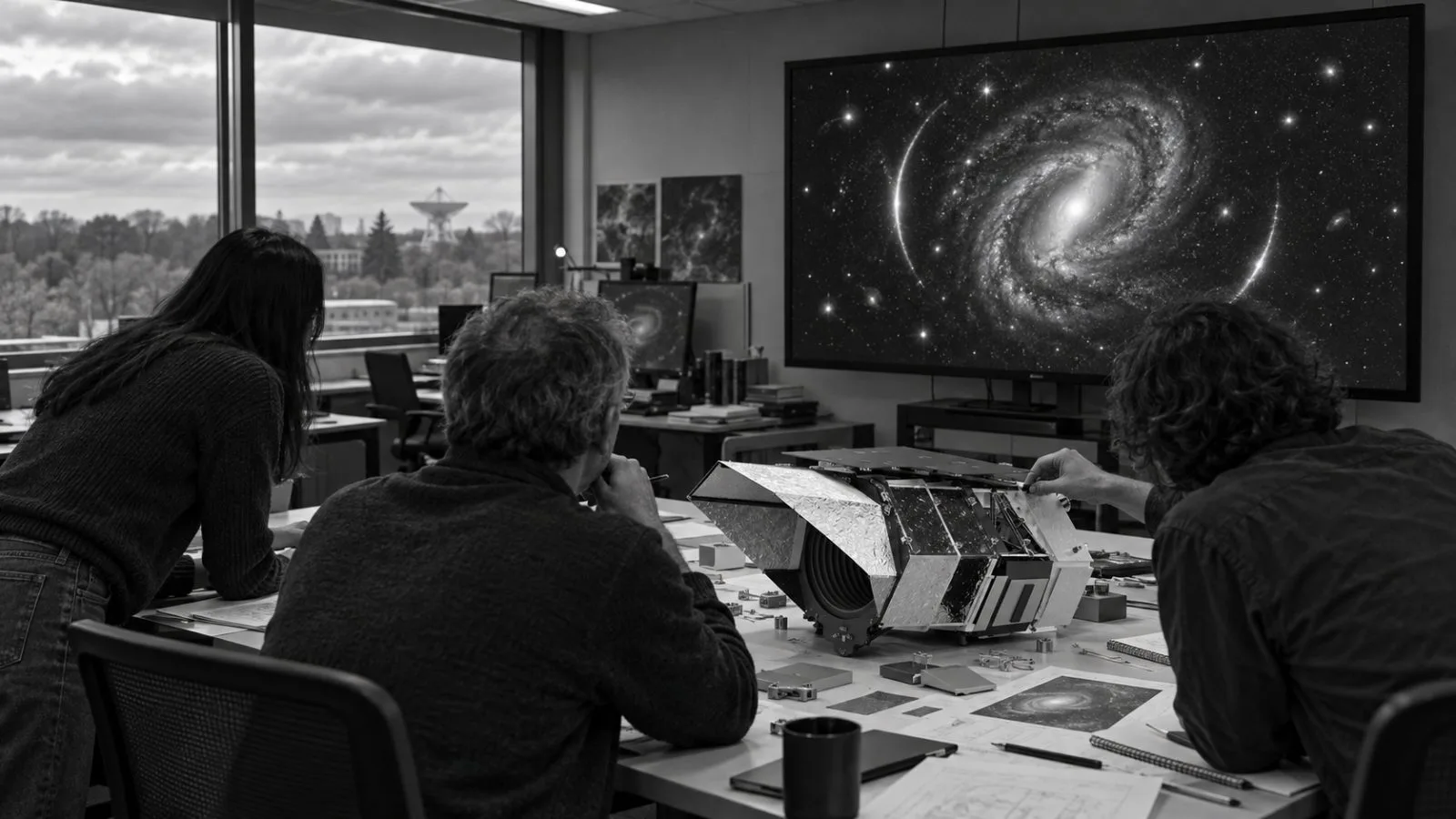
A NASA image published Oct. 29 shows a barred spiral galaxy and, near the lower right, a pair involved in gravitational lensing. Hubble took the image Oct. 22. The foreground elliptical galaxy lies about 4.5 billion light-years away, while the galaxy behind it is about 8 billion light-years away. The more distant galaxy appears as two arcs, one reversed relative to the other.
The foreground galaxy’s gravity changes the path of light from the farther object, distorting its appearance. NASA says researchers can use the arcs to estimate the foreground galaxy’s mass. Visible matter cannot account for all of the bending, so the same measurements can also help assess how much dark matter the galaxy contains.
Astronomers are assembling a computer model from Hubble’s detailed images to help interpret similar distortions in Roman observations. Hubble can examine lens systems individually, while Roman will survey a wider area and is expected to find a larger sample. NASA expects Hubble to take a closer look at selected systems Roman identifies.
NASA expects Roman’s images to have detail comparable to Hubble’s, while each frame covers a sky region with at least 100 times the area of a Hubble image. Roman’s weak-lensing survey will look for small changes in the apparent shapes of hundreds of millions of galaxies. NASA says those measurements are intended to map visible and unseen matter.
NASA said Aug. 30 that it anticipated releasing Roman’s first images by early 2027.