

As the Brexit negotiations grind on, and with a withdrawal agreement still seeming elusive, the British people are becoming more pessimistic about what Brexit might mean. A major new survey by the Policy Institute at King’s College London and Ipsos MORI reveals that nearly half (44%) expect the UK to leave the EU in March 2019 without a deal in place. Only three in ten expect a deal to be worked out.
If we break the population down by party support and preference on Brexit, other fascinating distinctions become apparent. The majority of Remain-backing Labour voters think the UK is heading for a no-deal Brexit, while the majority of Conservative-Leave supporters think the country will leave with a deal.
Strikingly, whatever the outcome of the negotiations, few see much personal economic benefit flowing from Brexit. Only 14% of the public expect that leaving the EU will result in an increase in their own standard of living in the next five years, with twice as many expecting their standard of living to decrease. The public have become more pessimistic since we last asked this question in May 2016, just before the referendum.
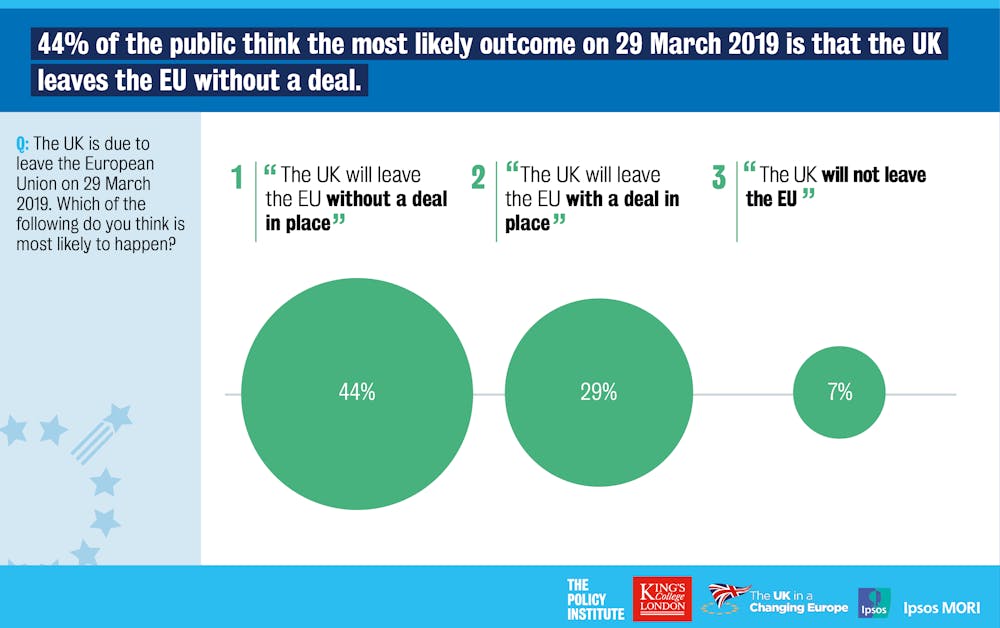
Feeling down about a deal. KCL/Ipsos Mori, Author provided
This personal economic pessimism reflects a broader sense of a negative impact on the UK economy, at least over the next five years. Only two in ten people expect the UK growth rate to increase as a result of Brexit over that period, with four in ten expecting it to decrease.
But this overall picture is again a balance of very different views between Leave and Remain supporters: 64% of Remain supporters expect Brexit to decrease growth rates, compared with only 17% of Leave supporters.
The bus has finally departed
The NHS was at the heart of the Leave campaign, with explicit messages about how leaving the EU will lead to more funding and reduced pressure. These claims resonated with the public – it is not too much of a stretch to say that the famous red bus promising an extra £300m a week for the NHS conveyed, at least in part, a pro-NHS and anti-austerity message.
Yet there is far less faith now that Brexit will have a positive impact on the NHS. A third expect the quality of health services to decrease as a result of Brexit, a third think the quality will stay the same, and a quarter that it will increase. But, crucially, the belief that Brexit will hurt the NHS has doubled since 2016, when only 17% thought leaving the EU would lead to a decline in the quality of health services.
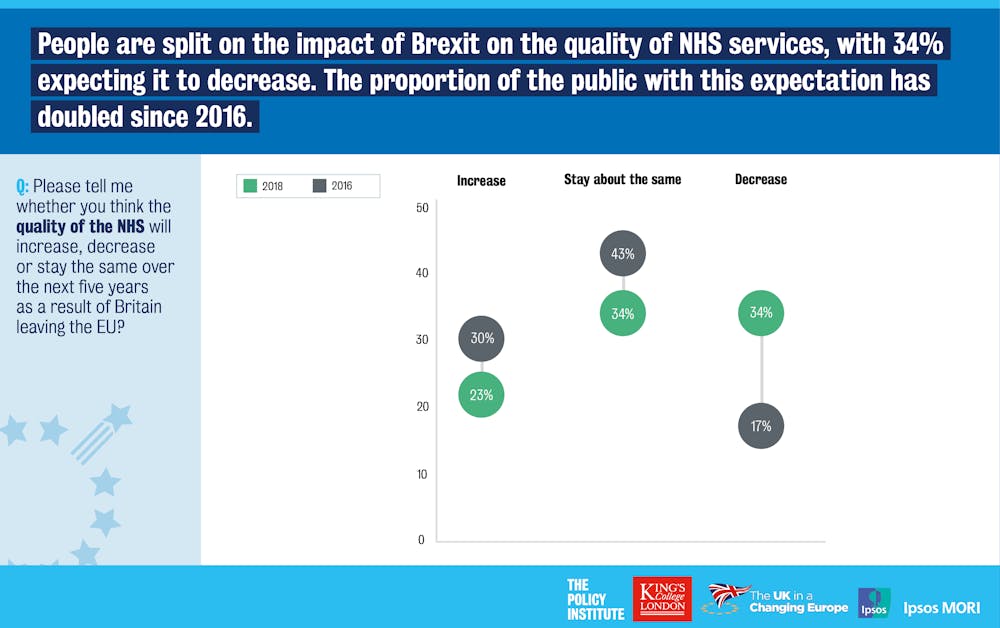
Feeling a bit queasy about the future of the NHS. KCL/Ipsos Mori, Author provided
Again, one’s views of Brexit tend to colour one’s expectations about its impact: six in ten Labour Remain supporters expect a decrease in NHS quality as a result of Brexit, compared with only 16% of Leave supporters.
The big unknown
The reality, of course, is that no one knows what the impact of Brexit will be, not least because no one knows what sort of Brexit the UK will end up with. In that context, it’s no surprise that unease is growing and that the country is so divided, as deadlines loom, talks seem to have stalled and the future is so unclear. But the degree to which beliefs about the future are structured by pre-existing beliefs about Brexit itself is striking (and perhaps understandable given that we don’t know where this process will end up).
And what remains remarkable, and will be the key issue over the weeks to come, is whether this widespread Brexit pessimism – about both the outcome and its impacts – will have any effect on the overall support for Brexit. To date, this has remained remarkably stable, albeit with a slight shift towards remain in recent months.
These attitudes, however, matter. If parliament becomes deadlocked over whatever Brexit deal it is asked to vote on, it is these public attitudes that might determine how Brexit is ultimately settled.

