
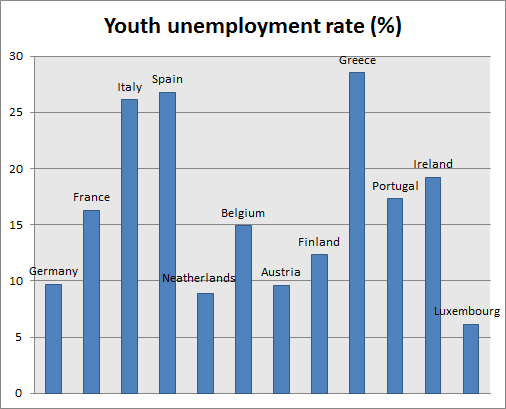
Latest statistics from Organization of Economic Development and Cooperation (OECD) show the high rates of inactivity among youth in the Euro zone.
- Since the 2008 great recession and 2011 Euro zone debt crisis the leaders have taken the path of austerity in some cases to level of draconian one.
- It could be argued that it was necessary for the return of confidence in Euro zone debt but it has cost the general public especially the youth too much.
- This year marks the seventh anniversary of 2008 crisis and it still refuses to be over. This could mark as a lost decade for the Euro zone's youth.
- Unemployment is at staggering high in most of the countries especially among youth. Greece leads with 28 percent whereas Luxemburg has the lowest at 6 percent. Even the second largest economy France has above 15 percent. The numbers exclude those doing studies or course or training.
- Until the situation over employment improves across Euro zone it is difficult to go long on Euro over longer term.
|
Youth unemployment (%) |
|
|
Germany |
9.7 |
|
France |
16.3 |
|
Italy |
26.1 |
|
Spain |
26.8 |
|
Netherlands |
8.9 |
|
Belgium |
14.9 |
|
Austria |
9.6 |
|
Finland |
12.3 |
|
Greece |
28.5 |
|
Portugal |
17.3 |
|
Ireland |
19.2 |
|
Luxembourg |
6.1 |


