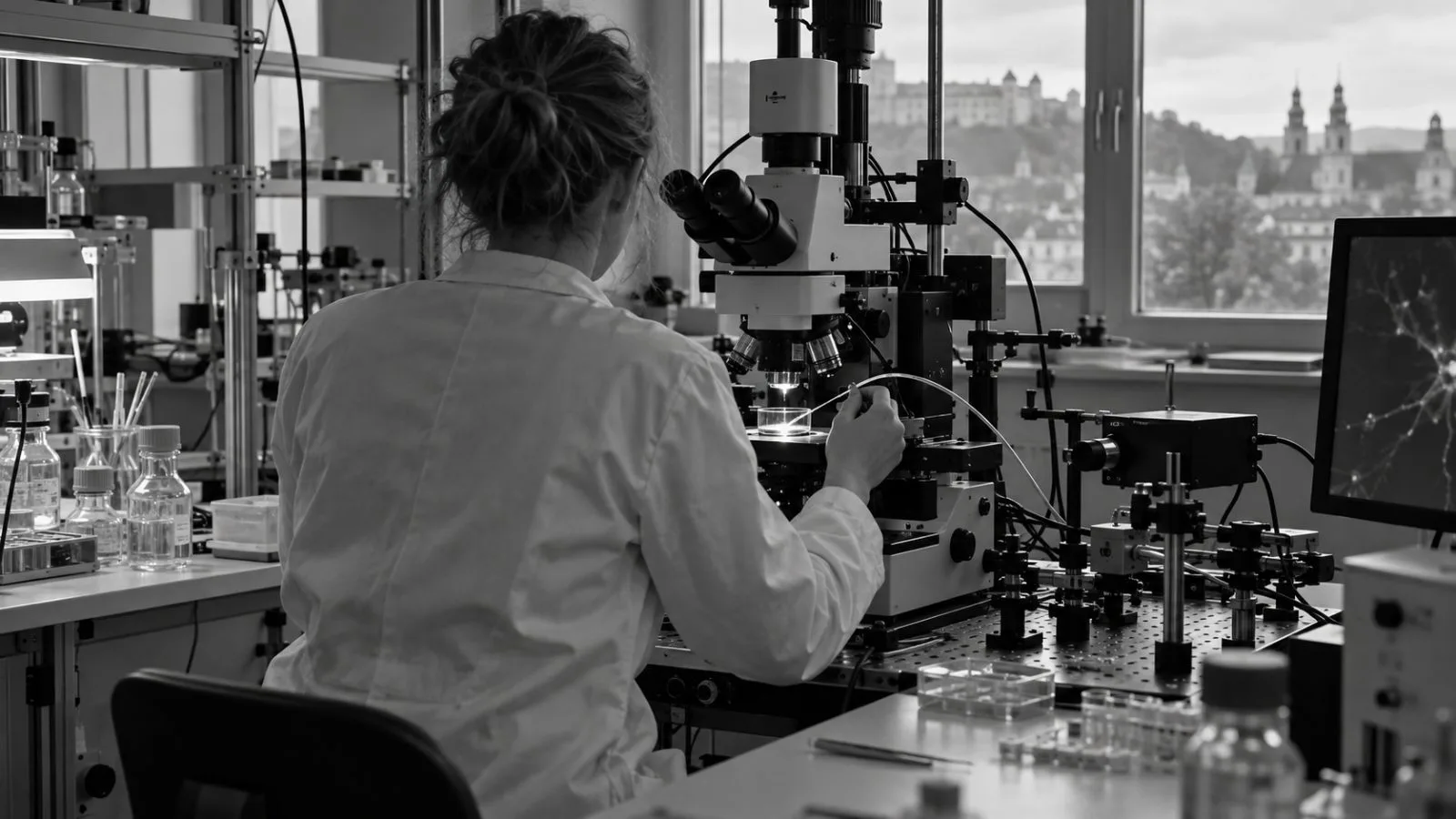
Three scientists whose work lets researchers change selected nerve cells with light won the 2026 Nobel Prize in Physiology or Medicine, recognizing a tool now used to test brain circuits and study retinal disease.
The Nobel Assembly awarded the prize to Karl Deisseroth, a professor at Stanford; Peter Hegemann, a neuroscience professor at Humboldt University of Berlin; and Georg Nagel, a professor at the University of Würzburg. The award recognized discoveries that made optogenetics possible.
Researchers introduce genes that enable selected cells to produce proteins responsive to light. Channelrhodopsin-2, identified in a 2003 study by Nagel and colleagues, comes from the green alga Chlamydomonas reinhardtii. When illuminated, it forms an ion channel that allows charged particles to cross a cell membrane. In 2005, Edward Boyden, Feng Zhang, Ernst Bamberg, Nagel and Deisseroth reported controlling mammalian neurons with timed light pulses on a millisecond scale. Changing a circuit’s activity gives researchers a way to examine its effects on behavior.
The method has also been used in animal experiments. In one 2021 mouse study, researchers optogenetically stimulated cells linking the lateral habenula and dorsal raphe nucleus while the animals underwent a subthreshold social-defeat stress protocol. The intervention induced stress susceptibility in the mice; the finding does not show that optogenetics treats human depression.
A clinical study published Oct. 7 enrolled 10 people who were blind from advanced retinitis pigmentosa. With light-stimulating goggles in use, seven participants showed increased light sensitivity, ranging from 2.0-fold to 62.3-fold; six met the study’s 0.6-log-unit benchmark. The authors said the cutoff was drawn from earlier research and had not been included in the protocol beforehand.
Nine participants experienced 34 eye-related adverse events: 23 mild, 10 moderate and one severe. The severe event was a retinal artery blockage after injection that cleared within minutes. The small, open-label study does not establish a routine treatment or long-term effectiveness, and its authors called for further research to evaluate safety and efficacy.