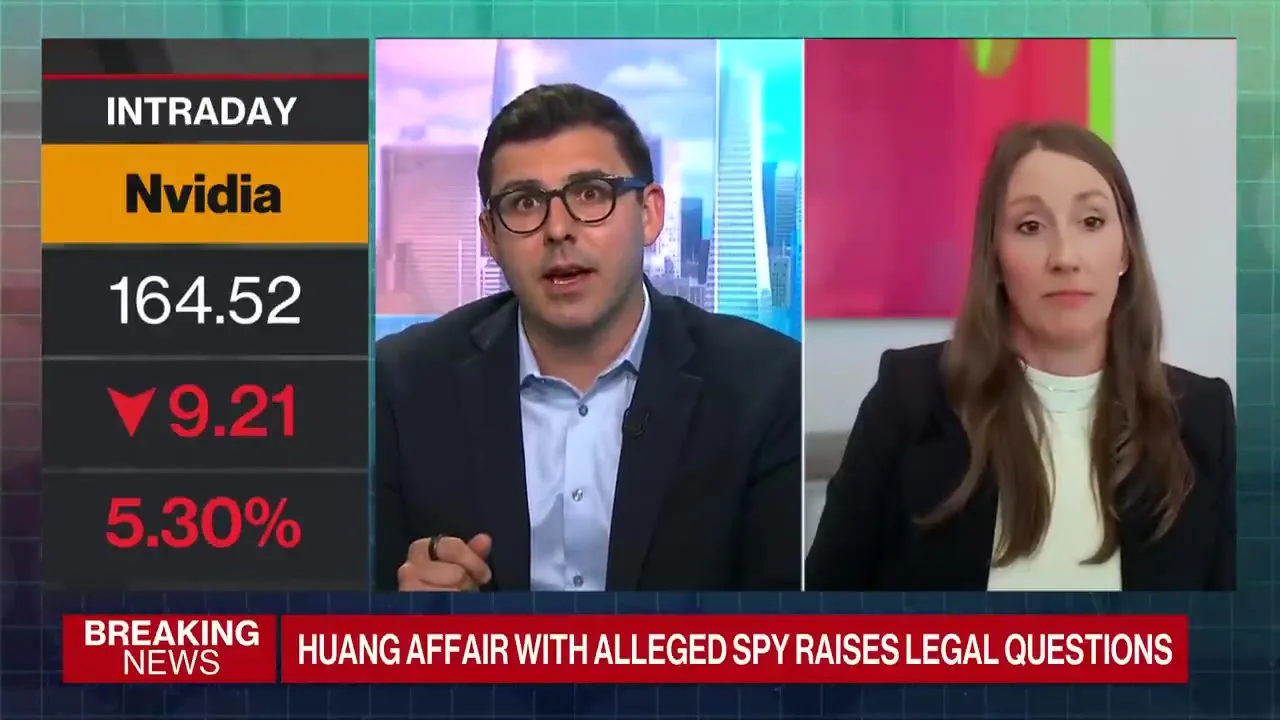
Nvidia and Jensen Huang could face criminal liability if evidence shows he helped facilitate export violations or prevent scrutiny, Christina Clark, a partner at Milliner and Chevalier, said.
The former federal prosecutor outlined possible exposure without reaching a conclusion about Huang's conduct. His communications and any evidence obtained through search warrants remain unresolved parts of that assessment.
Speaking on Bloomberg Technology in an interview published Nov. 12, Clark first separated counterintelligence inquiries from criminal investigations. She described them as parallel efforts that would address different questions about the relationship discussed in the interview.
The counterintelligence inquiry would examine whom the woman involved communicated with and when any relationship with the Chinese government began. That would include whether those ties began before or after her relationship with Huang.
Investigators would also examine communications between the pair and whether information Huang shared reached the Chinese government. Clark's assessment assumed that information had been passed on, without identifying evidence establishing that transfer during the interview.
Physical access to Huang's devices would also warrant scrutiny, even if obtaining that access had not been the original objective. “If I were the company, I would assume that information had been compromised,” Clark said.
On potential charges, political and economic interests could influence decisions about whether to prosecute. Her assessment also allowed for geopolitical considerations, public responses and evidence emerging through Congress or the investigation to affect the outcome.
Those considerations would not prevent a Justice Department investigation. The possible criminal conduct discussed concerned Mega Speed and a woman identified as Alice Huang, alongside questions about whether Jensen Huang played any role in export violations.
Action by Huang to keep Nvidia from examining Mega Speed more closely could potentially amount to aiding and abetting. A conspiracy case would require a higher threshold, and his communications could help determine whether either allegation had support.
Evidence that Huang prevented further scrutiny or helped transactions proceed could also create exposure for Nvidia because of his position at the company. The interview did not establish that he had taken either action.
Nvidia's board is conducting an internal investigation with outside lawyers, Bloomberg said. Clark explained that a company could present its findings to the Justice Department, which typically considers such work when assessing its response.
Criminal investigators can obtain material through search warrants and subpoenas that a company may be unable to access. That could include information from a phone, depending on whether investigators obtain a warrant to search it.
An internal inquiry could help Nvidia receive credit for cooperating if the company faces liability. But its findings would be one factor in the department's decision, leaving both the evidence and any eventual prosecution unresolved.