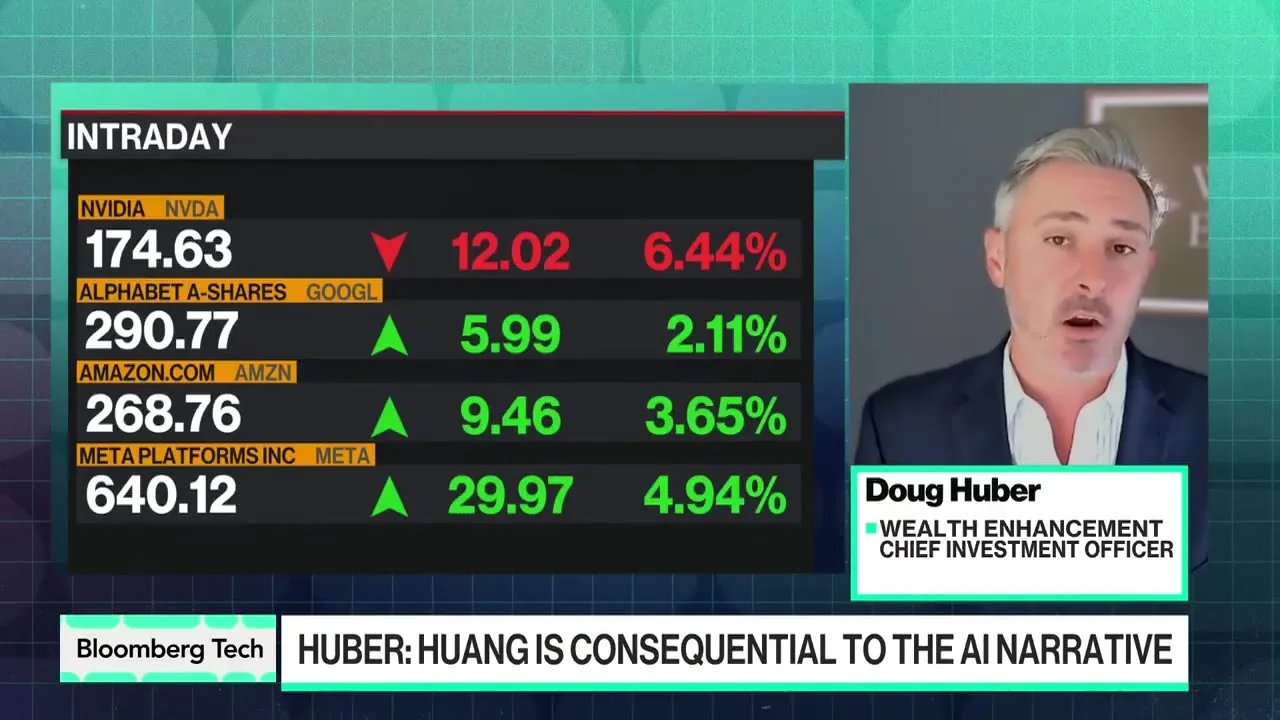
Nvidia’s leadership and governance now require greater weight in its valuation, although its business fundamentals had not changed over the weekend, Wealth Enhancement chief investment officer Doug Huber said.
The firm holds Nvidia shares, and Huber stopped short of saying the investment case had changed. But he said investors needed to consider how much the business depended on Jensen Huang.
Speaking on Bloomberg Technology, published Nov. 9, Huber described Huang’s importance as extending beyond his company to the broader development of artificial intelligence. Leadership and governance now demand “a much more explicit place in that valuation discussion,” he said.
Asked about Nvidia’s appeal as an investment without Huang, Huber said such a change would make investors reconsider their reasons for owning the company. Other businesses had changed leaders, although circumstances and the speed of those changes differed.
Nvidia had not publicly disclosed its succession plan, he said. That left investors facing a question about whether a business without Huang would still be the company they had assessed when making their investment.
The discussion then turned to whether strong earnings on Nov. 17 could push those concerns into the background. Huber said positive results would continue to support the business case for owning Nvidia.
That support would not settle questions about governance. Further evidence that problems extended more widely within the company, or involved other governance failures, could put pressure on the shares, he said.
Huber did not describe the underlying events discussed in the interview or identify any additional governance failures. His comments about broader problems and a possible leadership change were conditional.
Turning to AI investment more broadly, Huber distinguished between quarterly results, developments over the medium term and longer-term effects on productivity and employment. The questions investors followed continued to change as the technology developed.
He also linked the discussion to the previous week’s midterm elections, saying chips were no longer the only constraint on AI development. His firm was using the phrase “power and permission, not just processors.”
Investors would need to follow whether planned capacity actually became available and what it would cost to bring it into operation. Huber gave no capacity figures or cost estimates.
On portfolios, Huber said the firm encouraged long-term thinking and was spending considerable time considering diversification, or spreading investments to reduce dependence on any single exposure. The question extended beyond whether clients should buy or sell AI investments.
He said bonds had helped cushion the previous week’s selloff, while defensive and economically sensitive sectors had performed better during Thursday’s pullback. A portfolio split between 60% stocks and 40% bonds still offered diversification, he said.
Huber nevertheless expected heightened volatility because so much depended on the success of AI investments. The firm was considering other strategies, but he did not identify specific alternatives or announce portfolio changes.