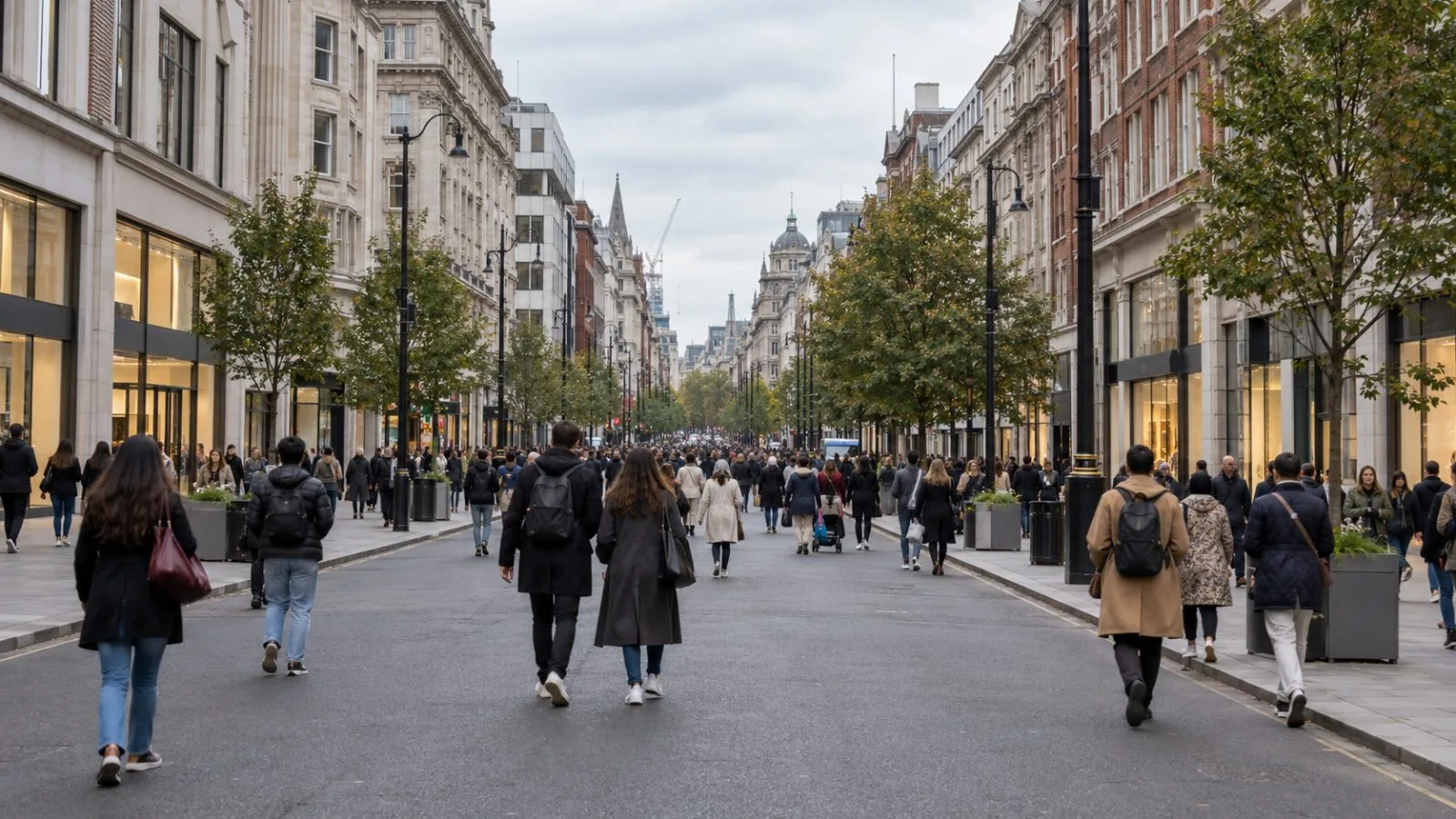
London's vehicle restrictions on Oxford Street took effect Monday, Oct. 26, sending buses onto surrounding roads and opening a central shopping stretch to pedestrians as officials expand public space.
The restricted area runs from Orchard Street to Great Portland Street and covers nearly a kilometer. Buses, taxis, private hire vehicles, private motor vehicles, bicycles, e-bikes, e-scooters and pedicabs are barred. Mobility scooters are allowed, and traffic can still cross at designated streets such as Regent Street, Duke Street and Great Portland Street.
Transport for London (TfL) has rerouted routes 98, 139 and 390, as well as night routes N98 and N207. Routes 7, 94, N7, N113 and N137 now terminate at Marble Arch. Other services have changed stops or shortened their routes.
The vehicle restriction applies at all hours. Delivery and servicing vehicles may enter via approved access routes from midnight to 7 a.m. London time (11 p.m. to 6 a.m. UTC during British Summer Time, or midnight to 7 a.m. UTC during Greenwich Mean Time); emergency vehicles may enter at any time. Nearby Underground and Elizabeth line stations remain open. Bond Street and Tottenham Court Road stations have step-free access, and taxi ranks are within 100 meters of the traffic-free area.
TfL's pre-launch model projected journey-time changes of a minute or less during peak periods for most local bus routes, with routes 98 and 390 facing the largest increases. The Mayor of London's decision document projects a two-to-five-minute increase for Route 98, depending on direction and peak period. These are forecasts; official sources have not yet published post-launch measurements. TfL also projected some additional traffic on surrounding streets.
Mayor of London Sadiq Khan has said the project aims to improve public space and support Oxford Street's retail and leisure role. TfL's assessment identifies lower pedestrian road-danger risk as a potential benefit. Consultees raised concerns that changes to bus and taxi access could affect the mobility and independence of disabled and older people who rely on those services.
The London Assembly says the first phase will cost £150 million, financed through borrowing. It also notes that a previous pedestrianisation proposal appeared in the mayor's 2016 manifesto and was consulted on in 2017, but did not proceed after Westminster City Council withdrew its support. The Oxford Street Development Corporation plans to use feedback from residents, accessibility groups, businesses and workers to shape a transitional scheme due by the end of spring 2027. TfL says it will monitor local traffic and work with Westminster City Council on cycling infrastructure.