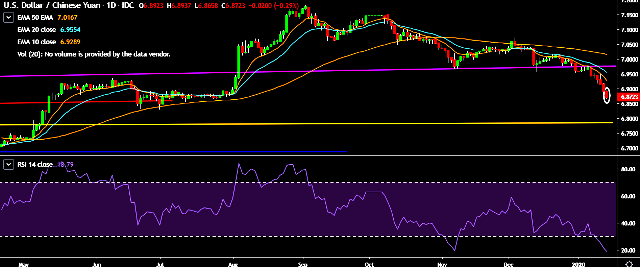
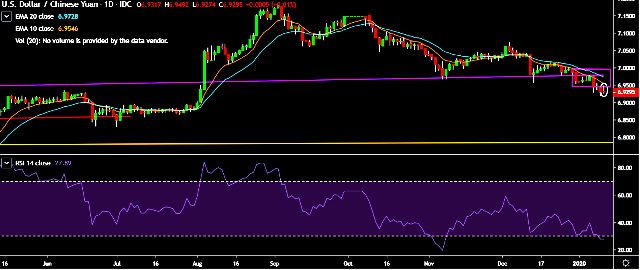
In the past two weeks, the CNY has lost nearly 1.5 percent against the USD, while the offshore CNH has weakened slightly less by 1 percent. In the two weeks since the 10 October, the dollar index has gained 1.8 percent and this has caused the PBoC to set a higher USD/CNY fixing rate so as to guide the spot USD/CNY and USD/CNH higher.
Deputy Governor of the People's Bank of China, Yi Gang, sought to calm markets through an article published in People’s Daily (government mouthpiece) on Tuesday. Yi said that there is no basis for continuous depreciation of China’s yuan, and the exchange rate will remain broadly stable.
“The Chinese currency has stayed stable against a basket of currencies. The yuan was less volatile than major reserve currencies, and its volatility was well below other emerging market currencies,” said Yi.
The yuan was trading at 6.7834 per dollar by lunchtime in the offshore market in Hong Kong on Tuesday, after touching a low of 6.7880 overnight, the weakest intraday level since the trading started back in 2010. Onshore yuan closed at 6.7767 on Tuesday in Shanghai, also the lowest level in six years.
Ma Jun, the PBOC’s chief economist, also said on Tuesday that the depreciation of the yuan since the beginning of October was primarily attributable to the rise in the US dollar index.