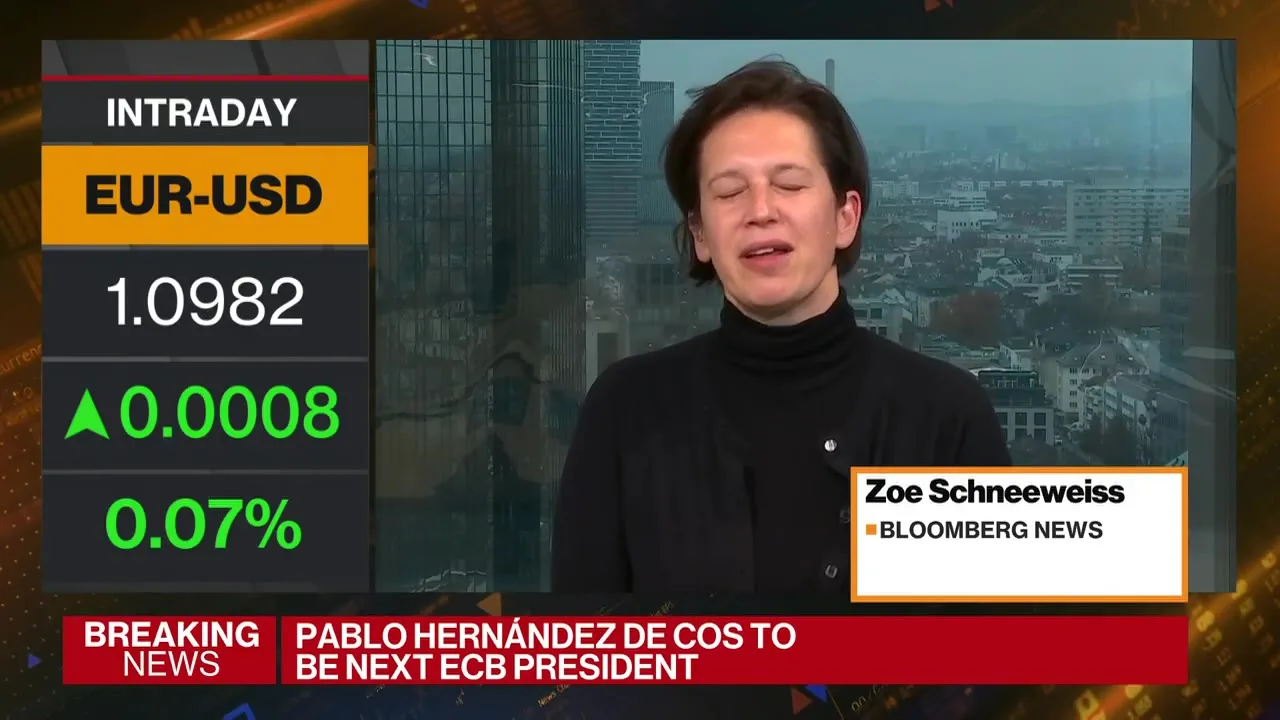
Pablo Hernandez de Cos is set to succeed Christine Lagarde as president of the European Central Bank after European Union leaders reached a consensus, Bloomberg Television said Nov. 26.
Formal steps, including a written procedure, still had to be completed, but officials said the agreement was certain. The discussions had taken place behind closed doors, with officials in Brussels working to establish the details of the deal.
Dutch officials had resisted conceding their candidate, Klaas Knot, and sought other concessions before accepting the consensus. They had been unwilling to concede at first and were described as annoyed, but ultimately agreed to go along with the consensus opinion.
France and Germany had effectively settled the appointments among themselves. Germany was to receive the ECB's chief economist post, while France was to take the role overseeing market operations. There were three senior positions being decided, including the presidency, the chief economist role and the markets chief role.
That arrangement cleared the way for de Cos to become president rather than Knot. Once Germany and France agreed on the distribution of the chief economist and market operations roles, de Cos was set to take the presidency.
De Cos was serving as head of the Bank for International Settlements after previously becoming governor of Spain's central bank. Earlier in his career, he advised Spain's representative on the ECB's executive board, giving him experience inside the institution. He therefore had experience both as a central bank governor and as someone who had worked within the ECB.
Bloomberg's economics editor said de Cos was regarded as a thorough and very good economist with fluent English and a strong understanding of the ECB and its governing council. The appointment would make him the first ECB career official to reach the presidency. His previous work inside the institution was seen as giving him an understanding of how the governing council operates.
Marcus Bonmaya, described as a U.S. academic and Princeton professor, was set to become chief economist. Laurence Boone, a former chief economist at the OECD and former Europe minister in the French government, was expected to oversee market operations. Boone was a familiar figure to the ECB, while Bonmaya was described as a sound economist.
The changes would reduce the number of women on the ECB's executive board from two to one. None of the central bank chiefs in the 21 countries using the euro is a woman, leaving the remaining female board member as the only woman in that group.
Boone's first five months in the market operations role were expected to coincide with the run-up to French elections. The ECB could be called on to act if French government bond yields widened to what was described as an intolerable level, although markets were still placing responsibility on Paris. The issue was expected to be one of the major challenges facing the ECB during the early part of Boone's tenure.