China's stock market and related policy developments will be more closely monitored by markets, given that the sharp fall in Chinese equities has started to send shock waves through broader markets.
However, the economic impact of China's leverage-driven equity boom-bust should not be overstated, according to Barclays Research, although downside risks to growth could rise via its impact on financial sector activity if the sell-off persists. Although Chinese authorities would likely prefer to maintain CNY stability and possibly delay any band-widening intentions to avoid exacerbating negative sentiment and capital outflows, commodity currencies will be most vulnerable should the Chinese equities rout extend, given the recent impact of Chinese stock volatility on commodity prices.
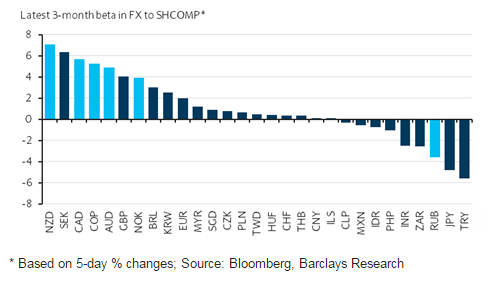
Commodity currencies such as NZD, CAD, COP and AUD have had a high beta to movements in the Shanghai Composite Index.
Meanwhile, the JPY has benefited as a safe haven currency amid the rise in risk aversion last week, with the beta to Chinese equity performance firmly negative.