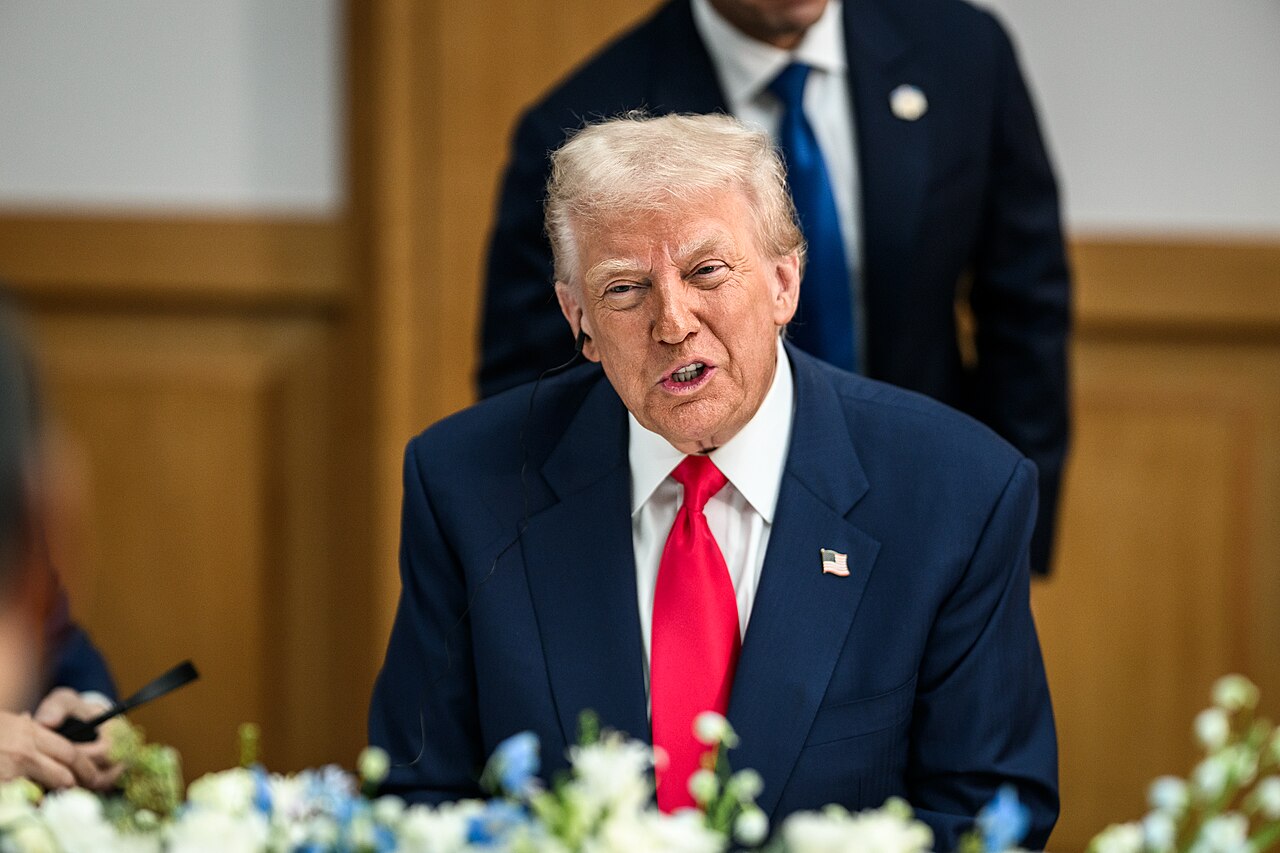
The negotiations to end the US-Iran war, resulting in the signing of a memorandum of understanding on June 17, have been something of an acid test of Donald Trump’s approach to diplomacy. What does it tell us? And has this US president changed the way diplomacy is done?
When Trump was inaugurated for his second presidency in January 2025, he announced his intention to be both a peacemaker and to pursue an “America first” foreign policy, focused on avoiding wars and bringing direct benefits to the US. By November 2025, he declared he had already settled eight “raging conflicts” across the world.
In January this year, the forced removal of Nicolas Maduro as president of Venezuela and installation of Delcy Rodríguez as a more US-friendly successor led Trump’s deputy chief of staff, Stephen Miller, to tell CNN: “You can talk all you want about international niceties and everything else. But we live in a world, the real world … that is governed by strength, that is governed by force, that is governed by power.”
But the Iran war has shown Trumpian diplomacy colliding with a real world that does not always bend to his will or succumb to US displays of force. The real world, it seems, is more complex than he thought.
Hitherto, five elements have characterised Trump’s approach to diplomacy. First, he prefers to eschew the traditional institutions and mechanisms of diplomacy. The State Department languishes, the UN is ignored. Traditional alliances, multilateral organisations and international gatherings have been disdained, unless they provide a platform for Trump to demonstrate his power and “call the shots”.
Rather than use US ambassadors or diplomats to tackle international issues, Trump relies on a small cast of trusted personal envoys – including his son-in-law Jared Kushner, real-estate developer Steve Witkoff and Massad Boulos, a Lebanese-American businessman who is father-in-law to his daughter Tiffany – to negotiate on his behalf. Even the secretary of state and national security advisor, Marco Rubio, is given a limited role, mainly in the western hemisphere.
Second, Trump’s approach to diplomacy, as to government as a whole, is distinctly personal. He likes to deal with other leaders directly, man-to-man, provided they are leaders he respects.
This tends to comprise a small group that includes Chinese president Xi Jinping, Russian president Vladimir Putin, Israeli prime minister Benjamin Netanyahu and (sometimes) Saudi Arabia’s ruler Mohammed bin Salman. Trump will see others but, as the Ukrainian president Volodymir Zelensky and South Africa’s Cyril Ramaphosa found, he likes to publicly demonstrate his superiority to them.
Third – as Miller reflected – Trump sees power as deriving from military might and economic strength. He is willing to use both freely in bilateral relations to get what he sees as a good deal for America. Appeals to principle, to the international rule of law, to human rights or to the value of democracy have all gone out of the window.
He has also demonstrated his willingness to strike first – by unilaterally imposing the so-called Liberation day tariffs, or by sending marines to Caracas – and talk later. Other leaders recognise that having friends can be a source of power – but this, it seems, is not an approach that appeals to the US president. Having friends requires building trust and accepting a reciprocal – not just transactional – relationship.
Fourth, public messaging is crucial. How do his actions look on the media, to his Maga faithful, to the markets and to the world? Trump’s use of his TruthSocial platform to negotiate in public – with friend and foe alike – is the antithesis of traditional diplomacy, where secret channels, confidential negotiations and trusted interlocutors play a central role.
His ability to “flood the zone”, by overwhelming the media and any critics while spinning his own message, has given him a big advantage in this social media-driven world. But as the Iran negotiations have shown, it has drawbacks when the hyperbole and spin are shown to be hollow.
Finally, Trump’s focus is relentlessly short term. “Strategic patience” – using restraint and timing to achieve his ends – does not appear in his lexicon. Results must be immediate, and the declaration of victory or peace or a deal is what matters – not the actual delivery of those outcomes.
The “deal” to end the conflict in Gaza, struck in October 2025, remains stuck in limbo as Trump’s interest has wandered. The Ukraine war that was to be settled in 24 hours grinds on relentlessly.
Trump’s weaknesses exposed
The war in Iran, in particular, has challenged Trump’s model of diplomacy and exposed its weaknesses. The Iranians refused to “cry uncle”, as he put it, when their leadership was wiped out, their nuclear facilities were pounded by bunker-buster bombs, and their economy was brought to its knees by sanctions.
Instead, they challenged the US to put boots on the ground, closed the Strait of Hormuz to hurt the US economy, and struck its erstwhile allies in the Gulf. They refused to talk to Trump’s envoys – who they distrusted after twice feeling betrayed when the US attacked them mid-negotiation – and they exposed the deception of his constant statements and social media posts claiming agreement had been reached, or victory was at hand.
As a result, Trump has had to rely on third-party intermediaries Pakistan and Qatar to negotiate with the Iranian regime. The UN remains firmly on the shelf, as Trump is resolutely opposed to the political constraints that operating through international organisations might impose on American freedom of manoeuvre. But even so, he has found himself in need of neutral third parties to do the deal that he could not.
Will Trump change? Yes and no. He has no ideological constraints, only pride and faith in his own abilities. So he could change course at any moment. But his antipathy to multilateralism and traditional diplomacy are unlikely to disappear.
The world at large is already adjusting to these new ways of doing diplomatic business. Some are seeking out “Trump whisperers” such as Nato’s chief Mark Rutte, or Maga-friendly lobbyists that, for example, Nigeria and the Democratic Republic of Congo have employed to secure US support for their respective struggles against Boko Haram and Rwanda.
Others are picking envoys to liaise with the likes of Witkoff and Kushner. The UK’s pick for this role is national security advisor Jonathan Powell, whose contacts with Witkoff played a significant part in calming US relations with Ukraine. As bilateral diplomacy replaces multilateral, the air miles of such envoys multiplies exponentially, while small countries are cut out of the action.
And yet, Trump’s last two summits with Putin and Xi yielded little – and he found himself spending more time at the latest G7 summit in France than at previous ones. Perhaps, the US president has found he needs some friends after all.
 Nicholas Westcott does not work for, consult, own shares in or receive funding from any company or organisation that would benefit from this article, and has disclosed no relevant affiliations beyond their academic appointment.