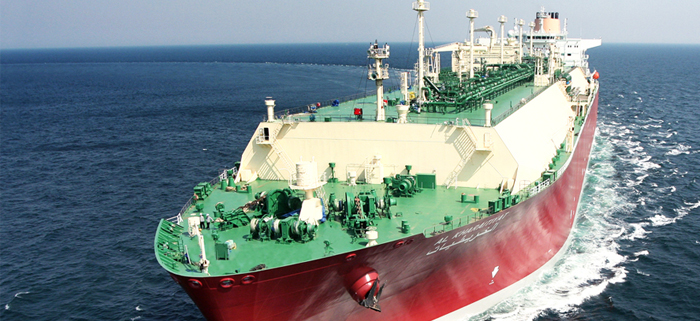
South Korea's shipbuilders led by Hyundai Heavy Industries Co. are scampering to develop eco-friendly power systems for ships to comply with stricter emission regulations.
The International Maritime Organization (IMO) has required carriers to operate vessels designed to cut emissions by over 30 percent by 2025 compared with 2008.
The requirement for emission levels reduction may reach 40 percent in 2030 and by 70 percent in 2050.
Beginning this year, the IMO lowered the maximum sulfur content on fuel from 3.5 percent to 0.5 percent.
Consequently, HHI and its holding company Korea Shipbuilding & Offshore Engineering Co. set up a center in March to develop ships powered by both fuel cells and liquefied natural gas (LNG) engines by late 2021.
In March 2019, Hyundai Heavy got the green light for the design of a crude carrier with the LNG-fuel cell-propelled engine system from DNV-GL, Norwegian-German quality assurance, and risk management firm.
The approval by DNV-GL enables Hyundai Heavy to receive an order for the ship with the system from buyers.
Hyundai Heavy also signed a deal with local fuel cell maker Mico Ltd. to develop a fuel cell system for ships in November 2019.
Hyundai Heavy's rival Samsung Heavy Industries Co. and Daewoo Shipbuilding & Marine Engineering Co. are also pushing for eco-friendly ships.
Samsung Heavy has signed a deal with U.S. fuel cell maker Bloom Energy to secure core technologies of solid oxide fuel cells (SOFCs) for LNG carriers and shuttle tankers by 2022.
DNV-GL also approved the company's design for fuel cell-propelled crude carriers in September 2019.
Meanwhile, Daewoo Shipbuilding has started developing lithium-ion energy storage systems for ships.