The average S&P 500 stock suffered a maximum decline of 27% this year despite gains in the benchmark, market commentator Liz Ann Sonders said on Schwab Network.
The index gained 11% this year and suffered a maximum decline of 9%, Sonders said in the November Market Snapshot published Nov. 5. The Nasdaq’s maximum decline reached 13%, against 49% for its average member.
“Index level returns tell very little about the experience of the typical stock,” she said. Indexes weighted by companies’ market values received support from whichever sector led at the time.
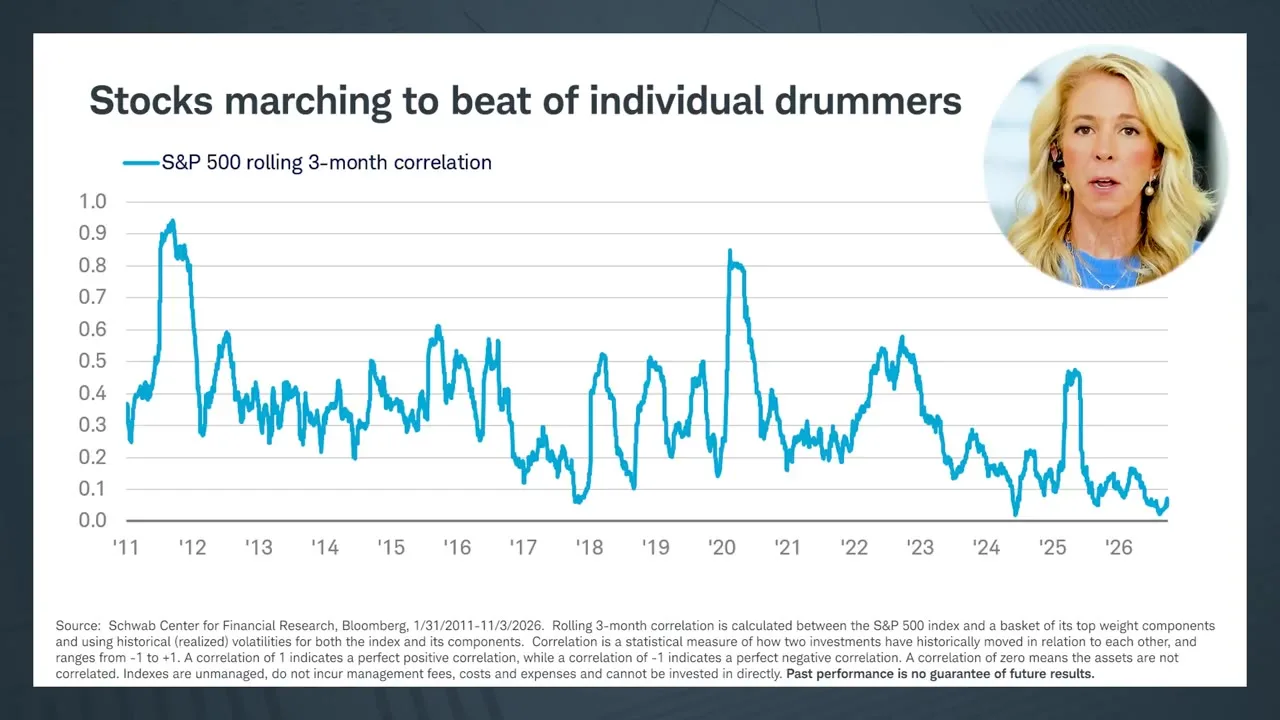
The rolling three-month correlation among S&P 500 members, a measure of how closely stocks move together, fell almost to zero. That put it near the bottom of its range since 2011.
Correlations jumped during the 2011 debt-ceiling and euro zone crises, the 2020 pandemic crash, the 2022 inflation surge and the spring 2025 tariff shock. Each jump gave way to declines, with the trend downward since 2023.
A record share of members moved in the opposite direction to the index over six months. More than 70% recently outperformed it over one month, up from 17% weeks earlier and near the highest readings since 2022.
That share fell to about 15% in spring, reached about 67% in summer and dropped below 20% in early autumn before rebounding.
Energy and technology, the two best-performing sectors on Oct. 28, had a negative correlation, the first in Ned Davis Research data stretching back to at least 1973. Healthcare subsequently overtook technology for second place.
Estimated third-quarter S&P 500 earnings growth reached 32% from a year earlier, compared with less than 28% at July’s start, Sonders said. Estimates rose instead of following the usual pattern of cuts as a quarter progresses.
Energy, industrials and financials received the largest upgrades. Communication services, materials and healthcare received the largest cuts.
Technology’s estimated growth rose more than 10 percentage points even though its shares fell nearly 7% in October. Communication services also suffered an October price decline.
Estimated earnings growth for the full year reached 36%, up from less than 27% on July 1, a revision of nearly 10 percentage points in four months. Estimates rose or held steady in 10 of 11 sectors.
Energy led expected annual growth, followed by communication services and consumer discretionary. Healthcare alone received a cut.
Communication services’ annual growth estimate rose 23 percentage points, while its third-quarter estimate fell 33 percentage points. The sector lost more than 7% over the past year.
Healthcare had the weakest expected annual earnings growth among the 11 sectors but ranked second for share-price performance over the past year.
Among Russell 2000 small-company stocks, profitable businesses gained more than 20% this year, while unprofitable companies gained about 3%. Last year, unprofitable companies outperformed profitable ones by nearly two to one.
The average Russell 2000 member suffered a maximum decline of 39% this year. Losses concentrated among less profitable, more speculative companies.
The remarks gave no numerical forecast for index returns or timetable for sector leadership to settle. Earnings estimates had improved since midyear, but the increases varied across sectors.