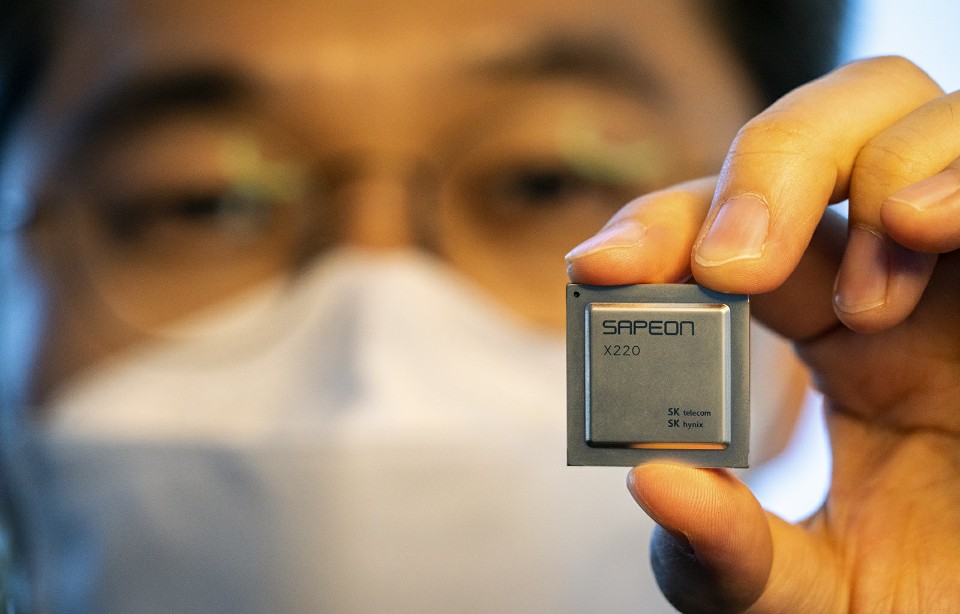
SK Telecom is now seeking to expand its AI semiconductor business by spinning off its business unit into a new entity named Sapeon Korea in January 2022.
Sapeon Korea will coordinate with SK Hynix in memory-related technologies and outsource semiconductor production to TSMC.
SK Telecom established Sapeon Korea to better serve the fast-growing AI semiconductor market.
Market research firm Gartner forecasts the global AI semiconductor market to multiply 3.6 times in five years from about 14 trillion won in 2020 to about 50 trillion won in 2024.
SK Telecom is competing in the AI semiconductors business with global fabless giants such as Nvidia and AMD.
The company entered the AI semiconductor market by unveiling its AI semiconductor, Sapeon X220, in November 2020.
According to SK Telecom, Sapeon X220 is 1.5 times faster than other GPUs in deep learning computation speed.
Although SK Hynix has grown into a world-class memory semiconductor company, SK Group is trying to expand its business areas to system semiconductors to diversify sales.