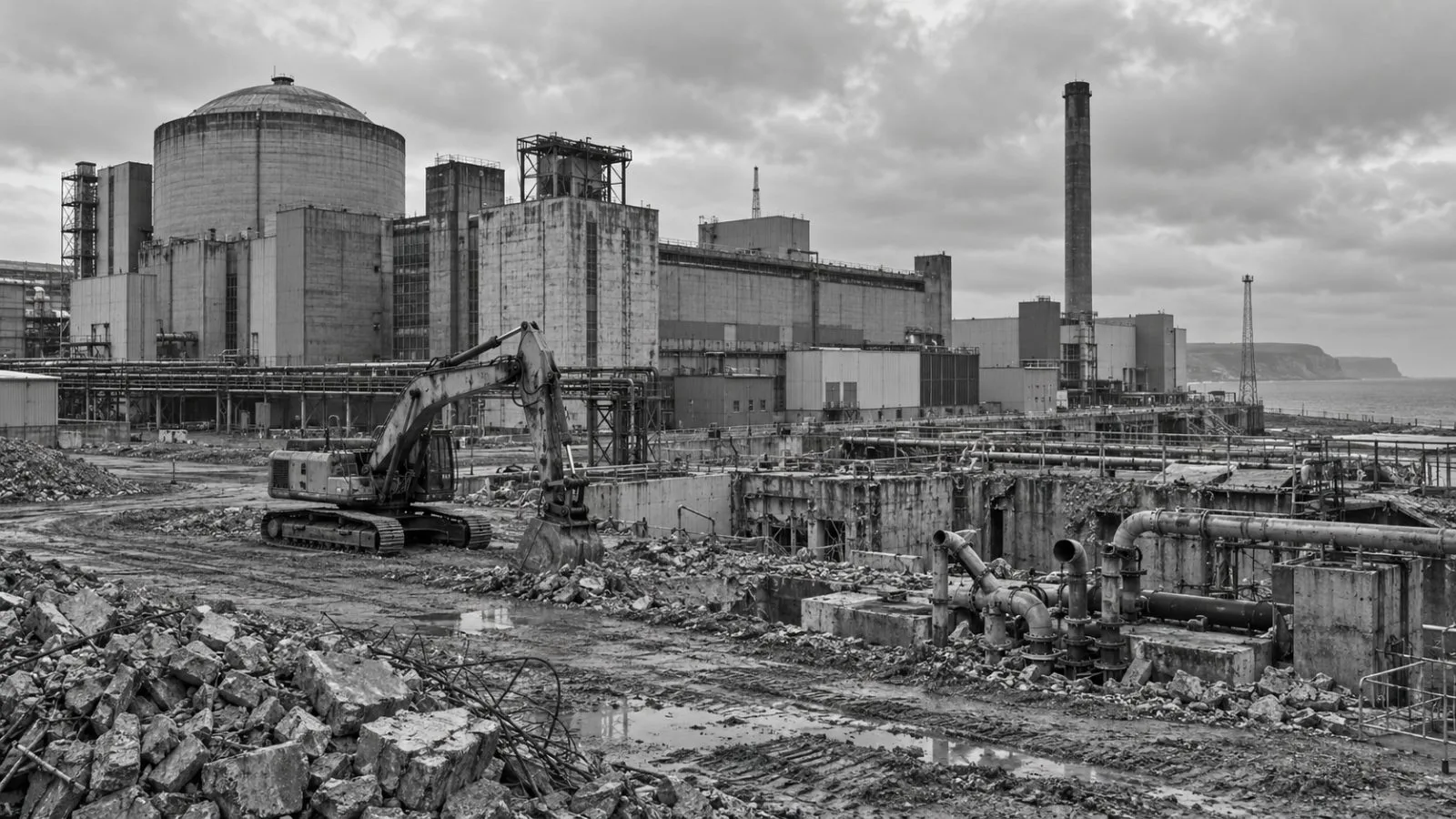
Sellafield Ltd’s decommissioning work at Calder Hall is clearing space for the site’s next radioactive-water treatment facility, with a company plan setting a mid-2027 target for one redevelopment area.
Sellafield Ltd’s September 2025 environmental management plan forecasts full demolition and ground remediation in the Turbine Hall A area by mid-2027. Sellafield prepared the plan, which is hosted on the Office for Nuclear Regulation (ONR) website. It identifies the area and associated buildings for redevelopment linked to SIXEP. The forecast applies to that designated area, not the entire Calder Hall decommissioning project. Sellafield says limited land at the site makes removing redundant buildings important for creating room for future facilities.
Crews have taken down the cooling towers and removed thousands of tonnes of asbestos from Calder Hall and nearby buildings, according to Sellafield. Work also includes dismantling redundant plant, pipework and structures. The station’s four Magnox reactors stopped generating electricity in March 2003.
Sellafield and the Nuclear Decommissioning Authority (NDA) announced the completion of fuel removal on Sept. 3, 2019. Their announcement said teams removed 38,953 spent fuel rods from the four reactors; a later Sellafield case study gives a rounded total of 40,000.
Queen Elizabeth II officially opened Calder Hall on Oct. 17, 1956. Sellafield says the station’s design influenced other Magnox plants in Britain and abroad, and that its decommissioning work is providing experience for later projects. The International Atomic Energy Agency (IAEA) uses different descriptions of Calder Hall’s place in nuclear history: one IAEA history says a 5-megawatt reactor at Obninsk entered commercial operation in 1954, while another IAEA publication calls Calder Hall the world’s first commercial electricity-generating plant.
The existing Site Ion Exchange Effluent Plant (SIXEP), operating since 1985, treats water from Sellafield’s operations by removing radioactive material. The SIXEP Continuity Plant is planned to extend that treatment system. Sellafield’s schedule lists active commissioning in 2029 and full operations in 2030.