
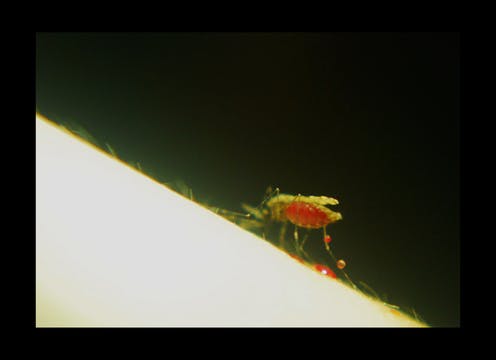
South Africa is one of four southern African countries aiming to eliminate malaria transmission by 2023. Indoor residual spraying using DDT and pyrethroid insecticides constitutes the backbone of South Africa’s malaria control programmes.
Effective vector control by indoor residual spraying has been key in the reduction of malaria cases. This was instrumental in creating malaria-free zones in most parts of the country. Malaria transmission is now limited to the north-eastern parts of Limpopo province, the low-veld areas of Mpumalanga province and the far northern parts of KwaZulu-Natal province.
Despite a concerted effort to eliminate malaria in these provinces, transmission has remained steady over the past decade.
Failure to eliminate malaria transmission is attributed, in part, to resistance to the insecticides being used. Added to this is the challenge of controlling the outdoor-biting Anopheles arabiensis population that’s largely considered responsible for most malaria transmission in the country.
Indoor spraying isn’t completely effective against this mosquito because it mainly targets indoor biting and resting mosquitoes. This strategy is not adequate against vectors that sometimes feed and rest outdoors, such as An. arabiensis.
Other, complementary vector control strategies are needed to eliminate the disease. These must be able to control outdoor feeding and resting mosquito populations.
One possible approach is a technique that involves sterilising the insects. The technology is currently being assessed in South Africa. The technique involves a genetic birth control method in which laboratory mass-produced sterile male insects are released into the wild at a ratio that effectively inundates a target population. This forces most females to mate with sterile males, substantially reducing their fecundity, and resulting in population suppression.
The sterile insect technique has been piloted against mosquito vectors of the Zika, yellow fever, chikungunya and dengue viruses, but has never been used for malaria control efforts. The South African sterile insect technique initiative together with a similar trial in Sudan are a first for African malaria vectors.
Preparations for the South African project are at an advanced stage. A pilot mass-rearing facility has been built and the size of the natural mosquito population has been estimated. In addition, a local community has been drawn into preparations and is now ready for a trial run. All these steps pave the way for a pilot demonstration.
The project
The sterile insect technique has been applied successfully against other insect pests including the fruit fly and the new-world screwworm fly . In South Africa this technology is routinely used in Citrusdal, Western Cape to control the false codling moth.
The project involving An. arabiensis aims to show that the sterile insect technique can be successfully used to suppress mosquito populations that carry and spread malaria. If it works, the approach can be used as an alternative vector control method to complement existing strategies.
The project is being implemented in three phases.
Phase 1 included trials showed that sterilised An. arabiensis males mass-reared under laboratory conditions can compete with fertile males for mates. This milestone informed phase II of the project which is currently underway.
This phase aims to test the feasibility of the sterile insect technique through a small-scale pilot field demonstration in northern KwaZulu-Natal. Research activities for phase II are in progress. The biggest development here is the building of Africa’s first pilot mosquito mass-rearing facility.
The sterile insect technique relies heavily on inundating the wild population with sterilised male insects. For this to succeed, it’s important to know the size of the wild mosquito population as this will determine how many laboratory-reared sterilised males would need to be released.
To estimate mosquito population numbers, a mark-release-recapture method was used. About 30,000 yellow and orange-dusted laboratory-reared males sharing the same genetic background as the wild population were released over two release periods. Some of these mosquitoes were recaptured together with wild mosquitoes and a formula was used to estimate the wild population size.
Interestingly, marked males were recaptured in swarms of wild males. This indicates that the laboratory-reared males were able to locate and participate in mating swarms – a crucial step for the potential success of the sterile insect technique.
Next steps
The eventual rollout of the pilot trial will require successful mass rearing of competitive sterile males and a technique to separate males from female insects. Work on optimising mass production of quality sterile male and a system to separate males from females are at an advanced stage.
In addition, it’s critical to get the community involved and addressing any social issues so that people cooperate and participate. This is particularly important because the sterile insect technique can be seen as increasing the numbers of mosquitoes in an area after the release of the sterile males. A malaria awareness campaign has already been conducted. Information on malaria transmission and control – including the potential of using the sterile insect technique – was shared through radio interviews, brochures, road shows and lectures in isiZulu.


