


 Cardano Hits Record 436 TPS as Network Scaling Advances
  XRP Whale Activity Drops 27% in Eight Days Amid Market Sell-Off
  Solana Targets 200ms Block Time in Major Network Upgrade
  DogecoinVM Makes DOGE Transactions 300x Faster
  Ethereum Price Drops Below $2,600 as Long Liquidations Hit 4-Month High
  Kazakhstan and Tether Explore Tenge Stablecoin and RWA Tokenization
  Zcash Privacy Demand Rises as AI Exposes Bitcoin Transactions
  Jameson Lopp Downplays AI Threat to Bitcoin Cryptography
  XRP Ledger Activates New Security Feature for Banks and Stablecoins
  Bitmine to Stop Ethereum Buying After Reaching 5% ETH Supply
  Bitcoin Price Falls Below $83K as Liquidations Hit $697M


 Add as a preferred source on Google
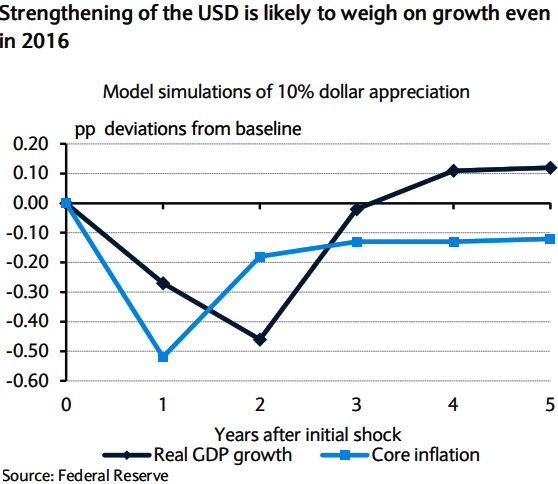
We reckon the strengthening of the USD is likely to weigh on the Fed's forecasts the most. While the fall in energy prices may be expected to provide a boost, the sell-off in the equity markets should offset that. Vice Chair Fischer squabbled that a 10% appreciation would put forth a 0.3% drag in the first year but almost 0.5% in the second year as shown in the diagram.
This suggests that the drag from the trade channel can persist through 2016 and that there is room for those growth forecasts to fall. Similarly, on the inflation front, YoY core PCE has drifted further away from the target, the USD has strengthened and energy prices have fallen since the June meeting. At the June meeting, the Fed forecast real GDP growth of 1.9% in 2015, rising to 2.55% in 2016 and YoY core PCE inflation to rise significantly to 1.75% by YE-16 from 1.35% at YE-15. With growth in the first half now looking better (at 2.15%), the Fed is likely to increase its 2015 forecast. However, at the same time, the tightening in financial conditions since the June meeting should weigh on 2016 forecasts.
What if Fed raises rate and what would be the impact:
Raising rates at the next meeting, even as it is just 25 bps would signal a hawkish shift in the reaction function. The Fed would be conveying that despite the tightening in financial conditions and the decline in realized core inflation, it has now become reasonably confident that inflation will move back to its 2% objective over the medium term. This would imply that policy is being driven primarily by the unemployment rate, a notion the Fed has tried to dismiss in the past.
We believe that financial conditions would tighten further in that scenario and it would be difficult to justify making policy less accommodative on the basis what the Fed has conveyed so far, even if marginally.

- News

- Economy

- Central Banks
- Investing
- Research
- Roundups
- Digital Currency
- Insights
- Technical Analysis
- Technology
- Business
- Law
- Health
- Nature
- Fintech
- Science
- Topic
- Opinions
- ©Econometrics LLC . All Rights Reserved.
Strengthening dollar to prop up growth forecasts
Friday, September 11, 2015 11:21 AM UTC
Editor's Picks



- Market Data
Most Popular




