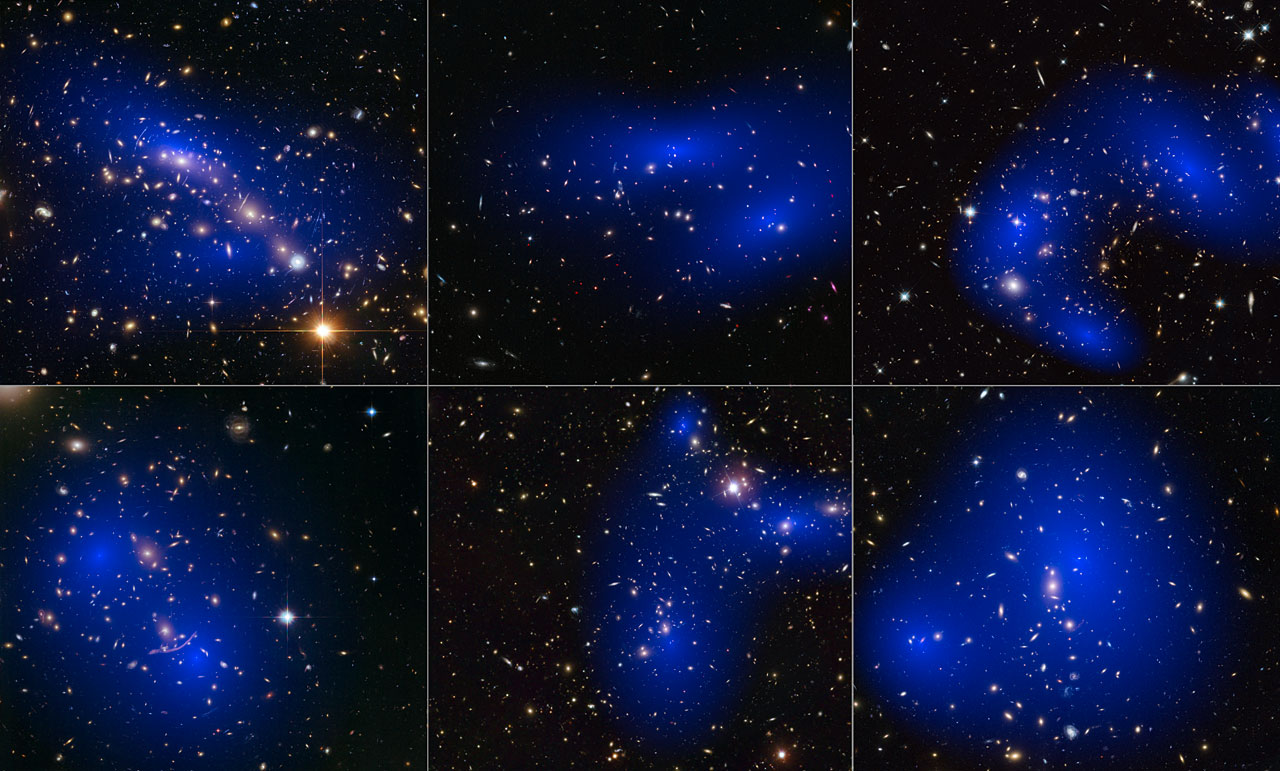
Scientists from Germany and Hungary have just come closer to proving the existence of dark matter thanks to the use of a supercomputer. The machine crunched some numbers and came up with a prediction regarding the mass of axions, which are basically considered tell-tale signs of dark matter.
The findings were published in Nature, detailing how the supercomputer basically created a model that will allow scientists to know what the mass of axioms is. This will then allow them to compare the data with other strange readings that are generally attributed to dark matter, thus putting them one step closer to understanding the elusive scientific concept.
In a press release, study co-author Andreas Ringwald said that the existence of dark matter is only ever hinted at via its effects on gravity. Ringwald is a professor at the German Electron Synchrotron in Hamburg.
“Dark matter is an invisible form of matter which until now has only revealed itself through its gravitational effects. What it consists of remains a complete mystery,” Ringwald said. “The adjective ‘dark’ does not simply mean that it does not emit visible light. It does not appear to give off any other wavelengths either – its interaction with photons must be very weak indeed.”
Naturally, this has made detecting dark matter incredibly difficult. However, detecting axioms is even more so, Inverse reports. This is where the predictive data from the supercomputer comes in.
By taking the mass of axioms and lumping them together with strange signals that scientists come across, dark matter suddenly becomes a lot less mysterious. This would be helpful as well since scientists are saying that dark matter makes up about 85 percent of the universe. That’s a huge chunk of space that can’t be detected.
As for axioms themselves, their existence is predicted via quantum chromodynamics (QCD) extension, Phys.org notes. QCD is key in quantum theory because it’s what holds the strong interaction effect that impacts nuclear force.