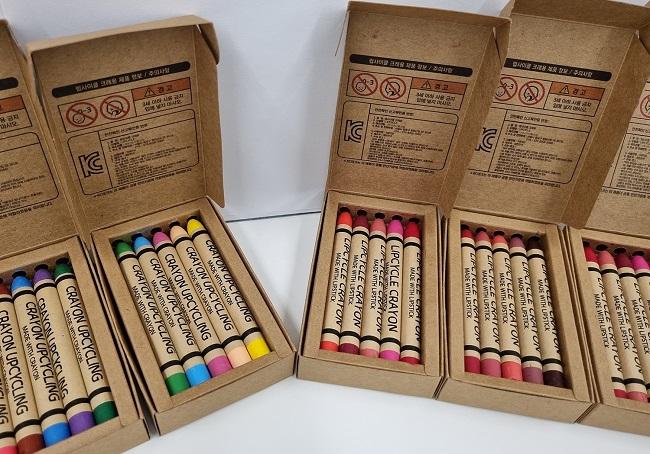
South Korean fashion retailer Shinsegae International Inc. has donated crayons made from recycled lipstick to Seoul-based charity Child Fund Korea.
Old lipsticks totaling 16,940 were used to make the crayons. One crayon can be made from two lipstick tubes.
Seventy-one childcare institutions have received 2,700 sets of crayons, including 1,700 sets of lipstick crayons and 1,000 sets of crayons produced from old, leftover crayons.
Shinsegae Worldwide also gave G Foundation, a non-governmental organization dedicated to international cooperation and development, 10,000 sets of cosmetics valued at 1.2 billion won.
Cleansing foam, lotion, a mask pack, and other items are included in each cosmetics package. They'll be delivered to single moms and single-parent families.



Meta Partners With Reliance to Launch First AI-Powered Data Center in India
How to support someone who is grieving: five research-backed strategies
Google promotes ‘teacher approved’ apps for kids. Here’s what parents should know
South Korea Weighs AI Profit Sharing as Samsung and SK Hynix Earnings Surge
Why have so few atrocities ever been recognised as genocide?
Honda Leadership Crisis Deepens as Retired Executives Challenge CEO Toshihiro Mibe’s Strategy
We combed through old botanical surveys to track how plants on Australia’s islands are changing
Intesa Sanpaolo Launches €30.6 Billion Bid for Monte dei Paschi to Drive Italian Banking Consolidation
Want to cut your energy bills? Here’s how five experts are doing it
LA fires: Long-term exposure to wildfire smoke is poorly understood − and a growing risk
Italy’s ITA Airways Weighs Legal Action Against Pratt & Whitney Over Grounded Airbus Fleet
Booked to travel through the Middle East? Here’s why you shouldn’t cancel your flight
Rice feeds billions of people – but its role in fueling climate change is growing
The ghost of Robodebt – Federal Court rules billions of dollars in welfare debts must be recalculated
6 simple questions to tell if a ‘finfluencer’ is more flash than cash
An unexpected anomaly was found in the Pacific Ocean – and it could be a global time marker 


