Imagine keeping a laser beam trained on a dime that’s 200 miles away. Now imagine doing that continuously for 24 hours, while riding a merry-go-round. Seem difficult? Well, that’s basically what the Hubble Space Telescope does.
After months of technical issues, NASA announced June 4 that Hubble would shift into one-gyroscope mode. This essentially means that the telescope will have to rely on just one of the several gyroscopes – devices that measure an object’s orientation in space – it normally uses to track and follow objects in space.
Named after astronomer Edwin Hubble, the Hubble telescope launched in 1990 into low Earth orbit. Here, it’s above Earth’s atmosphere, which interferes with the observations from Earth-based telescopes. During its three decades of operation, it has provided us with stunning pictures of distant galaxies and allowed scientists to look closer to the beginning of the universe.
Hubble takes clear, high-resolution pictures of stars billions of light years away. To collect enough photons – light “particles” – for a high-quality picture, it essentially acts as a very low-speed camera. It keeps its aperture – that is, the opening in the lens that lets light pass through – open for up to 24 hours to take a single picture.
Anyone who has taken a photo at a low shutter speed knows how difficult it is to avoid ending up with a blurry image. Hubble takes this to an extreme. It needs to stay pointed at the same distant point in space with an accuracy within a few milliarcseconds – where one milliarcsecond equals one 3,600,000th of a degree – for up to 24 hours. And it needs to keep this accuracy while orbiting the Earth at 17,000 miles per hour (27,000 kilometers per hour) through extreme heat and cold.
To keep track of its target and generate clear pictures, Hubble uses what aerospace engineers like me call attitude control systems. All spacecraft and aircraft have an attitude control system to help them point in the right direction.
What’s a gyro, anyway?
An attitude control system consists of a suite of sensors measuring the orientation of the spacecraft, a set of actuators – thrusters, reaction wheels or control moment gyroscopes – that move the spacecraft around, and a flight computer. The flight computer takes the measurements from the sensors and generates the commands for the actuators.
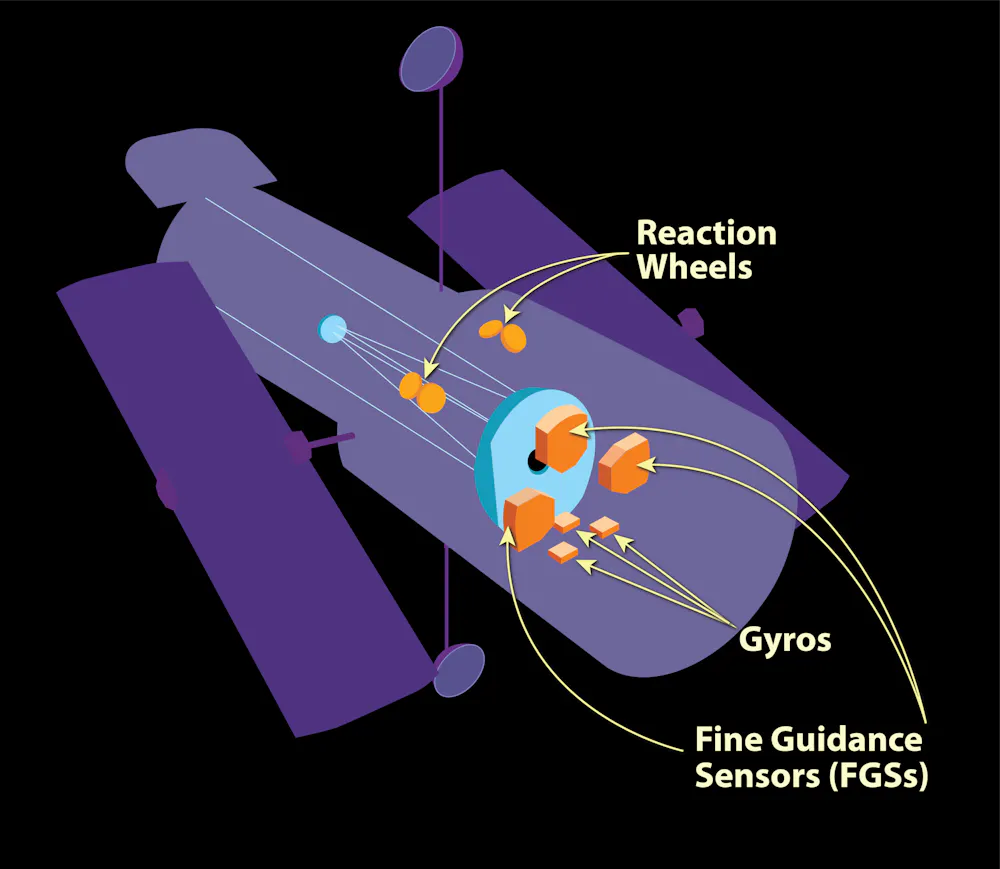
The gyros work in tandem with fine guidance sensors and reaction wheels to control the telescope’s orientation in space. NASA/STSci
A gyroscope is a device that measures an object’s attitude, or orientation in space. In other words, it measures how much the object has rotated from some fixed point. For Hubble to know where it’s pointing to take a picture, it has to know where it is in space. It needs at least three gyros – one per axis.
Hubble initially had six gyros: three main ones and three more as extras. But after more than 30 years in orbit, four of the gyros have failed from complications related to aging.
From the two remaining gyros, NASA has reserved one as a backup, so Hubble is now operating with a single gyro. But if you need at least three gyros – one per axis – to know where you are, how can Hubble figure out where it is with only one gyro?
One of Hubble’s gyroscopes.
The clever answer that NASA engineers came up with is actually very simple. You can use other sensors on the telescope, such as magnetometers and star sensors, to make up for the lack of gyros.
Gyro stand-ins
Magnetometers measure Earth’s local magnetic field, which scientists understand pretty accurately. You can use the magnetometers to get a rough idea of the attitude with respect to the known magnetic field direction, pretty much the same way you use a compass. A three-axis magnetometer can take measurements of the strength and direction of the Earth’s magnetic field as the satellite moves along its orbit to find its orientation in space.
Or you can use star trackers or sun sensors, which are much more accurate than magnetometers. These sensors use a map of the sky and align what they see with what’s on the map to figure out where they are pointing.
By combining the star trackers, sun sensors, magnetometers and a single gyro, Hubble can maintain a pointing accuracy that is very close to the three-gyro configuration – although the one-gyro configuration will limit how fast Hubble can track objects in space.
Hubble has one of the most accurate pointing attitude control systems ever built, and it has provided people with stunning pictures of the early universe. But losing all but two gyros is just another reminder that Hubble’s days are numbered.
Hubble’s successor, the James Webb Space Telescope, launched on Dec. 25, 2021. It is stationed 1,000,000 miles (1,609,344 km) away from Earth at what is called the second Lagrange point (L2).
At this point, the telescope, the Earth and the Sun are always aligned, and the telescope’s protective sun shield blocks the Sun’s rays. This feature allows its infrared camera to operate at chilly temperatures to provide much better-quality pictures.
While the long-enduring Hubble’s discoveries opened the universe to astronomers, Webb will allow us to look deeper into the cosmos than ever before.