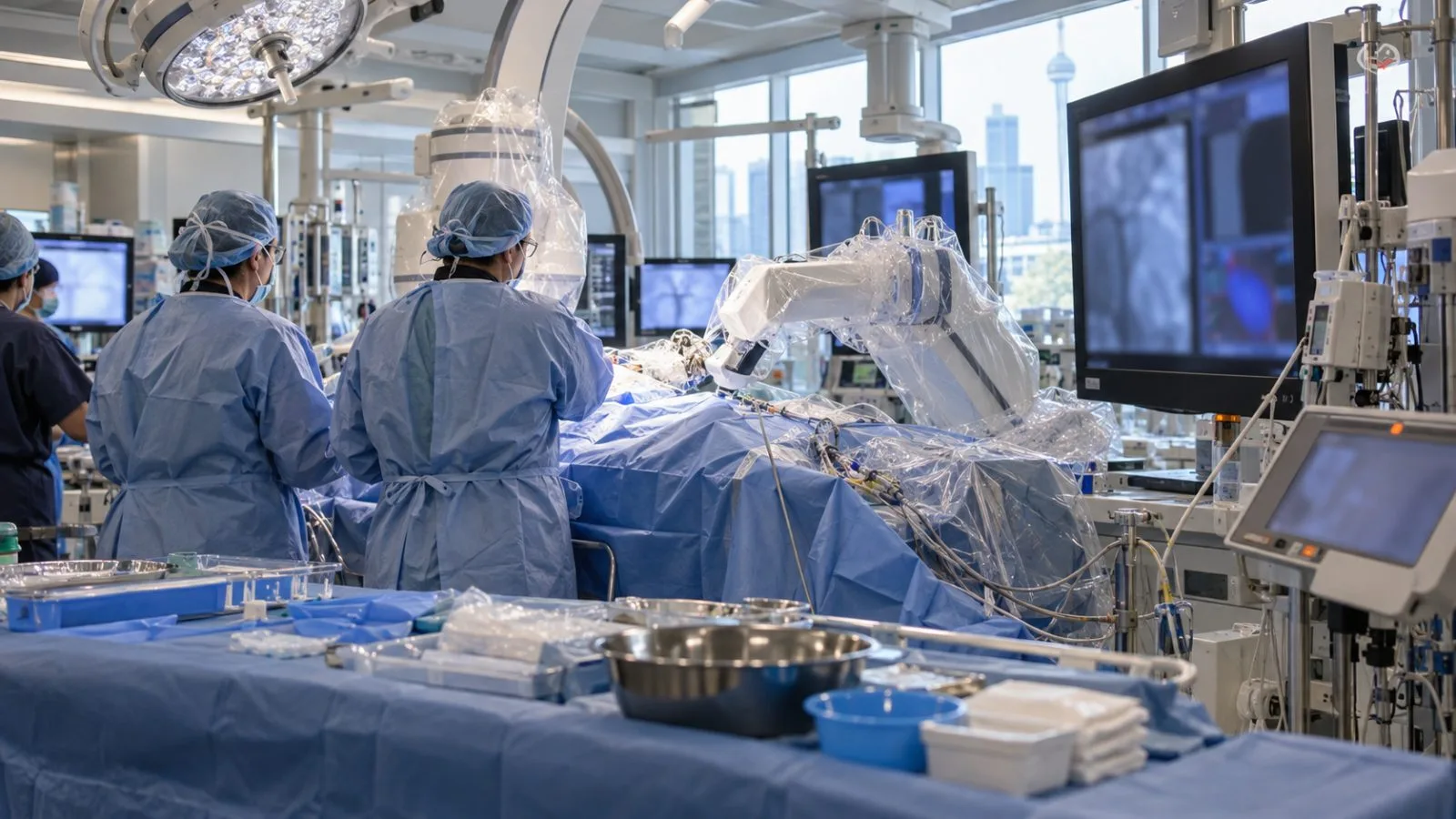
Unity Health Toronto lists a robotic-assisted hybrid procedure for atrial fibrillation in St. Michael’s minimally invasive cardiac surgery program; the page gives no local outcome data.
The hospital describes the procedure as robotic surgery combined with electrophysiology care. A 2024 international consensus statement traces the hybrid convergent approach to a 2009 description; it uses radiofrequency energy to treat tissue outside the heart, followed by catheter ablation from within.
A separate benchmark comes from CONVERGE, a 2020 randomized trial of 153 patients with persistent or long-standing persistent AF. At 12 months, 67.7% of the hybrid group (67 of 99) met the primary effectiveness endpoint, compared with 50% (25 of 50) in the catheter group. To qualify, patients had to be free of AF, atrial flutter and atrial tachycardia without starting or increasing class I or III antiarrhythmic drugs that had previously failed or been intolerable. In the hybrid arm’s safety group, eight of 102 patients (7.8%) had a primary safety event within 30 days. The trial examined hybrid ablation overall, not St. Michael’s robotic-assisted program.
A 2024 retrospective study at one U.S. center examined 64 robotic-enhanced hybrid procedures performed between January 2021 and June 2023. Thirty-two patients had reached the 12-month follow-up when the findings were reported; 23 of those 32 were free of supraventricular tachyarrhythmias. The other patients had not yet reached that follow-up.
Dr. Paul Angaran, St. Michael’s cardiac arrhythmia director, told Global News that long-term success among patients with long-standing persistent AF could reach 70% to 80%; the report gave no definition or follow-up period. Global News reported Oct. 25 that Edmonton patient Jon Davies underwent the surgical stage in September 2026 and was expected back in Toronto for catheter ablation in the following weeks. The outlet did not confirm that the second stage took place.