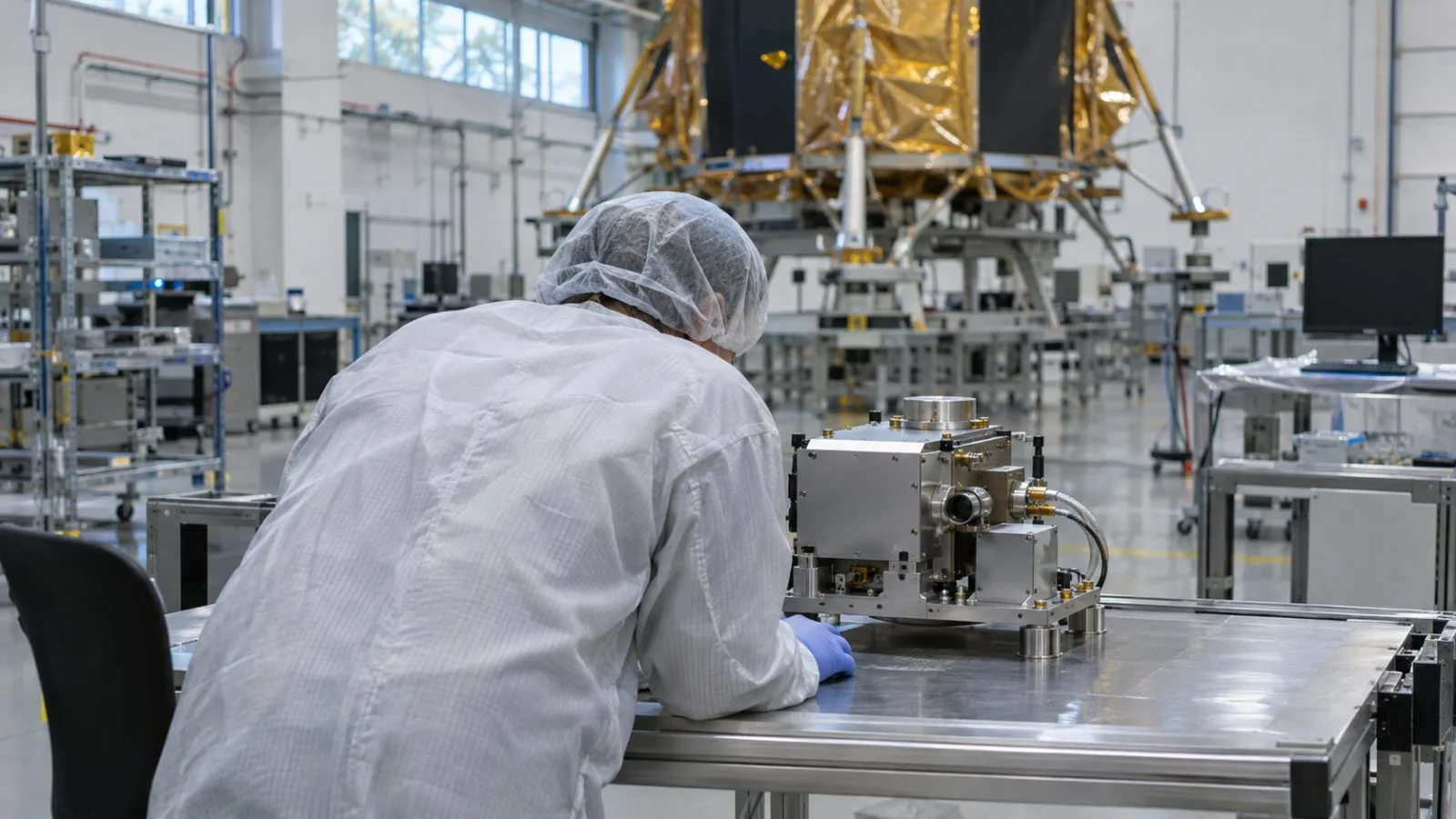
Firefly Aerospace plans a lunar-orbit test of U.S. GPS alongside Europe’s Galileo and future navigation services for the Moon, advancing satellite navigation beyond Earth on a mission slated to launch no earlier than 2028.
Firefly will carry QASCOM’s COLLINS payload aboard its Elytra Dark spacecraft. ASI’s mission designation is Blue Ghost Mission 3; Firefly lists the Gruithuisen Domes as its destination. Firefly says launch is planned for no earlier than 2028.
QASCOM is developing COLLINS for ASI; its name stands for Cislunar Orbiting L-band and LunaNet Integrated Navigation System. The payload is designed to combine signals from the Global Navigation Satellite System (GNSS), including GPS and Galileo, with future LunaNet positioning, navigation and timing services. Moonlight Lunar Communications and Navigation Services is part of the European Space Agency (ESA) effort. ASI says the instrument would be the first planned lunar-orbit payload to connect GNSS with LunaNet. The agency says the broader aim is to support an integrated navigation system for future cislunar missions between Earth and the Moon.
Firefly says Elytra will place Blue Ghost in lunar orbit and provide communications relay support while it is there. Blue Ghost is expected to conduct surface operations at the Gruithuisen Domes as Elytra stays in orbit. Firefly’s plan assigns COLLINS six months of operations, with the possibility of a longer run; Elytra’s imaging assignment is planned to last five years in lunar orbit.
NASA’s Commercial Lunar Payload Services initiative accounts for six of the mission’s eight payloads, Firefly says. The company’s mission page lists QASCOM and Starcloud as the two commercial payload customers.
The demonstration follows LuGRE, an earlier QASCOM-built instrument developed jointly for NASA and ASI. NASA said LuGRE determined its position on the lunar surface using GPS and Galileo signals for the first time on March 3, 2025. COLLINS is intended to test how satellite navigation signals can work alongside lunar services from orbit.
ASI said it signed the COLLINS agreement with QASCOM on Nov. 13 and described the project as a public-private co-investment. Firefly said it signed a commercial payload agreement with QASCOM to host COLLINS. Neither announcement disclosed the contract value or how costs are divided.