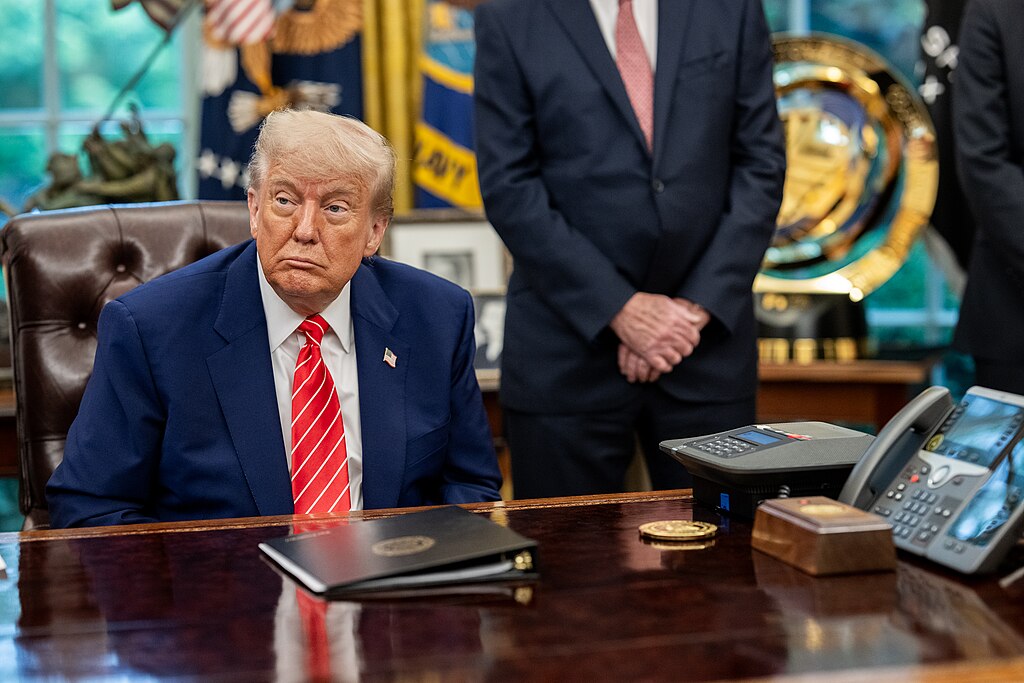
President Donald Trump announced Tuesday that the United States will provide political risk insurance and maritime guarantees for commercial shipping operating in the Gulf, while the U.S. Navy prepares to escort oil tankers through the strategically critical Strait of Hormuz. The move is aimed at stabilizing global energy trade as tensions between Iran and the U.S.-Israel alliance continue to disrupt one of the world’s most important oil transit routes.
In a post on Truth Social, Trump said the U.S. Development Finance Corporation will immediately offer insurance coverage and financial guarantees to shipping companies navigating the Gulf. According to the president, the program will be available to all shipping lines at what he described as a “very reasonable price,” with a particular focus on vessels transporting energy supplies such as crude oil and liquefied natural gas.
Trump emphasized that the United States is committed to maintaining the free flow of energy worldwide, highlighting the country’s economic strength and military capabilities. The policy signals Washington’s willingness to use both financial tools and naval power to secure shipping routes that are vital to global oil markets.
The announcement comes as escalating conflict between Iran and the U.S.-Israel coalition has severely disrupted maritime traffic through the Strait of Hormuz, a narrow waterway separating Iran and Oman that handles roughly 20% of global oil consumption along with significant volumes of natural gas shipments.
Shipping activity in the strait has nearly halted after Iran declared the passage closed and warned it could attack vessels attempting to transit the area. Reports indicate that at least five oil tankers have already been damaged during the confrontation, resulting in two fatalities. Meanwhile, approximately 150 vessels remain stranded around the region as uncertainty grows over safe passage.
Major global shipping companies, including Maersk, have announced temporary suspensions of operations through the strait due to escalating security risks.
Oil markets have reacted sharply to the geopolitical tensions. U.S. West Texas Intermediate crude futures surged above $77 per barrel earlier in the conflict before easing back toward the $73 range, reflecting ongoing concerns about global energy supply disruptions tied to the Strait of Hormuz crisis.