


 Solana User Growth Jumps 33%, Outpacing Ethereum and Chainlink
  Fed Unveils Stablecoin Rules Under GENIUS Act
  RBA Set for September Rate Hike as Inflation Stays High
  Oil Prices Rise as Hormuz Attacks Fuel Supply Fears
  Gold Prices Slip as Strong Dollar and High Treasury Yields Weigh
  RBI Raises Repo Rate to 5.50% in Hawkish Shift on Inflation Risks
  UK House Prices Flat in September as Mortgage Rates Weigh
  France to Release 10 Million Barrels of Diesel to Ease Fuel Prices
  US Stock Futures Flat as Fed Minutes, Earnings Loom
  Indian Stocks Fall as RBI Hikes Rates to 5.50%
  Kalshi Withdraws PEPE Perpetual Futures Filing
  Gold Prices Fall as Stronger Dollar Weighs on Bullion
  Litecoin Marks 15 Years as Grayscale Backs LTC ETF Push


 Add as a preferred source on Google
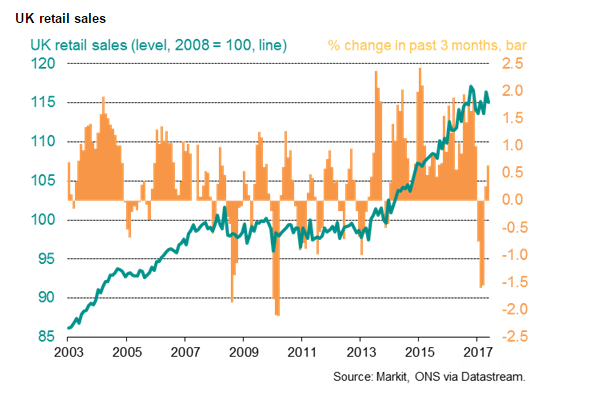
According to data released by The Office for National Statistics, the annual rate of growth in UK retail sales slipped to 0.9 percent, the lowest since April 2013. After a stronger than anticipated April retail sales on account of the timing of Easter, a more modest outcome for May was expected by most of the industry. But today's data was worse than expected and has raised warning signals for household consumption.
Retail sale volumes fell 1.2 percent m/m in May, worse than the 0.8 percent decline economists had expected and followed a 2.5 percent jump in the index in April. The main contributors to the retail sales fall in May were non-food stores, where the annual volume of sales fell 1.2 percent. Annual volume growth in food stores was just 0.1 percent, the weakest since July 2013.
Retail sales, which make up around 20 percent of the overall GDP, are considered a crucial barometer for the health of the economy. Most economists said the prospects for retail sales growth beyond this quarter were bleak. That said, the strong April still means second quarter sales are so far running 1.4 percent higher than the first quarter on average, and are likely to make a positive contribution to GDP in the second quarter after dragging in Q1.
"Clearly, the impact of the fall in the pound on prices is weighing heavily on spending volumes growth. And this week’s inflation and labour market figures showed that the squeeze on real earnings growth is intensifying," said Scott Bowman, economist at Capital Economics.
UK consumer prices are rising at an annual pace of 2.9 percent and regular pay is growing at a rate of just 1.7 percent. Real (inflation adjusted) pay is now falling at an annual rate of 0.6 percent, which is the steepest decline seen since 2014. The hurdle to consumer-led growth keeps rising as increasing inflationary pressures cap household purchasing power. Looking ahead, further increase in costs likely from sterling’s substantial post-referendum depreciation.
The Bank of England's (BoE) Monetary Policy Committee held rates unchanged as expected. But a deeper split emerged among its committee of policymakers, with three of the eight voting for an immediate rate rise to keep inflation in check. Looking ahead, key considerations in judging the appropriate stance in monetary policy are the evolution of inflationary pressures, the persistence of weaker consumption and the degree to which it is offset by other components of demand, the central bank said.
Pound spikes after BoE decision showed Monetary Policy Committee came its closest to voting for a rate rise since 2007. GBP/USD spiked from lows of 1.2693 to 1.2795 levels. FxWirePro's Hourly GBP Spot Index was at -82.2827 (Neutral) at 1130 GMT. For more details on FxWirePro's Currency Strength Index, visit http://www.fxwirepro.com/currencyindex.







