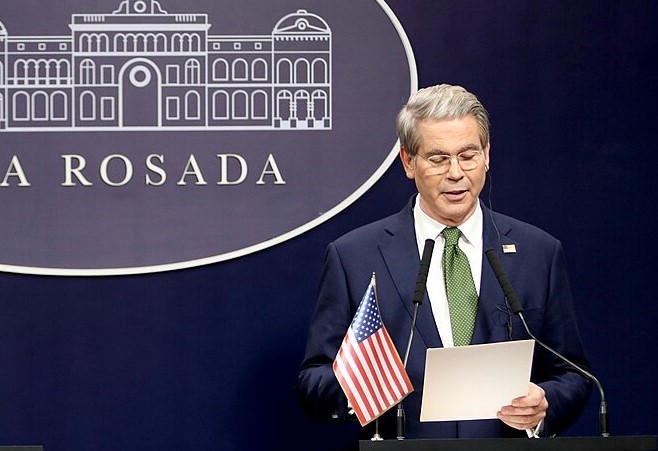
U.S. Treasury Secretary Scott Bessent is set to meet Chinese Vice Premier He Lifeng in Paris, France, from March 15 to 16, marking a significant step in ongoing efforts to stabilize the world's most consequential bilateral trade relationship. U.S. Trade Representative Jamieson Greer will also attend the discussions, which aim to advance the trade and economic dialogue between Washington and Beijing.
The Paris meetings are the latest in a series of high-level negotiations held across European cities, following a landmark trade truce that temporarily de-escalated tensions after the Trump administration imposed sweeping tariffs on Chinese imports. Those tariffs triggered retaliatory measures from China, including tightened export controls on rare earth minerals and magnets — materials critical to U.S. high-tech manufacturing. The resulting truce reduced new emergency tariff rates to roughly 20% and partially restored rare earth supply chains, with the agreement extended through November 2026 following a U.S.-China summit in South Korea.
The trade landscape has since shifted again. The U.S. Supreme Court ruled Trump's emergency tariffs unconstitutional, and Washington has since reimposed a 10% tariff on global imports under balance-of-payments authority. A fresh investigation into unfair trade practices, targeting excess industrial capacity across China and 15 other nations, could introduce additional tariffs within months.
Trade negotiators on both sides are under pressure to produce concrete results ahead of a potential Trump-Xi summit planned for late March in Beijing. American officials are pushing China to significantly increase purchases of U.S. agricultural products, energy exports, and Boeing aircraft — sectors that have seen little Chinese engagement in nearly a decade.
Analysts caution that the compressed timeline and geopolitical complications, including the ongoing conflict in Iran, may limit what the Paris talks can realistically deliver. Still, trade experts say the meetings are critical for narrowing the U.S.-China trade deficit, which has already dropped from a peak of $418 billion in 2018 to a more than 20-year low of $202 billion in 2025.