


 NEAR Intents Hack Drains $3.8 Million, NEAR Price Falls 7.5%
  XRP Asia Launches to Accelerate XRPL Adoption Across Asian Banks
  AAVE, PUMP, WLD and SKY Rally as Crypto Market Slips
  Zcash Awards $8 Million in Grants After Orchard Bug Crisis
  Bitcoin Exchange Reserves Hit Multi-Year Low at 2.68 Million BTC
  WordPress Malware Uses Ethereum to Evade Removal
  Ethereum Price Eyes $3,000 as Fed Rate Hike Odds Drop
  Evernorth Set for Nasdaq Debut With 473 Million XRP Treasury
  Bitcoin Holds Above $83,700 as High Treasury Yields Limit Rally
  Ripple and Cardano Expand Blockchain Adoption in Brazil
  Goldman Sachs Names CATL, Zenergy Top China Battery Picks
  Midnight NIGHT Token Surges 86% as Smart Contract Launch Nears
  XRP Ledger Hits 10 Million AI Payments as Bitcoin Retreats
  XRP Rises as Evernorth Merger Vote Clears Key Nasdaq Hurdle
  AI Agents Could Disrupt Financial Services, Bernstein Says
  Chainalysis AI Traces $387M Bitget Hack in Under 10 Minutes


 Add as a preferred source on Google
Slowdown in Chinese economy has created havoc for commodities across world and its producers.
Naturally a though has occurred -
After two years of sharp slowdown and currency market adjustment, question arises hasn't the market priced in China weakness already.
- What I mean is, Chinese economy has slowed down to 7% from double digit growth just few years back and it is expected to continue to slow down in the foreseeable future.
- Given such fundamentals, Commodities have fallen sharply, say energy for which price has fallen close to 60% from its peak in 2014.
- Currencies both across emerging markets as well as developed market have adjusted significantly over this concern, for example New Zealand Dollar is down close to 19% this year so far, while South African Rand is down close to 28% in past one year.
So how likely is further devaluation both in commodities and currencies, which are dependent on China?
Very much...if China slows down further and sharply.
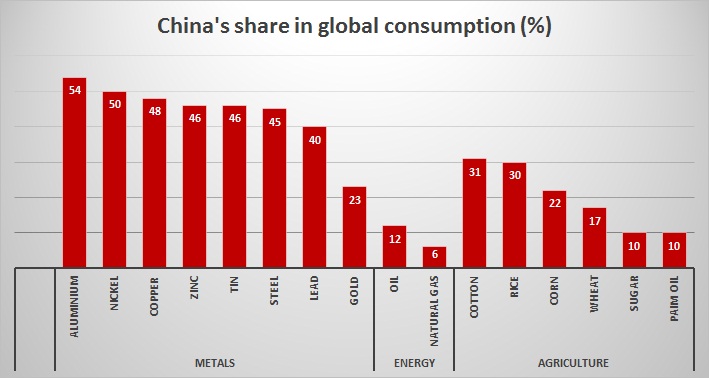
Because when it comes to commodities, China is still the glutton.
As of 2014,
Metals -
- China is consuming significant portion of world production of Aluminium (54%), Nickel (50%), Copper (48%), Zinc (46%), Tin (46%), Steel (45%), Lead (40%), and Gold (23%).
Energy -
- China is still not the largest consumer of energy products but raising consumption in both oil (12%) and natural gas (6%).
Agriculture -
- Not as large as industrials, nevertheless significantly large enough in Cotton (31%), Rice (30%), Corn (22%), Wheat (17%), Sugar (10%), and Palm oil (10%).







