


 US Treasury Yields Ease After Strong 10-Year Auction as Global Bonds Struggle
  RBI Raises Repo Rate to 5.50% in Hawkish Shift on Inflation Risks
  Gold Prices Fall Amid Rate Jitters; Copper Steady as China Stimulus Eyed
  US-Led Coalition Targets Global Factory Overcapacity
  Oil Prices Rise as Hormuz Risks Offset IEA Stock Release
  Gold Prices Hit One-Week High as Oil Falls, Fed Rate Outlook Weighed
  France to Release 10 Million Barrels of Diesel to Ease Fuel Prices
  Gold Prices Rise as Dollar Weakens, Treasury Yields Fall
  Iran Refuses to Halt Uranium Enrichment Amid US Nuclear Demands


 Add as a preferred source on Google
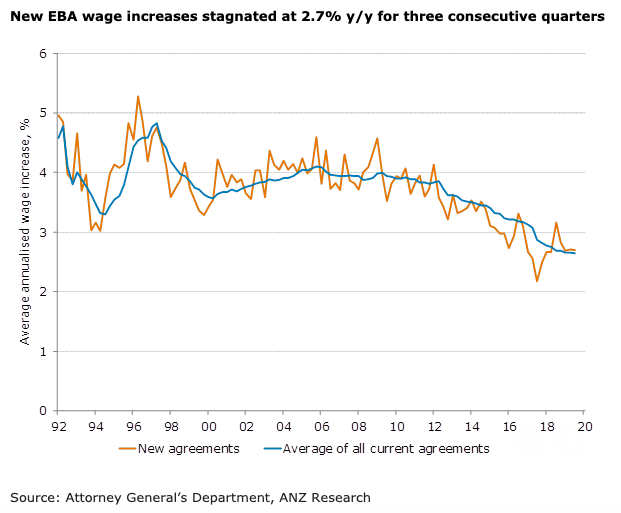
The average annual wage increase (AAWI) under new enterprise bargaining agreements (EBAs) has idled at 2.7 percent for the three quarters to September 2019. The private sector recorded a slight decline to 2.7 percent in Q3, which was largely offset by a small rise in the public sector to 2.6 percent, ANZ Research.
The average annual wage rise for all current agreements slowed to a record low of 2.6 percent in Q3. The EBA data are consistent with the weakening in the wage price index to 2.2 percent y/y in Q3.
The AAWI in the private sector has gradually declined over the past three quarters to 2.7 percent in Q3. This was largely offset by a small rise in the public sector AAWI to 2.6 percent, although this is still well down on the 3.3 percent recorded a year ago.
The Q3 results were mixed across industries. The largest declines in the AAWI under new EBAs were in arts and recreation (-0.5ppt), accommodation and food services (-0.4ppt), and transport, postal and warehousing (-0.4ppt).
The largest improvement was in rental, hiring and real estate (+1.4ppt to 3.5 percent), but this AAWI is still less than half of what it was a year ago. Construction, other services, utilities and retail also recorded rises in the AAWI for new agreements.
Only three out of the 19 industries had an AAWI at or above 3 percent: construction; rental, hiring and real estate; and utilities.
"We do not expect a material pick-up in wage growth any time soon," the report further commented.







