


 Trump Secures Russian Diesel Deal as US Fuel Prices Surge
  Iran Refuses to Halt Uranium Enrichment Amid US Nuclear Demands
  Morgan Stanley Raises Coinbase Stock Price Target to $258 Ahead of Earnings
  Trump Sanctions International Criminal Court, Sparking EU Backlash
  Trump Backs Florida Golf Course as Presidential Retreat
  Ledger Investigates Alleged $86 Million Crypto Wallet Theft
  Colombia Extradites FARC Dissident Leader ‘Spider’ to US
  Evan Gershkovich Says FSB Set Trap for 2023 Russia Arrest
  Ripple Chairman Chris Larsen Donates $22.5 Million Ahead of US Midterms
  Trump Cancels Alabama Football Trip as Hurricane Isaias Approaches
  Stellar Overtakes Ethereum in RWA Fund Inflows as XRP Leads Commodities
  California AG Subpoenas OpenAI Over AI Cybersecurity Incidents
  XRP Price Eyes $1.50 as ETFs Attract $8.17M Inflows
  RFK Jr. Launches Nationwide Vaccine Safety Review


 Add as a preferred source on Google
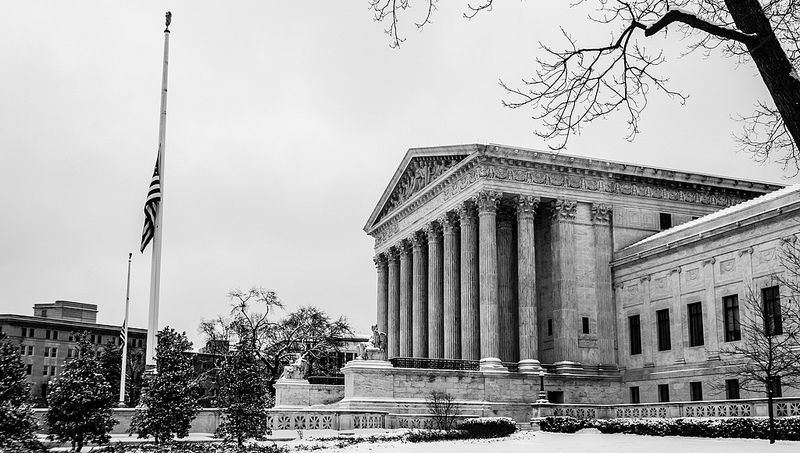
The late Justice Antonin Scalia believed that the federal Constitution allows states to ban abortion, to prohibit consensual sex between two adults in the privacy of their home as well as same-sex marriage, to keep a prestigious state-funded military college exclusively all male, and to start official legislative sessions (and high school graduation ceremonies) with exclusively Christian prayers.
Scalia also believed the Constitution prohibits states (even those with long histories of racially segregated public universities) from considering race as one factor among many in their admissions processes, from enacting most campaign finance reform regulations limiting the spending of money on political campaigns, and from enacting gun control laws.
Justice John Paul Stevens, the last Justice to leave the Court before Scalia, disagreed vehemently with every one of those “interpretations” of the Constitution. Although Stevens never voted on same-sex marriage or exclusively Christian prayers at legislative sessions, he would certainly have disagreed with Scalia on both issues.
Both men were skilled lawyers, jurists, and dedicated public servants. And yet, a country with a Supreme Court of five Justice Scalias would look substantially different than a country with five Justice Stevens.
Despite an avalanche of commentary in the popular press, social media, academics circles, and cable news shows on the implications of Scalia’s death, few are willing to say out loud what should now be patently obvious: we are not replacing a judge bound in any real sense by the law but an important political official who happens to sit in a courtroom. This person makes decisions not based strictly on legal interpretations but on his values writ large.
The most cited legal scholar of our time, Judge Richard Posner, has an eloquent way of making this same point. He has said that choosing between different results in hard constitutional law cases is like choosing between margaritas and cosmopolitans. Taste, not logic, dictates the choice.
However true that is for lower court federal judges and state judges, it is obviously accurate for Supreme Court Justices whose decisions cannot be reviewed except by formal amendments to the United States Constitution which are extremely rare. Even more importantly, they do not have to follow the prior decisions of past Courts.

Before starting his term, Obama visited the Supreme Court. Now with less than a year left, he faces a political fight over Justice Scalia’s successor. changedotgov/flickr, CC BY
As I have written before, in virtually every litigated area of constitutional law, from free speech, to race relations, to federal power, to state sovereign immunity, the Supreme Court has reversed course over and over.
Those changes occurred not because the text of the Constitution changed, or the Justices discovered new historical evidence concerning the meaning of the Constitution. Instead, it was because the Justices' values writ large (social, moral, religious, and partisan) changed when the people on the Court changed or existing Justices simply changed their minds.
So given that the Court without Scalia is divided among four Republicans and four Democrats, it is no wonder that the nomination and confirmation process in the wake of Scalia’s death is so politically charged and divisive.
With a court now evenly divided between conservatives and liberals, both the Majority Leader of United States Senate and the President of the United States are acting reasonably by retreating to their corners and coming out fighting with all of their political resources at their disposal (though they both could have waited a few days to do so).
As Adam Liptak reported in the New York Times, a number of key legal decisions – on abortion, gun control, campaign finance reform, separation of church and state, immigration, and voter redistricting – could change dramatically and move to the left with five as opposed to four liberals on the Court.
Given that this is an election year and the end of a two-term Presidency, the stakes for the American people could not be higher. If the goal of the process was to simply find an outstanding lawyer or judge, the process would already be under way.
But the role of Supreme Court Justice is not to interpret texts and make legal decisions but to make hard value choices on the most difficult moral and politically charged issues of our day.
That’s why I believe our two major political parties owe it to the American people to do their best to find a replacement for Justice Scalia who serves the interests of their respective constituencies.
Because the Republican Party controls the Senate, which must confirm the nominee, and the President is a Democrat (who must nominate Scalia’s successor), it is not surprising that the process has become one of low politics with each side scrambling for partisan advantage.
As Professor Mark Tushnet of Harvard Law School likes to say, law truly is politics all the way down. Justice Scalia’s untimely death certainly proves the truth of that maxim.
 Eric Segall does not work for, consult, own shares in or receive funding from any company or organization that would benefit from this article, and has disclosed no relevant affiliations beyond the academic appointment above.
Eric Segall, Kathy & Lawrence Ashe Professor of Law, Georgia State University
This article was originally published on The Conversation. Read the original article.







