


 Asian Currencies Steady as Dollar Holds Near 18-Month High
  Euro Hits 17-Month Low as France Debt Fears Boost Dollar
  Wall Street Rises as Oil Prices Ease, Nasdaq Hits Record
  Iran Tanker Attacks Surge as Hormuz Oil Flows Near Prewar Levels
  Asian Stocks Rise as Nasdaq Record Offsets Bond Yield Pressure
  Gold Prices Slip as Strong Dollar and High Treasury Yields Weigh
  Australia Consumer Confidence Plunges as RBA Rate Hike Hits Households
  Ukraine Faces $56 Billion Budget Gap as War Costs Soar
  Trump Opens Tax-Exempt Dyed Diesel Access as Fuel Prices Surge
  Gold Prices Rise as Dollar Weakens, Treasury Yields Ease
  Hong Kong Stocks Slip as Property, Financial Shares Weigh
  Oil Prices Rise as Hormuz Attacks Fuel Supply Fears
  Dollar Retreats From 18-Month High as Euro Rebounds
  China Shuts 670 Banks as Bitcoin Eyes Financial Risks
  Gold Prices Rise as Weak US Jobs Data Cuts Fed Hike Bets
  Europe EV Sales Hit Record as Affordable Models Boost Demand
  Thailand Plans Dual-Class Shares to Revive IPO Market


 Add as a preferred source on Google

The recent sharp rises in inflation have effectively put an end to three decades of relative price stability in the UK. The prices of most goods and services have gone up and could go even higher.
The reasons for this include increased economic activity after the ending of COVID restrictions, global supply chain issues and the war in Ukraine. And one immediate effect of such steep inflationary pressure is that people’s wages are suddenly not worth as much as they used to be.
In the UK, there have been strikes in 2022 by rail workers and criminal barristers, and warnings of industrial action in sectors such as nursing, education and transport – all seeking pay rises in response to the increasing cost of living.
But while inflation has indeed led to a substantial squeeze on living standards and depressed real wages, there have also been arguments made that increases in wages could lead to further inflation. The so-called “wage-inflation spiral” suggests that wage increases lead to higher price inflation which in turn makes workers demand higher wages.
The basic idea is that the consistent ratcheting up of workers’ pay to match inflation and cost of living increases leads to firms raising prices to protect their profit margins.
Some then, including the governor of the Bank of England, and the former chairman of Goldman Sachs, have called on both employers and employees to exercise “wage restraint”.
These interventions are easily (and often) criticised on the grounds that a person earning close to £500,000 a year (as the governor does) is not best placed to tell millions of people who earn much much less that they should settle for what they’ve got. But even if we ignore this moral dimension, there are still major flaws in the argument for not increasing wages.
Firstly, the notion that wage increases lead directly to an increase in inflation does not always hold. The current high inflation rate is largely caused by factors which are not connected to pay levels, so will not be solved by restraining wages. Secondly, a restriction on real wages is likely to bring forward the prospect of a recession.
The UK (along with the US and many European countries) is already showing a decline in economic growth. Allowing wages to fall in real terms is only likely to make this situation worse by squeezing household incomes. This squeeze will inevitably lead to a decrease in consumption and spending, putting further pressure on the economy. It is also likely to push many more people into poverty. The negative effects of wage restraint cannot be ignored.
Wage watch
It is also worth looking ahead. The most recent forecast by the Bank of England suggests that by the middle of 2025 there are risks of “deflation” – a reduction in general price levels across the economy. And while some may welcome the idea of price falls, deflation brings its own serious risks, including higher unemployment and lower economic growth.
What is needed now is urgent action to ensure that wages rise in line with inflation, so consumption and spending is maintained to avoid or at least dampen the expected recession. This will require workers to bargain for pay rises, and employers to provide them.

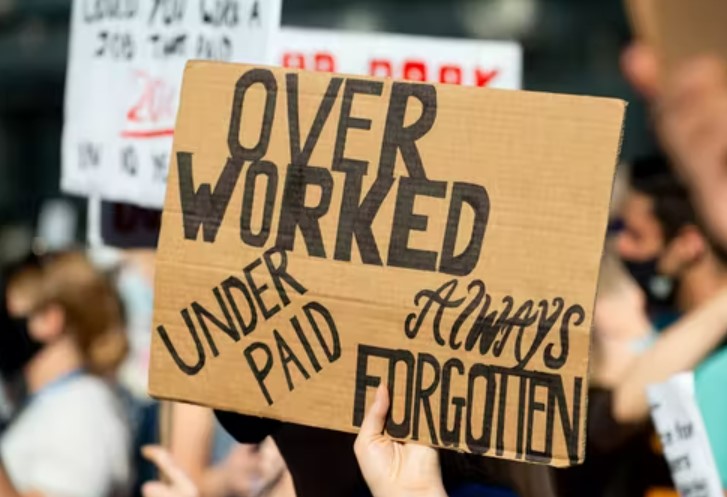
Improving morale. Shutterstock/Tony Stock
And yes, it will also probably mean more strikes in the public sector – but the government needs to come to terms with the economic value of raising public sector pay. Public sector workers – after years of pay freezes – deserve a pay rise. Their colleagues in the private sector also need and merit an uplift in their wages.
Finally, progress in pay and the move to a sustainable recovery will require a state determined to raise productivity. Increases in wages will themselves create the conditions for higher productivity by boosting the motivation and morale of workers. Higher wages can support the economy and help to avert the threat of stagnation – and ward off even higher inflation, and an even greater cost of living crisis.
 David Spencer has received funding from the ESRC.
Muhammad Ali Nasir does not work for, consult, own shares in or receive funding from any company or organisation that would benefit from this article, and has disclosed no relevant affiliations beyond their academic appointment.







