


 SpaceX Starlink Restrictions Disrupt Ukraine Military Operations
  Zelenskiy Seeks New US Talks to Revive Ukraine-Russia Peace Negotiations
  Zelenskiy Says Ukraine Received No Warning Before Russian Missile Attack
  US Recalls Nicaragua Envoy After Ambassador Rejection
  Trump Announces Massive Oil and Mineral Exploration Plans in Greenland
  Trump Denies Russia and China Are Helping Iran in U.S. Conflict
  Zelenskiy Says Trump’s Support for Russia Is ‘Painful’
  Most Americans Oppose Election Betting on Prediction Markets, Poll Finds
  US Justice Department Drops Prosecution of Ex-CIA Analyst Sue Mi Terry
  Jordan Bardella Antisemitism Allegations Threaten Le Pen’s Campaign
  US Senate Midterms 2026: Key Races That Could Flip Control
  Container Ship Sinks in Strait of Hormuz as Iran Attacks Escalate
  FBI Denies Report of Kash Patel’s Russia Visit
  China Warns Taiwan Over South China Sea Coast Guard Incident
  MI5 Warns of Rising Iran, Russia Threats and AI Bioweapon Risks
  Trump Confirms US Intelligence Sharing With Ukraine Amid Russian Strikes
  Elon Musk Donates $366 Million to 2026 US Midterms


 Add as a preferred source on Google
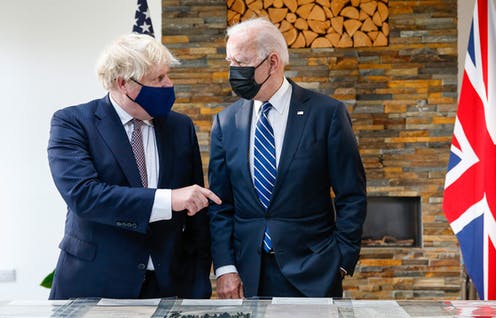

Franklin Roosevelt and Winston Churchill first met in the summer of 1941 on HMS Prince of Wales to create the Atlantic Charter, establishing the terms of their countries’ relationship in war, and, as it was to prove, in peace.
Eighty years later, Joe Biden and Boris Johnson meet in front of a new HMS Prince of Wales to renew the constitution of the “special relationship”, with the New Atlantic Charter. These are about as piquant a series of historical coincidences as an administration (or historian) could wish for.
Both charters commit the US and the UK to what they deem the pressing issues of the day. The original’s call for the lowering of trade barriers, self-determination, and economic cooperation remains not only pertinent, but crucial, both for a post-Brexit, “global” Britain, and for an America which wants once again to lead through alliances.
In an age when the world is actually becoming less democratic, the new accord makes paramount the defence of democracy, followed by strengthening international institutions, recognising sovereignty and territorial integrity, supporting collective security, and a rules-based global economy. It ends with tackling the climate crisis – a notion unknown in 1941 – and, topically, the catastrophic impact of health crises.
Where once there was war, now there is pandemic. Both Biden and Johnson have announced plans to collectively vaccinate 600 million people through another legacy of 1941, the World Health Organization. The leaders of the two countries which led the fightback in the second world war may think of themselves as leading the world again, but against a different kind of tyranny.
Historic echoes
Five months after Roosevelt and Churchill met, the Japanese bombed Pearl Harbour and delivered what the prime minister wanted most: America in the war. Two days later, the Japanese sank the HMS Prince of Wales and another experience was shared.
On the eve of his departure, Biden noted his intention to “affirm the special relationship between our nations”. This set up Johnson’s revelation that he didn’t like the term, saying he thought it was “needy and weak”. To freshen it up, he renamed it the “indestructable relationship”. This isn’t the first attempt to revamp it.
For example, it’s not uncommon for the US and UK to publicly mark anniversaries of the furniture of the special relationship: the NSA and GCHQ marked 75 years of their intelligence partnership while the US has celebrated how Churchill coined the term.. Churchill happens to be the Brit most revered by Americans – to the extent of having a warship named after him.
And this week, the 21st century may be seen to look back to the 20th. There’s even a biographical relationship: President Biden is as old as the Atlantic Charter. And he became a senator in 1973, the year that Britain pivoted from the new world back to the old. After the G7, Biden and Johnson will go on to NATO – yet another legacy of 1941 (as are the summits themselves).
A changing relationship
The precedents for the two men alone are auspicious. Biden-Johnson succeeds Trump-May and Trump-Johnson, respectively the worst, and the most dysfunctional presidential and prime ministerial relationships in history.
Neither having much in the way of fixed beliefs, for Trump and Johnson the personal had primacy. The preoccupation with their personalities and idiosyncrasies overwhelmed other aspects of US-UK relations.
Nevertheless, Biden – the most career of career politicians – and Johnson – whose non-conformity is central to his appeal – find their relationship more than usually freighted with baggage.
Overtly Irish-American, Biden publicly voiced his concerns about the implications of Brexit trade issues on peace in Northern Ireland.
Johnson’s reckless remark about Obama the Kenyan “has never gone away”. According to a member of Biden’s campaign team: “Biden’s got a long memory and Boris is not in his good books. Biden and Obama are like family.”
Equally unwisely, Biden described the new prime minister as a “kind of a physical and emotional clone” of Trump. Such antipathy stemmed from both the pro-Trump present and the anti-Obama past of the prime minister.
But ascending to office can do wonders to opinions. Biden appropriated Johnson’s slogan about the impending post-pandemic reconstruction: “Build Back Better”, while Johnson immediately welcomed the “incoming Biden-Harris administration” and spoke of “the previous president” without Trump’s name passing his lips.
With Biden’s election, in London and Washington the commentators’ word of choice for US-UK relations was “reset”. With Biden’s record of pragmatism and cooperation and the fortuitous coincidence of UK leadership of the UN Security Council – the core of the 1941 settlement –- as well as the G7 and COP26, an opportunity presented itself.
Scepticism will persist about the nature and extent – even the existence – of the special relationship. But the first world leader the new American president spoke to (other than those of the two countries bordering his own) was British, the first he met in person was British and the first country he visited as president was Britain.
And when they met, the president and the prime minister chose to retell the origin story of the special relationship.







