
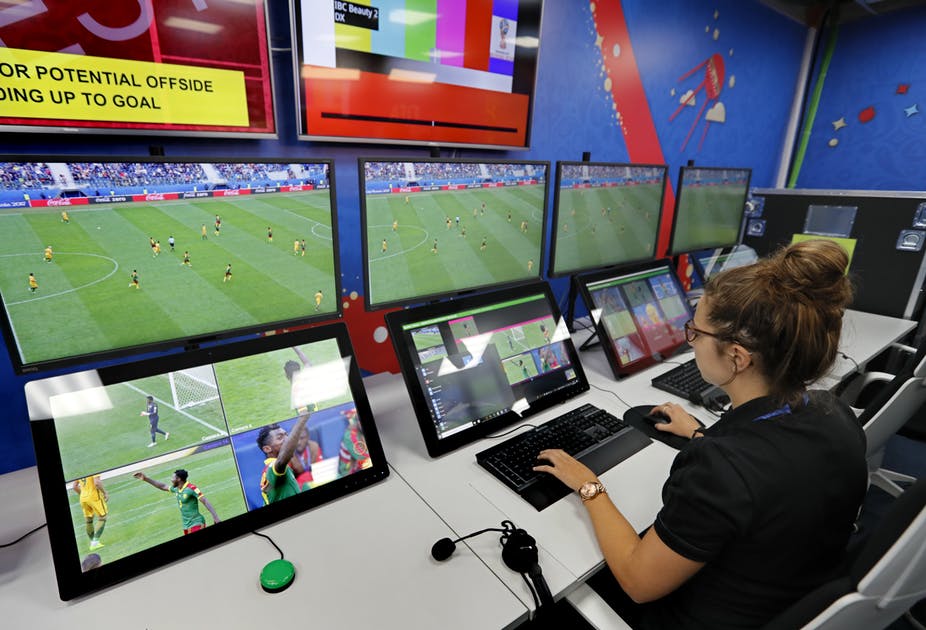
The men’s football World Cup presents a unique global opportunity to showcase new football technology – from boots and balls to digital systems designed to enhance both officiating accuracy and fan engagement.
The process of bringing these technologies to the game often begins in universities and other research institutions. The academic journal Sports Engineering, of which I am editor-in-chief, publishes peer-reviewed studies that are closely monitored by the sport’s global governing body, Fifa.
In our two collections of studies so far, prominent research themes include the automatic tracking of players and automated event detection. Another strand focuses on checking how well wearable sensors work within stadium environments.
Data obtained from tracking player movements can be used to create virtual avatars. Use of this technology is being explored to further grow audiences for what is already the world’s most popular sport, both in terms of players and fans.
Goal three of Fifa’s strategic objectives (2023-27) is to “deliver fan engagement including through eFootball, and to invest in digital technology and artificial intelligence for the next generations”.
So what innovations have made it to the current World Cup in North America – and which others are likely to be introduced at future tournaments?
Enhanced viewing angles
Perhaps the most discussed technological innovation at this World Cup is the frequent use of body cameras by referees. This additional view has been widely praised for giving fans a fascinating new perspective on key moments, including goals and what refs saw when making key decisions.
But the revolution in viewing angles doesn’t stop there. An increasingly common aspect of match coverage is 3D recreations – for example, when tight offside decisions are explained following a VAR (video assistant referee) review. These use data on player positions and movements from optical tracking systems to recreate gameplay from new perspectives – potentially giving fans entirely new views of the action, such as from the goalkeeper’s perspective.
Official help
Goal-line technology was first used in the 2014 men’s World Cup to determine whether the whole of the ball had crossed the goal-line. The 2026 World Cup has gone a step further by using out-of-bounds technology for the first time to determine whenever the ball has left the field of play – whether for a throw-in or corner.
Viewers may also notice team officials using a digital substitution tablet in place of handwritten paper notes to explain the player swaps they wish to make. This makes it easier for substitutions to be approved by match officials and rapidly communicated to broadcasters – while also being “less sensitive to weather conditions” in the form of a rain-sodden notepad.
Data analytics
Fifa has pledged that for this World Cup, all 48 teams should “benefit from the same pre- and post-match analytical capabilities” through its AI Pro system. The system uses “AI agents capable of querying structured match data” to deliver rapid tactical insights, performance analyses and strategic recommendations.
Researchers are also exploring how to track players and automatically detect events using broadcast video footage, rather than additional specialist camera technology. Ensuring these capabilities are made available beyond the game’s elite leagues is seen as important for democratising the way the game develops.
Video: BBC News.
The ball
Each World Cup sees the introduction of a new ball. The 2026 Adidas Trionda features four uniquely shaped panels – the smallest number ever used to make a World Cup ball.
These panels, made of polyurethane, have grooves and small, raised surface features in the form of eagle, maple leaf and star symbols to reflect the three host nations. Along with the seams, these are intended to give the ball desirable aerodynamics that produces predictable and stable flight behaviour.
Like its predecessor, the Trionda also has an internal sensor that can sample data at 500 times per second to measure its movement. This is relayed to match officials in real time, supporting their decision-making.
Fifa’s football testing manual even incorporates a balance test for balls with this internal sensor. This is to ensure the internal sensor does cause the ball to behave unpredictably when rolling or in the air.
Pitches
Some players at this World Cup have complained about the temporary grass pitches used at some stadiums feeling “more like an artificial surface”.
There is a huge amount of research on the effect of pitches on player performance, including injury risk. This can be particularly important for female players, for whom knee injuries are more prevalent.
The latest football turf testing manual includes a “critical fall height test”. This is designed to ensure surfaces are sufficiently soft and compliant to avoid posing an excessive head injury risk to players falling from a minimum of 0.6 metres.
Boot design
Academic research continually informs updates in football boot design. For example, it has shown that padding on the upper section of the boot can hinder shooting accuracy.
We are now starting to see 3D-printed boots worn by some players. These boots use metamaterials – artificially-made materials with unconventional properties – that promise to improve fit and comfort.
While you may see a few of these boots at this World Cup, the inexorable march of technology means you can expect such designs to be a common sight in Morocco, Portugal and Spain in four years’ time – along with many other new innovations currently at the research stage.
Thomas Allen has received research funding from FIFA. He is the Editor-in-Chief of the Sports Engineering journal.
Thomas Allen, Senior Lecturer, Department of Engineering, Manchester Metropolitan University


