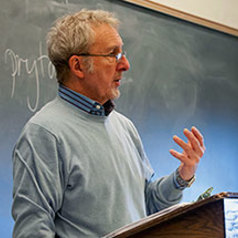
Garland was a Fulbright Scholar and Fellow of the Center for Hellenic Studies from 1985-86, Fellow of the Institute for Advanced Study Spring in 1990 and the Benjamin Meaker Distinguished Visiting Professor at Bristol University in 1995. He is the author of many books, including The Eye of the Beholder: Deformity and Disability in the Graeco-Roman World (Bristol Classical Press 2nd ed. 2010), Ancient Greece: Everyday Life in the Birthplace of Western Civilization (Sterling 2013), and Wandering Greeks: The Ancient Greek Diaspora from the Age of Homer to the Death of Alexander the Great (Princeton University Press 2014).
Amanda D. Lotz is professor of Communication Studies and Screen Arts & Cultures at the University of Michigan. She is the author of The Television Will Be Revolutionized (New York University Press, 2014, 2007), Cable Guys: Television and American Masculinities in the 21st Century (New York University Press, 2014), and Redesigning Women: Television After the Network Era (University of Illinois Press, 2006), and editor of Beyond Prime Time: Television Programming in the Post-Network Era (Routledge, 2009). She is co-author, with Timothy Havens, of Understanding Media Industries (Oxford University Press, 2017, 2011) and, with Jonathan Gray, of Television Studies (Polity, 2011).
Steven Weber works at the intersection of technology markets, intellectual property regimes, and international politics. His research, teaching, and advisory work focus on the political economy of knowledge intensive industries, with special attention to health care, information technology, software, and global political economy issues relating to competitiveness. He is also a frequent contributor to scholarly and public debates on international politics and US foreign policy. One of the world’s most expert practitioners of scenario planning,Weber has worked with over a hundred companies and government organizations to develop this discipline as a strategy planning tool. Steve went to medical school at Stanford then did his Ph.D. in the political science department also at Stanford. He served as special consultant to the president of the European Bank for Reconstruction and Development and has held academic fellowships with the Council on Foreign Relations and the Center for Advanced Study in the Behavioral Sciences, and was Director of the Institute of International Studies at UC Berkeley from 2003 to 2009. His books include The Success of Open Source and most recently The End of Arrogance: America in the Global Competition of Ideas (with Bruce Jentleson) and Deviant Globalization: Black Market Economy in the 21st Century (with Jesse Goldhammer and Nils Gilman). He is currently working on a new book, Beyond the Globally Integrated Enterprise, that explains how economic geography is evolving and the consequences for multinational organizations in the post financial crisis world. Steve is the faculty director for the Berkeley Center for Long Term Cybersecurity (CLTC).
Dr John Hewson is the former leader of the Liberal Party of Australia. John has had a distinguished business career both before and after his political career. He has worked as an economist for the Australian Treasury (Census and Statistics), the Reserve Bank, the International Monetary Fund and also as an advisor to two successive Federal Treasurers and the Prime Minister. John was a Director of Macquarie Bank and a past Chairman of ABN AMRO in Australia. His academic career included 11 years as a Professor of Economics, with four years as Head of the School of Economics at the University of New South Wales, and two years as Dean, Macquarie Graduate School of Management and Professor of Management at Macquarie University. John has been director of many organisations and has guided many from early stage to maturity. John has been extensively involved in the climate debate in Australia and internationally. He is a the Chairman of the Asset Owners Disclosure Project. John is an Honorary Professorial Fellow at the Crawford School of Public Policy at the Australian National University.
Nancy Modesitt is an Associate Professor at the University of Baltimore School of Law, where she teaches Employment Law and Employment Discrimination. Before becoming a law professor, she worked at the U.S. Department of Justice as well as at several large law firms, where she specialized in employment law, including employment discrimination law. She is the lead author of Whistleblowing: The Law of Retaliatory Discharge. In addition to her academic work on whistleblowing, Professor Modesitt has testified before the Equal Employment Opportunity Commission on its strategic enforcement plan and proposed restructuring that agency to improve its ability to combat discrimination.
I am a Professor of Earth Sciences and Climate Change at the University of New South Wales where my team and I are focusing our efforts on using the past to better understand the causes and impacts of future environmental change. As part of this I set up and now direct the Earth's Past Future Project (www.earthspastfuture.com), an international, multidisciplinary programme dedicated to exploiting records of past change to help reduce the uncertainties surrounding future projections; within this I co-lead the Ellsworth Mountains Project (http://ellsworthmountains.com/) and the Ancient Kauri Project (http://ancientkauriproject.com/). To do something positive about climate change, I am working with a wonderful group of people at CarbonScape (http://carbonscape.com/), a carbon refining company that has developed microwave technology to fix carbon from the atmosphere and make a host of green bi-products, including activated carbon, sustainable fuels and biochar. Communicating science is more critical than ever. As a scientist I believe we need to show why science is such a wonderful tool for understanding the world around us; not just the headline discoveries but how science actually works. I have written several books, the most recent of which is 1912: The Year The World Discovered Antarctica which looked at the dawn of a new age in understanding the natural world, and how we might reawaken the public's excitement for exploration and discovery. Inspired by the events surrounding 1912 I led the Australasian Antarctic Expedition 2013-2014, a privately-funded multidisciplinary scientific expedition, that set out to discover the environmental changes taking place in the south. A major part of the AAE 2013-2014 was communicating our scientific findings – from the deep field and in real time. You can follow my team in the lab and the field using the full range manner of social media as Intrepid Science (www.intrepidscience.com), reporting discoveries when they happen, where they happen. I'm passionate about science, adventure and leadership. Please feel free to contact me.