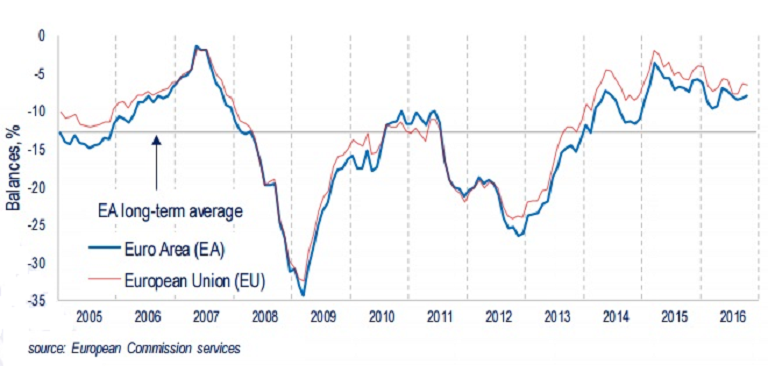
Consumer confidence in the eurozone inched higher during the month of October, improving largely in line with what markets had initially anticipated. However, there was no market reaction post the release of the data.
Eurozone consumer confidence indicator strengthened fractionally to -8.0 for October from -8.2 the previous month, data released by the European Commission showed Friday. The index was forecast to rise to -8.0, with 35 economist estimates ranging from -8.6 to -7.0.
In the wider European Union of 28 countries, confidence dropped by 0.1 points to -6.5 points, the Commission said in a statement. After dipping lower following the UK Referendum on EU membership, there has been a gradual recovery in consumer confidence over the past two months, although it remains below the levels seen in May and June.
However, there will remain concerns over weakness in spending habits, more as unemployment remains low for a prolonged period.
Meanwhile, from the ECB’s perspective, there will be some concerns that prolonged weakness in the index is also a function of declining inflation expectations, although underlying uncertainty surrounding the overall outlook is likely to be a more important factor holding back confidence and spending, reports said.