
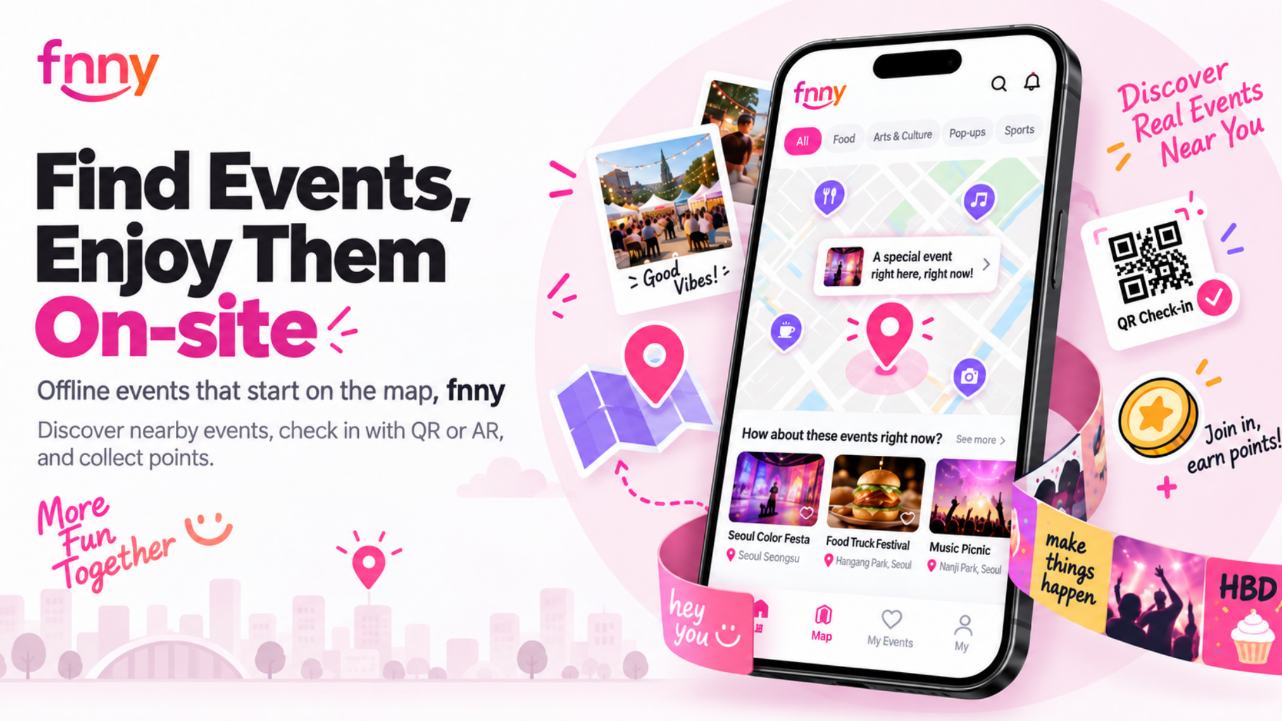
The new location-based platform wants to turn cities into interactive event maps, connecting discovery, real-world check-ins and rewards in one experience.
For years, finding something to do has meant opening a search engine, scrolling through social media or clicking through a collection of event pages.
A new Web3 platform called fnny (fnny.com) is betting that the process should begin somewhere more obvious: the map.
The company has launched fnny Beta, a location-based event platform designed to help people discover nearby events, visit them in person and record their participation through QR codes or augmented-reality check-ins.
The premise is deliberately simple: find something nearby, go there, check in and earn rewards.
Users can now sign up and explore the beta service at fnny.com.
fnny describes itself as an offline event platform that begins with location. Users can discover nearby experiences, participate through QR or AR, and collect points as they move from one event to another.
It is an attempt to solve a familiar problem in an increasingly digital world: there may be more events than ever, but discovering what is actually happening nearby — and deciding whether it is worth leaving the house — can still be surprisingly difficult.
An Event Map, Rather Than an Event List
The most immediate difference is the interface.
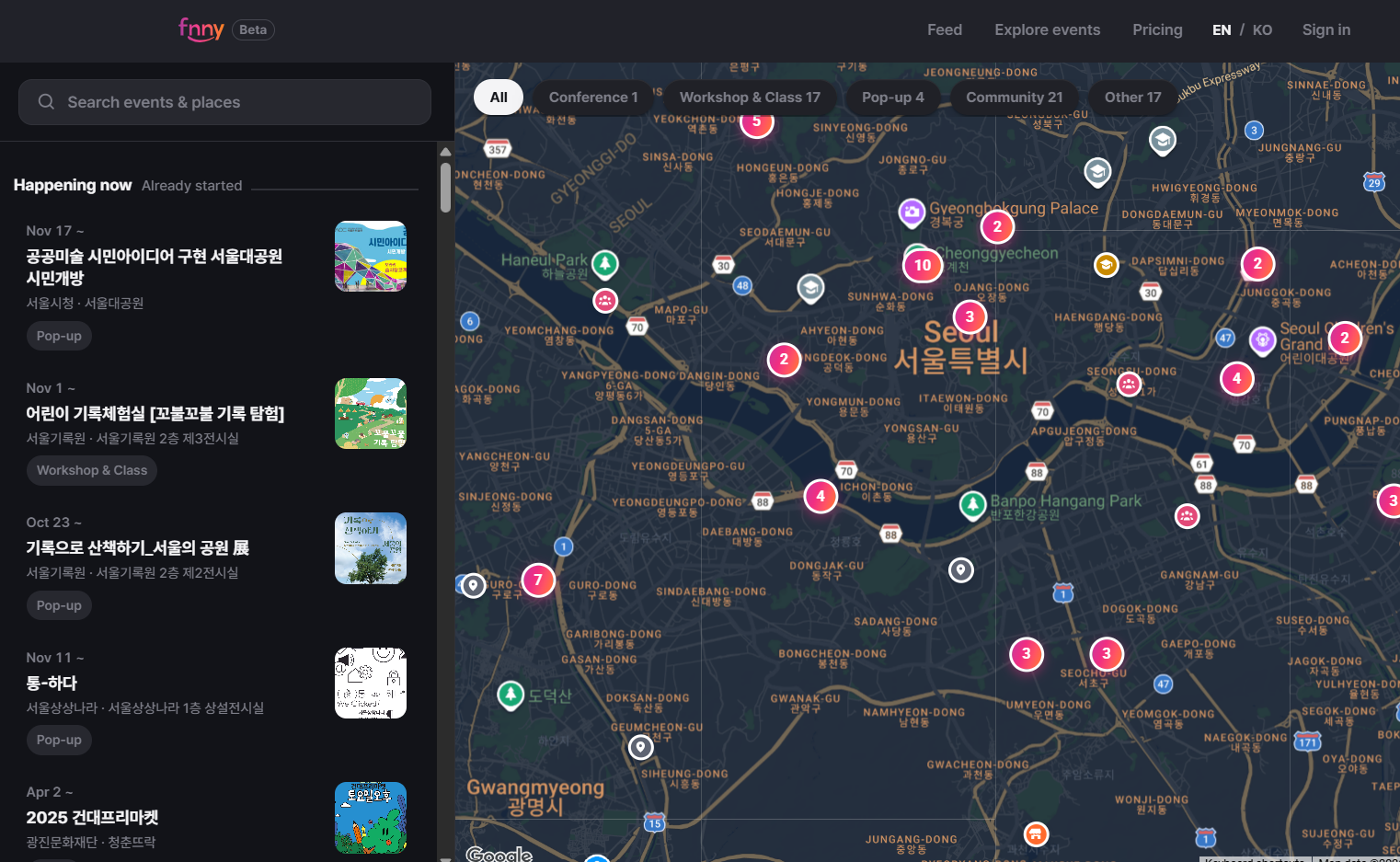
Instead of treating events primarily as pages in a directory, fnny places them on a map.
Users can see nearby event locations, examine the details of an event and, where applicable, check the remaining quantity of available rewards before deciding where to go.
That seemingly small design choice changes the way the service feels.
A traditional event platform asks, “What are you searching for?”
fnny is closer to asking, “What is happening around you right now?”
That opens the platform to more than major festivals and conferences. A pop-up store, neighborhood campaign, brand activation, café promotion or community gathering can all become part of the same map.
The city itself becomes the interface.
The Important Part Happens After You Leave the Screen
Many event platforms are built around registration. A user discovers an event, signs up and receives a confirmation.
fnny is designed to continue beyond that point.
Once a participant arrives at an event, a QR or AR check-in can be used to record the visit. The system can verify conditions including whether the participant is within the designated location, whether the event is currently active and whether the user's registration status meets the requirements.
In other words, the action that matters is not merely clicking “Attend.”
It is actually attending.
That distinction is central to the product.
A successful check-in becomes a participation record, and participating users can accumulate points. Depending on the campaign, those points may be exchanged for rewards such as gift certificates or TPC.
The result is something closer to a real-world game layer placed over events.
Discover a place. Go there. Participate. Collect something. Then find the next one.
From Conference Booths to Neighborhood Stores
The concept becomes more interesting when applied at scale.
At a conference, for example, individual booths or sessions could become separate fnny locations. Attendees might move through the venue collecting check-ins as part of a digital stamp tour.
At a festival, multiple stages or attractions could be connected.
A retail district could use the same structure to reward customers for visiting participating businesses.
And a single brand could create a campaign around one temporary location.
The company identifies event booths, stores and commercial districts, conferences and festivals, and project-based campaigns as potential use cases for the platform.
fnny does not necessarily need to replace an organizer's existing event website, either.
A conventional registration page can continue to handle schedules and attendee information before an event, while fnny handles on-site discovery, check-ins and participation records during the event. Organizers can then review participation data afterward.
That gives fnny a potentially useful position: not simply another place to advertise an event, but a layer connecting digital promotion with physical attendance.
For Organizers, the Question Changes
For event organizers, one of the persistent limitations of online registration is that registration does not necessarily equal attendance.
Ten thousand people may click.
Far fewer may show up.
fnny is built around the latter.
After an event, organizers can review records showing who participated, when they checked in and which location they visited.
That information can be used to identify reward recipients or simply understand how an event was actually experienced on the ground.
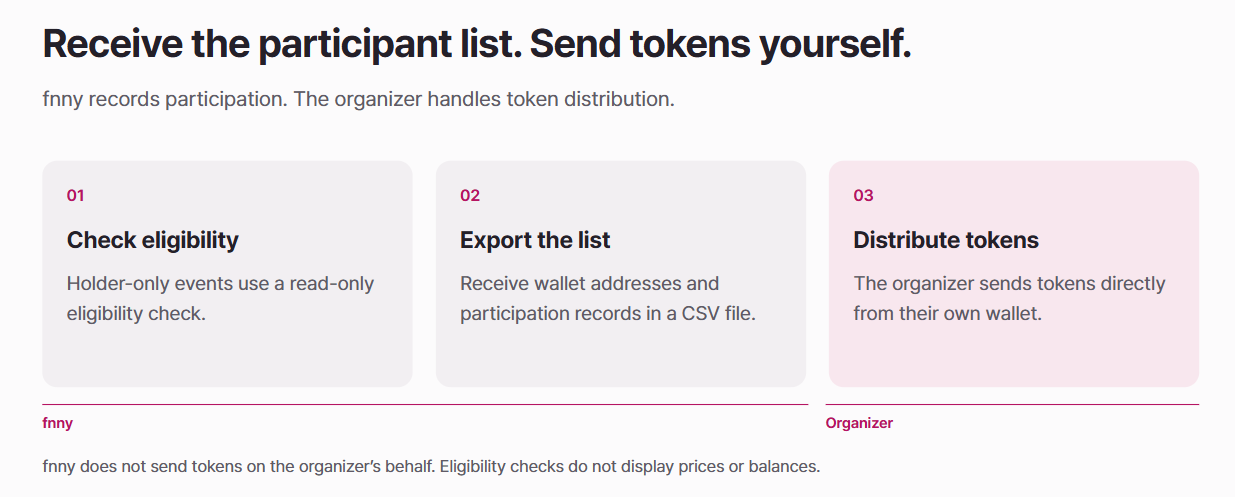
The platform also includes support for holder-only events. In those cases, fnny can verify eligibility on a read-only basis and provide organizers with participation records and wallet addresses. Token distribution itself remains with the organizer rather than fnny.
That separation allows the platform to support Web3-oriented campaigns without positioning itself as the custodian distributing tokens on behalf of projects.
A Bet on the Return of the Physical World
The broader idea behind fnny is almost counterintuitive.
Technology spent decades making it easier to avoid physical places. Shopping moved online. Meetings moved online. Communities moved online.
fnny is using technology for the opposite purpose.
It wants to give people another reason to go somewhere.
The map is not the destination. It is the starting point.
A pin leads to a café, a booth, an exhibition, a meetup or a festival. A check-in becomes proof that a digital discovery turned into a real-world experience. A reward offers another small reason to participate again.
That may ultimately be the more interesting proposition behind the platform.
fnny is not trying merely to catalogue events.
It is trying to connect discovery, movement and participation.
The Beta Is Now Open
fnny Beta is now available for users who want to explore nearby events and for organizers interested in experimenting with location-based campaigns.
Organizers can configure elements including the event location and operating period, QR or AR participation methods, eligibility requirements and rewards.
For users, there is an even simpler way to understand the product.
Open the map.
See what is happening nearby.
And go.
fnny Beta is available now at fnny.com.


